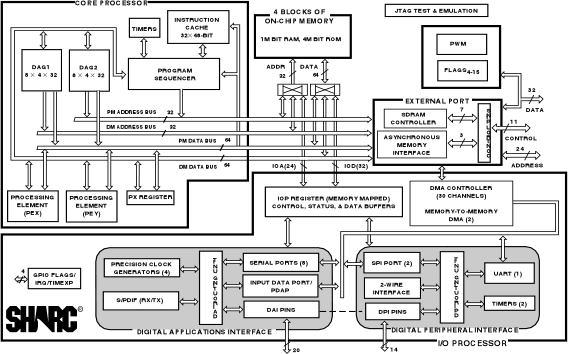
ADSP-21375High-Performance 32-bit Floating-Point SHARC Processor | Embedded | 2 | Active | The ADSP-21375 SHARC® Processor family offers the highest MFLOP/$ performance for a variety of applications. The ADSP-21375 device is pin-compatible and code-compatible with prior SHARC Processors such as the ADSP-21367 and ADSP-21369. This member of the SHARC Processor family is based on a single-instruction, multiple-data (SIMD) core, which supports both 32-bit fixed-point and 32-/40-bit floating-point arithmetic formats, making them particularly suitable for cost optimized high precision applications.SHARC Processors also integrate many peripherals designed to simplify hardware design, minimize system design risks, and reduce end-customer time to market. Grouped together, and broadly named the Digital Applications Interface (DAI), these functional blocks may be connected to each other or to external pins via the software-programmable Signal Routing Unit (SRU). The SRU is an innovative architectural feature that enables complete and flexible routing amongst DAI blocks. Peripherals connected through the SRU include, but are not limited to, serial ports and SPI ports block. |
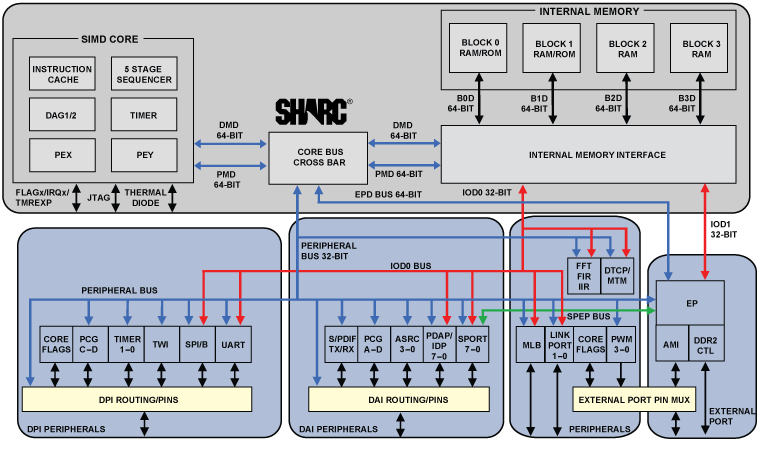
| DSP (Digital Signal Processors) | 3 | Active | The fourth generation of SHARC®Processors, which includes the ADSP-21469, offers increased performance, hardware-based filter accelerators, audio and application-focused peripherals, and new memory configurations capable of supporting the latest surround-sound decoder algorithms. All devices are pin-compatible with each other and completely code-compatible with all prior SHARC Processors. These newest members of the SHARC Processor family are based on a single-instruction, multiple-data (SIMD) core, which supports both 32-bit fixed-point and 32-/40-bit floating-point arithmetic formats making them particularly suitable for high-performance audio applications.The ADSP-21469 offers the highest performance – 450 MHz/2700 MFLOPs -- within the fourth generation SHARC Processor family. This level of performance makes the ADSP-21469 particularly well suited to address the increasing requirements of the professional and automotive audio market segments. In addition to its higher core performance, the ADSP-21469 includes additional processing blocks such as FIR, IIR, and FFT accelerators to increase the total performance of the system. There is a new feature called Variable Instruction Set Architecture (VISA) that allows the code size to be decreased by 20% to 30% and increase the memory size availability. The fourth generation DSP allows the ability to connect to faster external memory by providing a glueless interface to 16-bit wide DDR2 SDRAMs.Fourth-generation SHARC Processors also integrate application-specific peripherals designed to simplify hardware design, minimize design risks, and ultimately reduce time to market. Grouped together, and broadly named the Digital Applications Interface (DAI), these functional blocks may be connected to each other or to external pins via the software-programmable Signal Routing Unit (SRU). The SRU is an innovative architectural feature that enables complete and flexible routing amongst DAI blocks. Peripherals connected through the SRU include but are not limited to serial ports, SPI ports, S/PDIF Tx/Rx, and an 8-Channel asynchronous sample rate converter block. The fourth generation SHARC allows data from the serial ports to be directly transferred to external memory by the DMA controller. Other peripherals such as UART and Two-Wire Interface are routed through a Digital Peripheral Interface (DPI). |
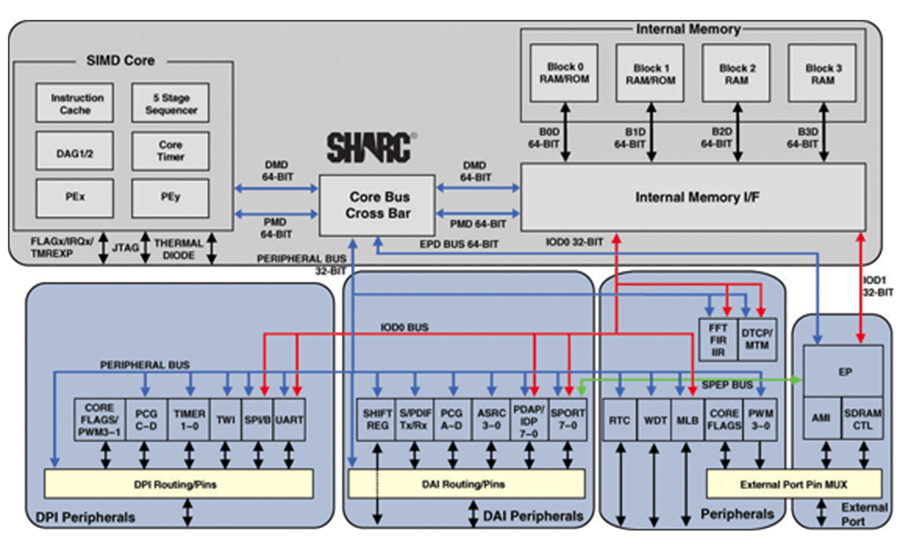
| Integrated Circuits (ICs) | 3 | Active | The fourth generation of SHARC®Processors, the ADSP-21477, includes low power floating point DSP products, which provide increased performance, hardware-based filter accelerators, audio and application-focused peripherals, and 2M Bit on Chip SRAM, capable of supporting a single chip solution. All devices are code-compatible with all prior SHARC Processors. These newest members of the fourth generation SHARC Processor family are based on a single-instruction, multiple-data (SIMD) core, which supports both 32-bit fixed-point and 32-/40-bit floating-point arithmetic formats and their low power make them particularly suitable for battery powered applications or where a higher ambient operating temperature is required.The ADSP-21477 offers a very low power and high performance Processor – 200 MHz/1200 MFLOPs – in an 88-Ld LFCSP package. The low power architecture of the ADSP-21477 makes these products particularly well suited to address the automotive audio and industrial control market segments where low power is a requirement. In addition to its high core performance, the ADSP-21477 includes additional processing blocks such as FIR, IIR, and FFT accelerators to increase the total performance of the system. There is a new feature called Variable Instruction Set Architecture (VISA) that allows the code size to be decreased by 20% to 30% and increase the memory size availability. The fourth generation DSP allows the ability to connect to external memory by providing a glueless interface to 16-bit wide SDR SDRAMs.Fourth-generation, ADSP-21477 SHARC Processors also integrate application-specific peripherals designed to simplify hardware design, minimize design risks, and ultimately reduce time to market. Grouped together, and broadly named the Digital Applications Interface (DAI), these functional blocks may be connected to each other or to external pins via the software-programmable Signal Routing Unit (SRU). The SRU is an innovative architectural feature that enables complete and flexible routing amongst DAI blocks. Peripherals connected through the SRU include but are not limited to serial ports, SPI ports, S/PDIF Tx/Rx, and an 8-Channel asynchronous sample rate converter block. The fourth generation SHARC allows data from the serial ports to be directly transferred to external memory by the DMA controller. Other peripherals such as UART and Two-Wire Interface are routed through a Digital Peripheral Interface (DPI). |
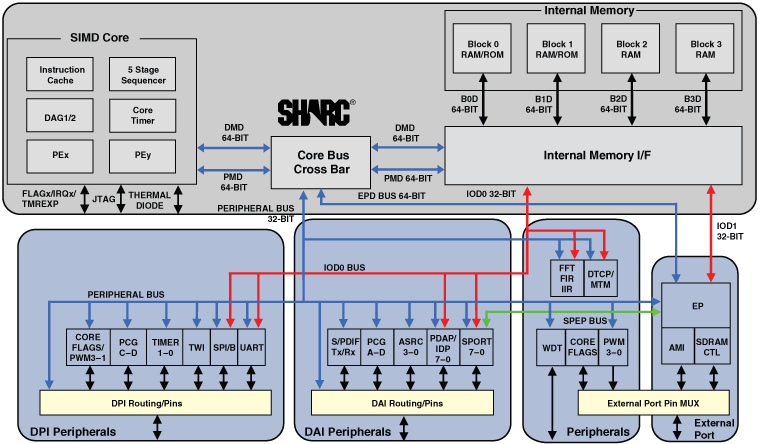
| DSP (Digital Signal Processors) | 9 | Active | The fourth generation ofSHARC®Processorsnow includes the low power floating point DSP products – the ADSP-21478 andADSP-21479and offers increased performance, hardware-based filter accelerators, audio and application-focused peripherals, and new memory configurations capable of supporting a single chip solution. All devices are pin-compatible with each other and completely code-compatible with all prior SHARC Processors. These newest members of the fourth generation SHARC Processor family are based on a single-instruction, multiple-data (SIMD) core, which supports both 32-bit fixed-point and 32-/40-bit floating-point arithmetic formats and their low power make them particularly suitable for battery powered applications or where a higher ambient operating temperature is required.The ADSP-21478 offers a very low power and high performance – 266 MHz/1596 MFLOPs – in a BGA and LQFP package within the fourth generation SHARC Processor family. This feature of power makes the ADSP-21478 particularly well suited to address the automotive audio and many industrial control segments where low power is a requirement. In addition to its high core performance, the ADSP-21478 includes additional processing blocks such as FIR, IIR, and FFT accelerators to increase the total performance of the system. There is a new feature called Variable Instruction Set Architecture (VISA) that allows the code size to be decreased by 20% to 30% and increase the memory size availability. The fourth generation DSP allows the ability to connect to external memory by providing a glueless interface to 16-bit wide SDR SDRAMs.Fourth-generation SHARC Processors also integrate application-specific peripherals designed to simplify hardware design, minimize design risks, and ultimately reduce time to market. Grouped together, and broadly named the Digital Applications Interface (DAI), these functional blocks may be connected to each other or to external pins via the software-programmable Signal Routing Unit (SRU). The SRU is an innovative architectural feature that enables complete and flexible routing amongst DAI blocks. Peripherals connected through the SRU include but are not limited to serial ports, SPI ports, S/PDIF Tx/Rx, and an 8-Channel asynchronous sample rate converter block. The fourth generation SHARC allows data from the serial ports to be directly transferred to external memory by the DMA controller. Other peripherals such as UART and Two-Wire Interface are routed through a Digital Peripheral Interface (DPI). |
| Embedded MCU, DSP Evaluation Boards | 10 | Active | |
| Embedded | 10 | Active | The SHARC ADSP-21488 is one of two new members of the fourth generation ofSHARC®Processorsthat now includes theADSP-21486,ADSP-21487, ADSP-21488,ADSP-21489and offers increased performance, hardware-based filter accelerators, audio and application-focused peripherals, and new memory configurations capable of supporting the latest surround-sound decoder algorithms. All devices are pin-compatible with each other and completely code-compatible with all prior SHARC Processors. These newest members of the fourth generation SHARC Processor family are based on a single-instruction, multiple-data (SIMD) core, which supports both 32-bit fixed-point and 32-/40-bit floating-point arithmetic formats making them particularly suitable for high-performance audio applications.The ADSP-21488 offers the highest performance–400 MHz/2400 MFLOPs–in an LQFP package within the fourth generation SHARC Processor family. This level of performance makes the ADSP-21488 particularly well suited to address the automotive audio and industrial control segments. In addition to its high core performance, the ADSP-21488 includes additional processing blocks such as FIR, IIR, and FFT accelerators to increase the total performance of the system. There is a new feature called Variable Instruction Set Architecture (VISA) that allows the code size to be decreased by 20% to 30% and increase the memory size availability. The fourth generation DSP allows the ability to connect to external memory by providing a glueless interface to 16-bit wide SDR SDRAMs.Fourth-generation SHARC Processors also integrate application-specific peripherals designed to simplify hardware design, minimize design risks, and ultimately reduce time to market. Grouped together, and broadly named the Digital Applications Interface (DAI), these functional blocks may be connected to each other or to external pins via the software-programmable Signal Routing Unit (SRU). The SRU is an innovative architectural feature that enables complete and flexible routing amongst DAI blocks. Peripherals connected through the SRU include but are not limited to serial ports, IDP, S/PDIF Tx/Rx, and an 8-Channel asynchronous sample rate converter block. The fourth generation SHARC allows data from the serial ports to be directly transferred to external memory by the DMA controller. Other peripherals such as SPI,UART and Two-Wire Interface are routed through a Digital Peripheral Interface (DPI). |
| Embedded | 10 | Active | |
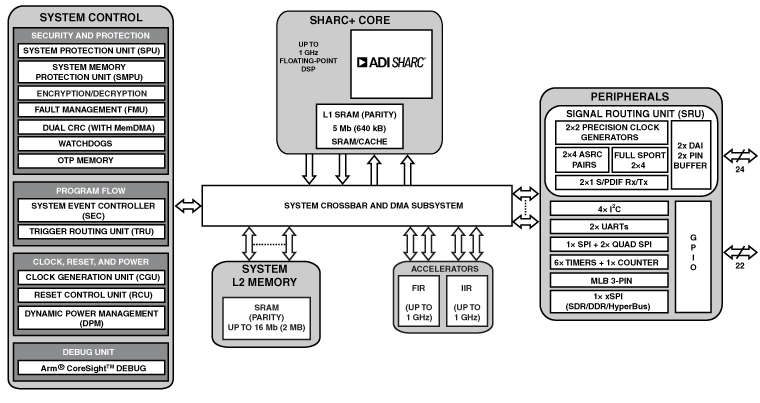
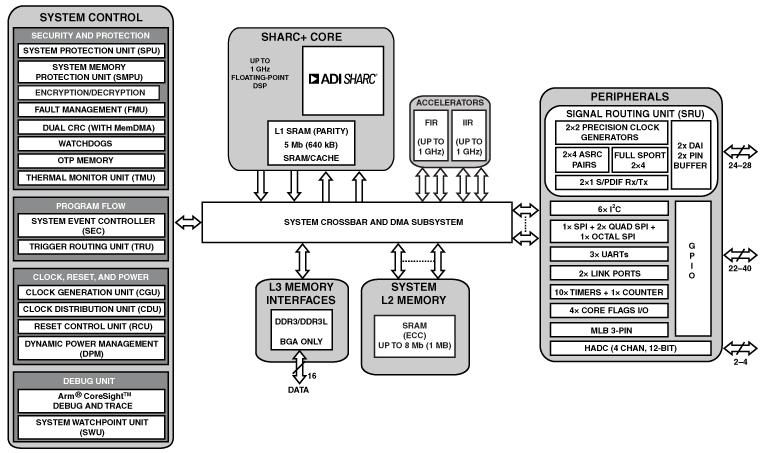
ADSP-21561Up to 933 MHz SHARC+ DSP with 1536 KB Shared L2 SRAM | Integrated Circuits (ICs) | 2 | Active | Reaching speeds of up to 933 MHz, theADSP-21560/ADSP-21561/ADSP-21564processors are members of the SHARC®family of products. These processors offer a cost-reduced pin- and code-compatible option to theADSP-21562/ADSP-21563/ADSP-21565processors, while offering increased L2 memory (up to 2MB).The processors are members of the SIMD SHARC family of digital signal processors (DSPs) that feature Analog Devices, Inc., Super Harvard Architecture. These 32-bit/40-bit/64-bit floating-point processors are optimized for high performance audio/floating-point applications with large on-chip static random-access memory (SRAM), multiple internal buses that eliminate input/output (I/O) bottlenecks, and innovative digital audio interfaces (DAI). Additions to the SHARC+ core include cache enhancements and branch prediction, while maintaining instruction set compatibility to previous SHARC products.By integrating a rich set of industry-leading system peripherals and memory, the SHARC+ processor is the platform of choice for applications that require programmability similar to reduced instruction set computing (RISC), multimedia support, and leading edge signal processing in one integrated package. These applications span a wide array of markets, including automotive, professional audio, and industrial-based applications that require high floating-point performance.APPLICATIONSAutomotive:audio amplifier, head unit, ANC/RNC, rear seat entertainment, digital cockpit, ADASConsumer & Professional Audio:speakers, sound bars, AVRs, conferencing systems, mixing consoles, microphone arrays, headphones |
ADSP-21562400MHz SHARC+ DSP with 640KB L1, 256KB Shared L2 SRAM, 120-lead LQFP_EP | Integrated Circuits (ICs) | 2 | Active | Reaching speeds of up to 1 GHz, the ADSP-2156x processors are members of the SHARC®family of products. The ADSP-2156x processor is based on the SHARC+®single core. The ADSP-2156x SHARC processors are members of the SIMD SHARC family of digital signal processors (DSPs) that feature Analog Devices, Inc., Super Harvard Architecture. These 32-bit/40-bit/64-bit floating-point processors are optimized for high performance audio/floating-point applications with large on-chip static random-access memory (SRAM), multiple internal buses that eliminate input/output (I/O) bottlenecks, and innovative digital audio interfaces (DAI). New additions to the SHARC+ core include cache enhancements and branch prediction, while maintaining instruction set compatibility to previous SHARC products.By integrating a rich set of industry-leading system peripherals and memory (see Table 1 in the data sheet), the SHARC+ processor is the platform of choice for applications that require programmability similar to reduced instruction set computing (RISC), multimedia support, and leading edge signal processing in one integrated package. These applications span a wide array of markets, including automotive, professional audio, and industrial-based applications that require high floating-point performance.APPLICATIONSAutomotive:audio amplifier, head unit, ANC/RNC, rear seat entertainment, digital cockpit, ADASConsumer & Professional Audio:speakers, sound bars, AVRs, conferencing systems, mixing consoles, microphone arrays, headphones |
ADSP-21563Up to 800MHz SHARC+ DSP with 640KB L1, 512KB Shared L2 SRAM, 120-lead LQFP_EP | Embedded | 2 | Active | Reaching speeds of up to 1 GHz, the ADSP-2156x processors are members of the SHARC®family of products. The ADSP-2156x processor is based on the SHARC+®single core. The ADSP-2156x SHARC processors are members of the SIMD SHARC family of digital signal processors (DSPs) that feature Analog Devices, Inc., Super Harvard Architecture. These 32-bit/40-bit/64-bit floating-point processors are optimized for high performance audio/floating-point applications with large on-chip static random-access memory (SRAM), multiple internal buses that eliminate input/output (I/O) bottlenecks, and innovative digital audio interfaces (DAI). New additions to the SHARC+ core include cache enhancements and branch prediction, while maintaining instruction set compatibility to previous SHARC products.By integrating a rich set of industry-leading system peripherals and memory (see Table 1 in the data sheet), the SHARC+ processor is the platform of choice for applications that require programmability similar to reduced instruction set computing (RISC), multimedia support, and leading edge signal processing in one integrated package. These applications span a wide array of markets, including automotive, professional audio, and industrial-based applications that require high floating-point performance.APPLICATIONSAutomotive:audio amplifier, head unit, ANC/RNC, rear seat entertainment, digital cockpit, ADASConsumer & Professional Audio:speakers, sound bars, AVRs, conferencing systems, mixing consoles, microphone arrays, headphones |