A
Analog Devices Inc./Maxim Integrated
| Series | Category | # Parts | Status | Description |
|---|---|---|---|---|
| Part | Spec A | Spec B | Spec C | Spec D | Description |
|---|---|---|---|---|---|



| Series | Category | # Parts | Status | Description |
|---|---|---|---|---|
| Part | Spec A | Spec B | Spec C | Spec D | Description |
|---|---|---|---|---|---|
| Series | Category | # Parts | Status | Description |
|---|---|---|---|---|
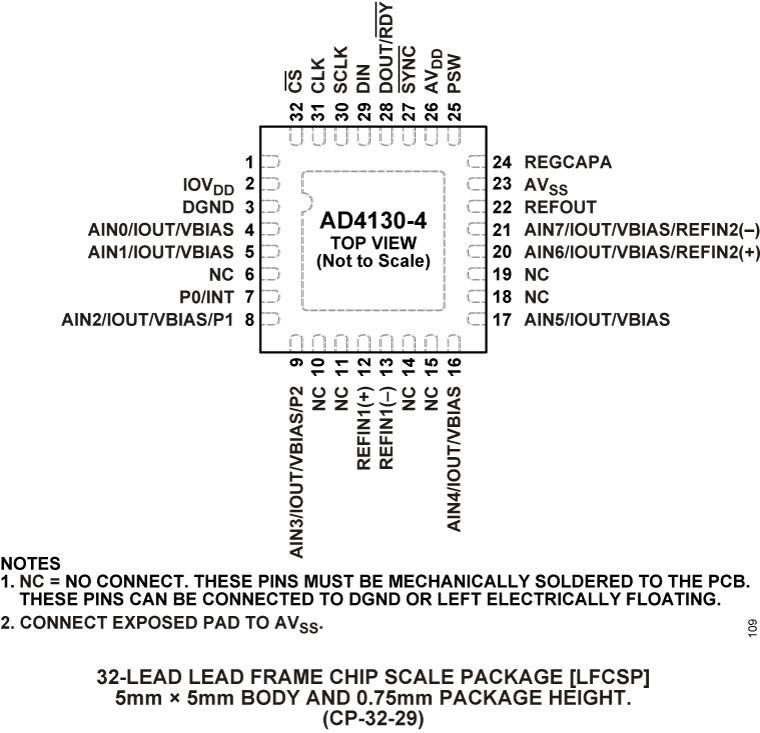
AD4130-432 μA, Ultra-Low Power, 24-Bit Sigma-Delta ADC with Integrated PGA and FIFO | Analog to Digital Converters (ADC) | 1 | Active | The AD4130-4 is an ultra-low power, high precision, and measurement solution for low bandwidth battery operated applications. The fully integrated analog front end (AFE) includes a multiplexer for up to 8 single-ended or 4 differential inputs, programmable gain amplifier (PGA), 24-bit sigma-delta (Σ-Δ) analog-to-digital converter (ADC), on-chip reference and oscillator, selectable filter options, smart sequencer, sensor biasing and excitation options, diagnostics, and newly added features to improve the battery-operated lifetime (more than 5 years on a coin cell), that is, a first in, first out (FIFO) buffer and duty cycling.The AD4130-4 allows users to measure low frequency signals with a current consumption of 28.5 μA (gain = 1) and 32.5 μA (gain = 128) while continuously converting, and even lower average currents when using one of the duty cycling options. The AD4130-4 can be configured to have 4 differential inputs or 8 single-ended or pseudo differential inputs, which connect to a crosspoint multiplexer, where any input pair can become a measurement channel input to the PGA and ADC.The AD4130-4 is designed to allow the user to operate from a single analog supply voltage from 1.71 V to 3.6 V. In battery applications, operation as low as 1.71 V can extend the system lifetime as the AFE can continue its operation, even as the battery voltage dissipates. The digital supply can be separate and range from 1.65 V to 3.6 V.Together with the reduced current consumption, the integration of an on-chip FIFO buffer can be used in tandem with the smart sequencer, to enable the AD4130-4 to become an autonomous measurement system, which allows the microcontroller to sleep for extended periods.Intelligent interrupt functionality gives the user a greater confidence in both error detection and safety. The user can enable an interrupt signal to trigger when the samples in the FIFO reach a predefined value or when a user programmable threshold is exceeded.The following key analog functions are offered on the AD4130-4 to allow simple and effective connection to transducers used for measuring temperature, load, and pressure:PGA: Due to the programmable gain (from 1 to 128) and the high input impedance with low input current, the PGA allows direct interfacing to transducers with low output amplitudes such as resistive bridges, thermocouples, and resistance temperature detectors (RTDs).The capacitive PGA allows full common-mode input range, which gives designers a greater margin for widely varying input common modes. A wider common-mode input range improves the overall resolution and is highly effective in ratio metric measurements.Low drift precision current sources. The IEXC0 and IEXC1 current source can be used to excite 2‑, 3‑, and 4‑wire RTDs. Excitation current output options include 100 nA, 10 μA, 20 μA, 50 μA, 100 μA, 150 μA, and 200 μA.The low-side power switch (PDSW) can be used to power down bridge sensors between conversions. The PDSW can be controlled within the sequencer on a per channel basis, which allows optimum timing and energy savings in the overall system. The PDSW can also allow higher powered analog sensors to be used in a low power system.Voltage bias for thermocouples (the VBIAS source sets the common-mode voltage of a channel to AVDD/2).The smart sequencer allows the conversion of each enabled preconfigured channel in a predetermined order, which allows a mix of transducer, system checks, and diagnostic measurements to be interleaved. The sequencer eliminates need for repetitive serial interface communication with the device. The 16 channels can be configured in the sequence, each of them selecting from eight predefined ADC setups that allow selection of gain, filter type, output data rate, buffering, timing, and reference source.High levels of integrated front-end functionality coupled with small package options allow smaller end solutions. For example, the AD4130-4 integrates a low thermal drift band gap reference in addition to accepting an external differential reference, which can be internally buffered.In safety critical applications, the AD4130-4 includes diagnostic functionality such as open-wire detection through burnout currents, internal temperature sensor, reference detection, and analog input overvoltage and undervoltage detection. Added diagnostics are included on the digital interface such as cyclic redundancy check (CRC) and serial interface checks for a robust communication link.ApplicationsSmart transmittersWireless battery and harvester powered sensor nodesPortable instrumentationTemperature measurement: thermocouple, RTD, thermistorsPressure measurement: bridge transducersHealthcare and wearables |
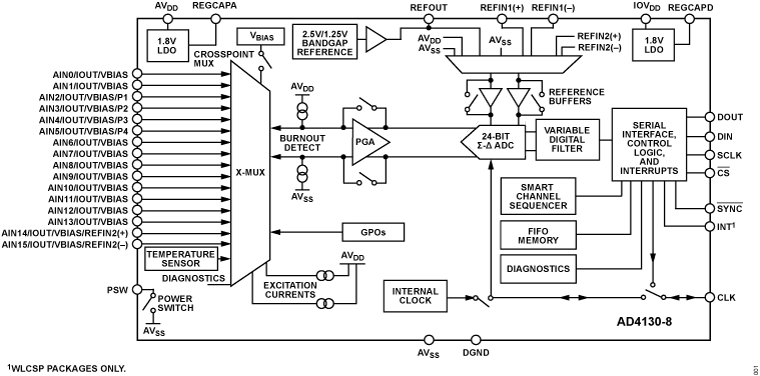
AD4130-832 μA, Ultra Low Power, 24-Bit Sigma-Delta ADC with Integrated PGA and FIFO | Data Acquisition | 2 | Active | The AD4130-8 is an ultra low power, high precision, measurement solution for low bandwidth battery operated applications. The fully integrated analog front end (AFE) includes a multiplexer for up to 16 single-ended or eight differential inputs, programmable gain amplifier (PGA), 24-bit sigma-delta (Σ-Δ) analog-to-digital converter (ADC), on-chip reference and oscillator, selectable filter options, smart sequencer, sensor biasing and excitation options, diagnostics, and newly added features to improve the battery-operated lifetime (more than 5 years on a coin cell), that is, a first in, first out (FIFO) buffer and duty cycling.The AD4130-8 allows users to measure low frequency signals with a current consumption of 28.5 μA (gain = 1) and 32.5 μA (gain = 128) while continuously converting, and even lower average currents when using one of the duty cycling options. The AD4130-8 can be configured to have 8 differential inputs or 16 single-ended or pseudo differential inputs, which connect to a crosspoint multiplexer, where any input pair can become a measurement channel input to the PGA and ADC.The AD4130-8 is designed to allow the user to operate from a single analog supply voltage from 1.71 V to 3.6 V. In battery applications, operation as low as 1.71 V can extend the system lifetime as the AFE can continue its operation, even as the battery voltage dissipates. The digital supply can be separate and range from 1.65 V to 3.6 V.Together with the reduced current consumption, the integration of an on-chip FIFO buffer can be used in tandem with the smart sequencer, to enable the AD4130-8 to become an autonomous measurement system, which allows the microcontroller to sleep for extended periods.Intelligent interrupt functionality gives the user a greater confidence in both error detection and safety. The user can enable an interrupt signal to trigger when the samples in the FIFO reach a predefined value or when a user programmable threshold is exceeded.The following key analog functions are offered on the AD4130-8 to allow simple and effective connection to transducers used for measuring temperature, load, and pressure:PGA. Due to the programmable gain (from 1 to 128) and the high input impedance with low input current, the PGA allows direct interfacing to transducers with low output amplitudes like resistive bridges, thermocouples, and resistance temperature detectors (RTDs).The capacitive PGA allows full common-mode input range, giving designers greater margin for widely varying input common modes. A wider common-mode input range improves the overall resolution and is highly effective in ratio metric measurements.Low drift precision current sources. The IEXC0 and IEXC1 current source can be used to excite 2‑, 3‑, and 4‑wire RTDs. Excitation current output options include 100 nA, 10 μA, 20 μA, 50 μA, 100 μA, 150 μA, and 200 μA.The low-side power switch (PDSW) can be used to power down bridge sensors between conversions. The PDSW can be controlled within the sequencer on a per channel basis, allowing optimum timing and energy savings in the overall system. The PDSW can also allow higher powered analog sensors to be used in a low power system.Voltage bias for thermocouples (the VBIAS source sets the common-mode voltage of a channel to AVDD/2).The smart sequencer allows the conversion of each enabled preconfigured channel in a predetermined order, allowing a mix of transducer, system checks and diagnostic measurements to be interleaved. The sequencer eliminates need for repetitive serial interface communication with the device. Sixteen channels can be configured in the sequence, each of them selecting from eight predefined ADC setups that allow selection of gain, filter type, output data rate, buffering, timing, and reference source.High levels of integrated front-end functionality coupled with small package options allow smaller end solutions. For example, the AD4130-8 integrates a low thermal drift band gap reference in addition to accepting an external differential reference, which can be internally buffered.In safety critical applications the AD4130-8 includes diagnostic functionality such as open wire detection via burnout currents, internal temperature sensor, reference detection, and analog input overvoltage and undervoltage detection. Added diagnostics are included on the digital interface like cyclic redundancy check (CRC) and serial interface checks for a robust communication link.APPLICATIONSSmart transmittersWireless battery and harvester powered sensor nodesPortable instrumentationTemperature measurement: thermocouple, RTD, thermistorsPressure measurement: bridge transducersHealthcare and wearables |
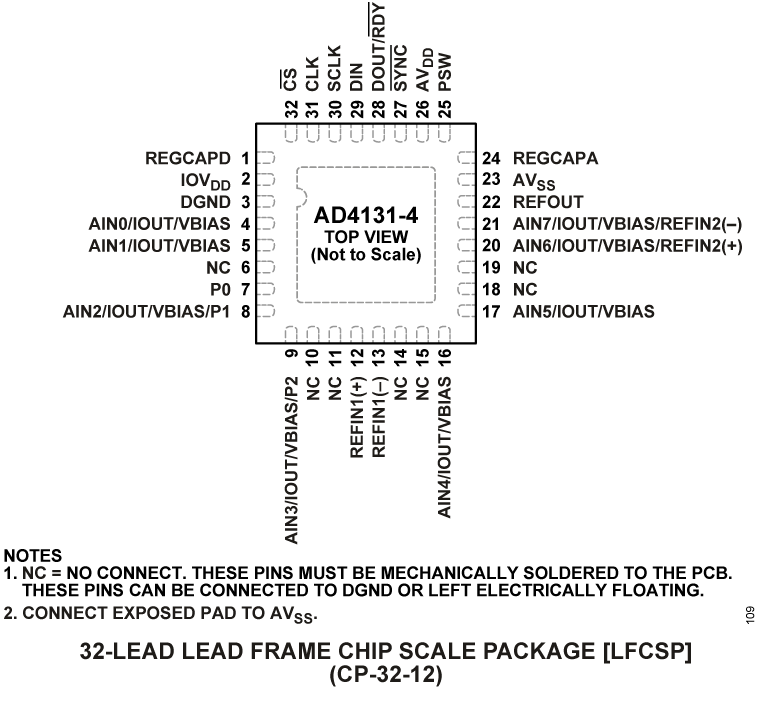
AD4131-432 μA, Ultra-Low Power, 16-Bit Sigma-Delta ADC with Integrated PGA | Analog to Digital Converters (ADC) | 1 | Active | The AD4131-4 is an ultra-low power, high precision, measurement solution for low bandwidth battery operated applications. The fully integrated analog front end (AFE) includes a multiplexer for up to 8 single-ended or 4 differential inputs, programmable gain amplifier (PGA), 16-bit sigma-delta (Σ-Δ) analog-to-digital converter (ADC), on-chip reference and oscillator, selectable filter options, flexible sequencer, sensor biasing and excitation options, diagnostics, and newly added features to improve the battery-operated lifetime (duty cycling).The AD4131-4 allows users to measure low frequency signals with a current consumption of 28.5 μA (gain = 1) and 32.5 μA (gain = 128) while continuously converting, and even lower average currents when using one of the duty cycling options. The AD4131-4 can be configured to have 4 differential inputs or 8 single-ended or pseudodifferential inputs, which connect to a crosspoint multiplexer, where any input pair can become a measurement channel input to the PGA and ADC.The AD4131-4 is designed to allow the user to operate from a single analog supply voltage from 1.71 V to 3.6 V. In battery applications, operation as low as 1.71 V can extend the system lifetime as the AFE can continue its operation, even as the battery voltage dissipates. The digital supply can be separate and range from 1.65 V to 3.6 V.The following key analog functions are offered on the AD4131-4 to allow simple and effective connection to transducers used for measuring temperature, load, and pressure:PGA. Due to the programmable gain (from 1 to 128) and the high input impedance with low input current, the PGA allows direct interfacing to transducers with low output amplitudes like resistive bridges, thermocouples, and resistance temperature detectors (RTDs).The capacitive PGA allows full common-mode input range, giving designers greater margin for widely varying input common modes. A wider common-mode input range improves the overall resolution and is highly effective in ratio metric measurements.Low drift precision current sources. The IEXC0 and IEXC1 current source can be used to excite 2‑, 3‑, and 4‑wire RTDs. Excitation current output options include 100 nA, 10 μA, 20 μA, 50 μA, 100 μA, 150 μA, and 200 μA.The low-side power switch (PDSW) can be used to power down bridge sensors between conversions. The PDSW can be controlled within the sequencer on a per channel basis, allowing optimum timing and energy savings in the overall system. The PDSW can also allow higher powered analog sensors to be used in a low power system.Voltage bias for thermocouples (the VBIAS source sets the common-mode voltage of a channel to AVDD/2).The flexible sequencer allows the conversion of each enabled preconfigured channel in a predetermined order, allowing a mix of transducer, system checks, and diagnostic measurements to be interleaved. The sequencer eliminates need for repetitive serial interface communication with the device. Sixteen channels can be configured in the sequence, each of them selecting from eight predefined ADC setups that allow selection of gain, filter type, output data rate, buffering, timing, and reference source.High levels of integrated front-end functionality coupled with small package options allow smaller end solutions. For example, the AD4131-4 integrates a low thermal drift band gap reference in addition to accepting an external differential reference, which can be internally buffered.In safety critical applications, the AD4131-4 includes diagnostic functionality such as open wire detection through burnout currents, internal temperature sensor, reference detection, and analog input overvoltage and undervoltage detection. Added diagnostics are included on the digital interface such as cyclic redundancy check (CRC) and serial interface checks for a robust communication link.APPLICATIONSSmart transmittersWireless battery and harvester powered sensor nodesPortable instrumentationTemperature measurement: thermocouple, RTD, thermistorsPressure measurement: bridge transducersHealthcare and wearables |
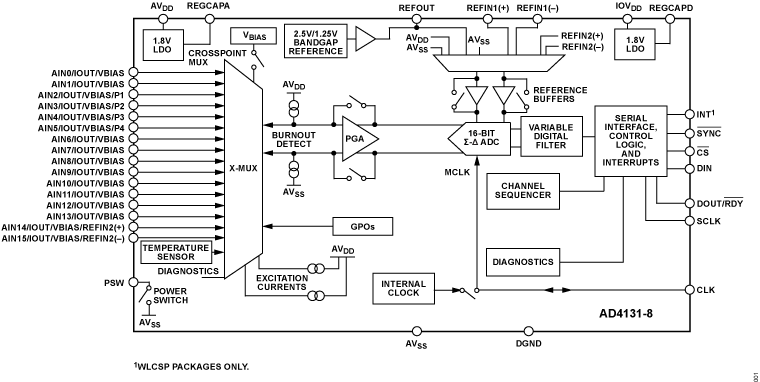
AD4131-832 μA, Ultra Low Power, 16-Bit Sigma-Delta ADC with Integrated PGA | Analog to Digital Converters (ADC) | 1 | Active | The AD4131-8 is an ultra-low power, high precision, measurement solution for low bandwidth battery operated applications. The fully integrated analog front end (AFE) includes a multiplexer for up to 16 single-ended or eight differential inputs, programmable gain amplifier (PGA), 16-bit sigma-delta (Σ-Δ) analog-to-digital converter (ADC), on-chip reference and oscillator, selectable filter options, smart sequencer, sensor biasing and excitation options, diagnostics, and duty cycling.The AD4131-8 allows to measure low frequency signals with a current consumption of 28.5 μA (gain = 1) and 32.5 μA (gain = 128) while continuously converting, and even lower average currents when using one of the duty cycling options. Configure the AD4131-8 to have eight differential inputs or 16 single-ended or pseudodifferential inputs, which connect to a crosspoint multiplexer, where any input pair can become a measurement channel input to the PGA and ADC.The AD4131-8 is designed to operate from a single analog supply voltage from 1.71 V to 3.6 V. In battery applications, operation as low as 1.71 V can extend the system lifetime as the AFE can continue its operation, even as the battery voltage dissipates. The digital supply can be separate and range from 1.65 V to 3.6 V.The AD4131-8 offers the following key analog functions to allow simple and effective connection to transducers used for measuring temperature, load, and pressure:PGA. Due to the programmable gain (from 1 to 128) and the high input impedance with low input current, the PGA allows direct interfacing to transducers with low output amplitudes like resistive bridges, thermocouples, and resistance temperature detectors (RTDs).The capacitive PGA allows full common-mode input range, giving designers greater margin to widely vary input common modes. A wider common-mode input range improves the overall resolution and is highly effective in ratiometric measurements.Low drift precision current sources. Use the IEXC0 and IEXC1 current source to excite 2‑, 3‑, and 4‑wire RTDs. Excitation current output options include 100 nA, 10 μA, 20 μA, 50 μA, 100 μA, 150 μA, and 200 μA.Use the low-side power switch (PDSW) to power down bridge sensors between conversions. Control the PDSW within the sequencer on a per channel basis, allowing optimum timing and energy savings in the overall system. The PDSW can also allow higher powered analog sensors to be used in a low power system.Voltage bias for thermocouples (the VBIASsource sets the common-mode voltage of a channel to AVDD/2).The sequencer allows the conversion of each enabled preconfigured channel in a predetermined order, allowing a mix of transducer, system checks, and diagnostic measurements to be interleaved. The sequencer eliminates the need for repetitive serial interface communication with the device. Configure sixteen channels in the sequence, each of them selecting from eight predefined ADC setups that allow the selection of gain, filter type, output data rate, buffering, timing, and reference source.High levels of integrated front-end functionality coupled with small package options allow smaller end solutions. For example, the AD4131-8 integrates a low thermal drift band gap reference in addition to accepting an external differential reference, which can be internally buffered.In safety critical applications, the AD4131-8 includes diagnostic functionality such as open wire detection through burnout currents, internal temperature sensor, reference detection, and analog input overvoltage and undervoltage detection. The digital interface includes added diagnostics like cyclic redundancy check (CRC) and serial interface checks for a robust communication link.APPLICATIONSSmart transmittersWireless battery and harvester powered sensor nodesPortable instrumentationTemperature measurement: thermocouple, RTD, thermistorsPressure measurement: bridge transducersHealthcare and wearables |
| Integrated Circuits (ICs) | 2 | Active | ||
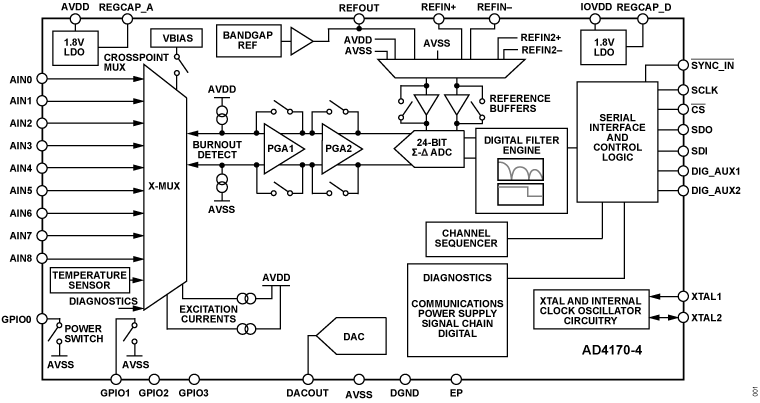
AD4170-424-Bit, DC to 50 kHz Input Bandwidth, Multichannel, Low Noise Precision Sigma-Delta ADC with PGA | Analog to Digital Converters (ADC) | 2 | Active | The AD4170-4 is a DC to 50 kHz input bandwidth, low noise, high speed, completely integrated analog front end for high precision measurement applications. The AD4170-4 offers output data rates from 7.6 SPS up to 500 kSPS. The device contains a low noise, 24-bit Σ-Δ analog-to-digital converter (ADC), and can be configured to have four differential inputs or eight single-ended or pseudodifferential inputs. The on-chip low noise gain stage ensures that signals of small amplitude can be interfaced directly to the AD4170-4.The AD4170-4 offers the highest degree of signal chain integration. The device contains an internal reference and accepts two external differential references, which can be internally buffered. Other key integrated features include the following:Programmable gain amplifier (PGA). Due to the programmable gain (0.5 to 128), the PGA allows direct interfacing to transducers with low output amplitudes such as resistive bridges, thermocouples, and resistance temperature detectors (RTDs).The PGA has a wide common-mode input range, giving designers greater margin for widely varying input common modes.Low drift, well matched precision current sources. Excitation current sources can be used to excite 2-, 3-, and 4-wire RTDs or bridge type sensors. Excitation current output options include 10 μA, 50 μA, 100 μA, 250 μA, 500 μA, 1 mA, and 1.5 mA. The currents can also be added if higher currents are needed. The currents are made up of two pairs with the pairs optimized for matching and drift matching.The low-side power switch (PDSW) can be used to power down bridge sensors between conversions.Voltage bias for thermocouples (the VBIAS source sets the common-mode voltage of a channel to (AVDD + AVSS)/2.The smart sequencer allows the conversion of each enabled preconfigured channel in a predetermined order, allowing a mix of transducer, system checks, and diagnostic measurements to be interleaved. The sequencer eliminates the need for repetitive serial interface communication with the device to change configuration. Sixteen channels can be configured in the sequence. Each of these channels selects from eight user-defined ADC setups that allow selection of gain, filter type, output data rate, buffering, and reference source.The AD4170-4 also has extensive diagnostic functionality integrated as part of its comprehensive feature set. These diagnostics include a cyclic redundancy check (CRC), signal chain checks, and serial interface checks, which lead to a more robust solution.The device also offers a multitude of digital filter options, ensuring that the user has the highest degree of flexibility. The device contains a finite impulse response (FIR) filter which offers low pass-band ripple for analog inputs from DC up to 50 kHz, quick roll-off and excellent stop-band rejection. Also available in this device is a programmable FIR filter that can accept up to 72 user coefficients. The part contains sinc filters which allow faster settling in multiplexed applications. In addition, the AD4170-4 offers multiple options for simultaneous 50 Hz and 60 Hz rejection.The AD4170-4 also has overvoltage/undervoltage tolerance. If a channel has a signal which is slightly beyond AVDD or AVSS, adjacent channels can continue to function and convert correctly. The embedded features, diagnostics, and intelligence minimize the component count when designing a signal chain, resulting in reduced board space needs, reduced design cycle times, and cost savings.The device operates with a single analog power supply from 4.75 V to 5.25 V or a bipolar +2.5 V power supply. The digital supply has a range of 1.7 V to 5.25 V. The device is specified for a temperature range of −40°C to +105°C. The AD4170-4 is housed in a 32-lead LFCSP package.APPLICATIONSIndustrial process control: PLC/DCS modulesTemperature and pressure measurementHigh accuracy medical and scientific instrumentationChromatographySeismic and energy explorationElectrical test and measurementAcoustic analysisInstrumentationWeigh scale |
| Data Acquisition | 4 | Active | ||
| Data Acquisition | 5 | Active | ||
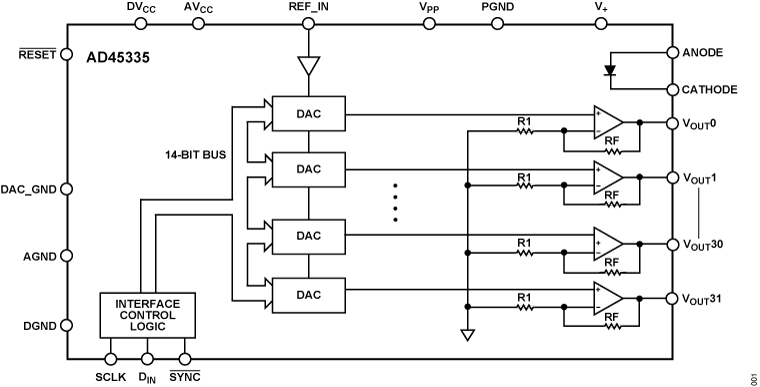
AD4533532-Channel, 14-Bit DAC with Full-Scale Output Voltage Programmable from 50 V to 200 V | Digital to Analog Converters (DAC) | 1 | Active | The AD45335 is a 32-channel, 14-bit denseDAC®with an on-chip high voltage output amplifier. This device is targeted for optical micro-electromechanical systems. The output voltage range is programmable via the REF_IN pin. The output range is 0 V to 50 V when REF_IN = 1 V, and 0 V to 200 V when REF_IN = 4 V. REF_IN is buffered internally on the AD45335 and should be driven from a stable reference source.The selected digital-to-analog converter (DAC) register is written to via the 3-wire interface. The SPI operates at clock rates of up to 30 MHz.APPLICATIONSOptical microelectromechanical systems (MEMS)Optical crosspoint switchesMicropositioning applications using piezoelectric actuatorsLevel setting in automotive test and measurement |
| Evaluation Boards | 4 | Active | ||
| Part | Category | Description |
|---|---|---|
 Analog Devices Inc./Maxim Integrated | Development Boards Kits Programmers | EVAL BOARD HMC264LM3 |
 Analog Devices Inc./Maxim Integrated | Development Boards Kits Programmers | EVAL BOARD HMC362S8GE |
 Analog Devices Inc./Maxim Integrated | Development Boards Kits Programmers | BOARD EVAL DIVIDER HMC365 |
 Analog Devices Inc./Maxim Integrated | Development Boards Kits Programmers | EVAL BOARD HMC413QS16G |
 Analog Devices Inc./Maxim Integrated | Development Boards Kits Programmers | EVAL BOARD HMC414MS8G |
 Analog Devices Inc./Maxim Integrated | Development Boards Kits Programmers | EVAL BRD, 3.5GHZ, SPDT NON-REFLECTIVE SW ROHS COMPLIANT: YES |
 Analog Devices Inc./Maxim Integrated | Development Boards Kits Programmers | BOARD EVALUATION HMC435AMS8G |
 Analog Devices Inc./Maxim Integrated | Development Boards Kits Programmers | EVALUATION BOARD, HMC536MS8G, RF SWITCH, RF / IF |
 Analog Devices Inc./Maxim Integrated | Development Boards Kits Programmers | EVAL BOARD HMC415LP3 |
 Analog Devices Inc./Maxim Integrated | Development Boards Kits Programmers | EVAL BRD, HBT MMIC, DIVIDE-BY-2, 8GHZ ROHS COMPLIANT: YES |