


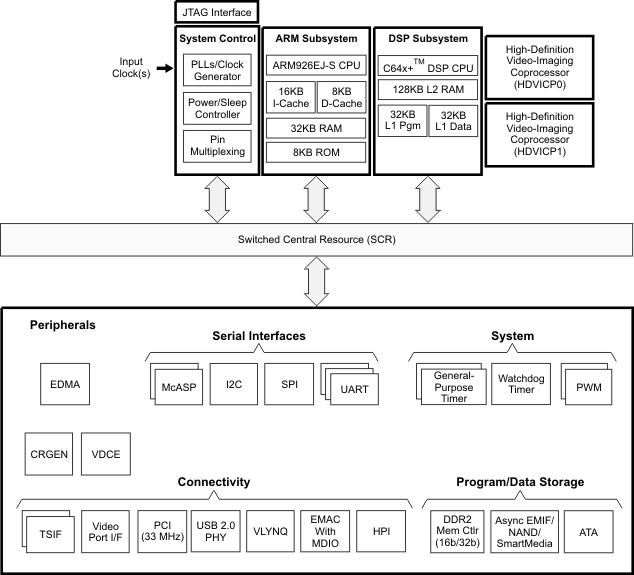
TMS320C6202B Series
Low power C55x fixed point DSP- up to 200MHz, USB, LCD interface, FFT HWA, SAR ADC
Manufacturer: Texas Instruments
Catalog
Low power C55x fixed point DSP- up to 200MHz, USB, LCD interface, FFT HWA, SAR ADC
| Part | On-Chip RAM | Operating Temperature [Max] | Operating Temperature [Min] | Type | Voltage - Core | Interface | Non-Volatile Memory | Mounting Type | Voltage - I/O | Package / Case | Supplier Device Package | Clock Rate |
|---|---|---|---|---|---|---|---|---|---|---|---|---|
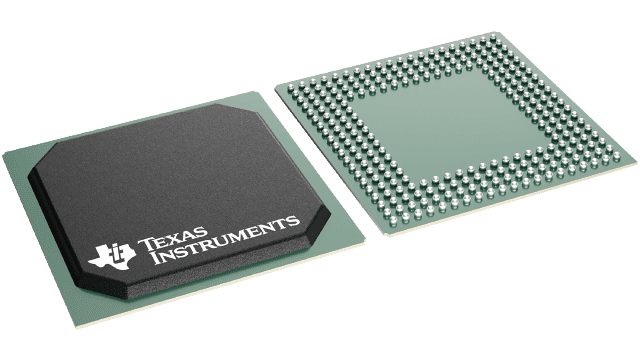 Texas Instruments | 72 kB | 105 °C | -40 °C | Fixed Point | 1.8 V | Host Interface McBSP | External | Surface Mount | 3.3 V | 256-BGA | 256-BGA (27x27) | |
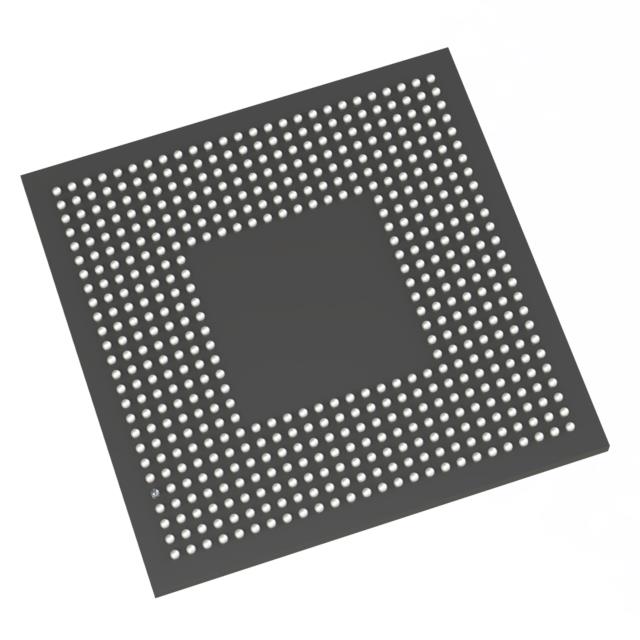 Texas Instruments | 1.03 MB | 90 °C | 0 °C | Fixed Point | 1.4 V | Host Interface McBSP | External | Surface Mount | 3.3 V | 532-BFBGA FCBGA | 532-FCBGA (23x23) | 720 MHz |
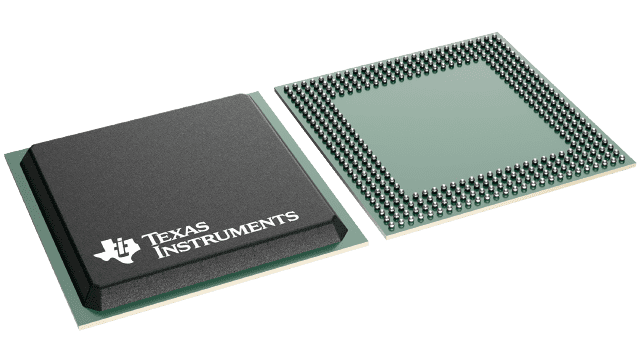 Texas Instruments | 384 kB | 105 °C | -40 °C | Fixed Point | 1.5 V | McBSP | External | Surface Mount | 3.3 V | 352-BBGA FCBGA | 352-FCBGA (27x27) | 250 MHz |
Texas Instruments | 1.03 MB | 90 °C | 0 °C | Fixed Point | 1.2 V | Host Interface McBSP PCI UTOPIA | External | Surface Mount | 3.3 V | 532-BFBGA FCBGA | 532-FCBGA (23x23) | 500 MHz |
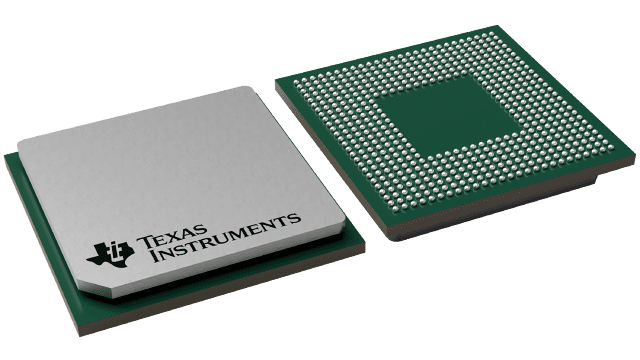 Texas Instruments | 1.03 MB | 90 °C | 0 °C | Fixed Point | 1.4 V | Host Interface McBSP | External | Surface Mount | 3.3 V | 532-BFBGA FCBGA | 532-FCBGA (23x23) | 600 MHz |
Texas Instruments | 1.03 MB | 90 °C | 0 °C | Fixed Point | 1.4 V | Host Interface McBSP PCI UTOPIA | External | Surface Mount | 3.3 V | 532-BFBGA FCBGA | 532-FCBGA (23x23) | 720 MHz |
Texas Instruments | 1.03 MB | 90 °C | 0 °C | Fixed Point | 1.2 V | Host Interface McBSP | External | Surface Mount | 3.3 V | 532-BFBGA FCBGA | 532-FCBGA (23x23) | 500 MHz |
 Texas Instruments | 72 kB | 90 °C | 0 °C | Fixed Point | 1.8 V | Host Interface McBSP | External | Surface Mount | 3.3 V | 256-BGA | 256-BGA (27x27) | |
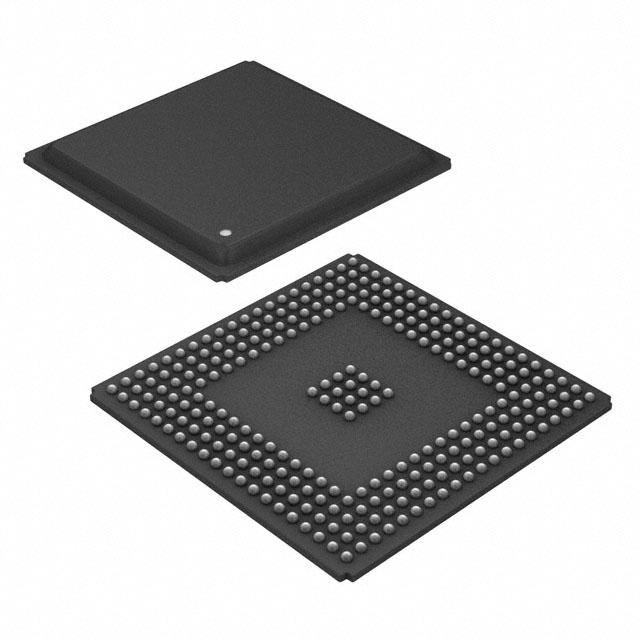 Texas Instruments | 264 kB | 105 °C | -40 °C | Floating Point | 1.2 V | External | Surface Mount | 3.3 V | 272-BBGA | 272-BGA (27x27) | 200 MHz | |
Texas Instruments | 1.03 MB | 90 °C | 0 °C | Fixed Point | 1.4 V | Host Interface McBSP PCI UTOPIA | External | Surface Mount | 3.3 V | 532-BFBGA FCBGA | 532-FCBGA (23x23) | 600 MHz |
Key Features
• Highest-Performance Fixed-Point Digital Signal Processors (DSPs)2-, 1.67-, 1.39-ns Instruction Cycle Time500-, 600-, 720-MHz Clock RateEight 32-Bit Instructions/CycleTwenty-Eight Operations/Cycle4000, 4800, 5760 MIPSFully Software-Compatible With C62x™C6414/15/16 Devices Pin-CompatibleVelociTI.2™ Extensions to VelociTI™ Advanced Very-Long-Instruction-Word (VLIW) TMS320C64x™ DSP CoreEight Highly Independent Functional Units With VelociTI.2™ Extensions:Six ALUs (32-/40-Bit), Each Supports Single 32-Bit, Dual 16-Bit, or Quad 8-Bit Arithmetic per Clock CycleTwo Multipliers Support Four 16 x 16-Bit Multiplies (32-Bit Results) per Clock Cycle or Eight 8 x 8-Bit Multiplies (16-Bit Results) per Clock CycleNon-Aligned Load-Store Architecture64 32-Bit General-Purpose RegistersInstruction Packing Reduces Code SizeAll Instructions ConditionalInstruction Set FeaturesByte-Addressable (8-/16-/32-/64-Bit Data)8-Bit Overflow ProtectionBit-Field Extract, Set, ClearNormalization, Saturation, Bit-CountingVelociTI.2™ Increased OrthogonalityViterbi Decoder Coprocessor (VCP) [C6416]Supports Over 600 7.95-Kbps AMRProgrammable Code ParametersTurbo Decoder Coprocessor (TCP) [C6416]Supports up to 7 2-Mbps or 43 384-Kbps 3GPP (6 Iterations)Programmable Turbo Code and Decoding ParametersL1/L2 Memory Architecture128K-Bit (16K-Byte) L1P Program Cache (Direct Mapped)128K-Bit (16K-Byte) L1D Data Cache (2-Way Set-Associative)8M-Bit (1024K-Byte) L2 Unified Mapped RAM/Cache (Flexible Allocation)Two External Memory Interfaces (EMIFs)One 64-Bit (EMIFA), One 16-Bit (EMIFB)Glueless Interface to Asynchronous Memories (SRAM and EPROM) and Synchronous Memories (SDRAM, SBSRAM, ZBT SRAM, and FIFO)1280M-Byte Total Addressable External Memory SpaceEnhanced Direct-Memory-Access (EDMA) Controller (64 Independent Channels)Host-Port Interface (HPI)User-Configurable Bus Width (32-/16-Bit)32-Bit/33-MHz, 3.3-V PCI Master/Slave Interface Conforms to PCI Specification 2.2 [C6415/C6416 ]Three PCI Bus Address Registers:Prefetchable MemoryNon-Prefetchable Memory I/OFour-Wire Serial EEPROM InterfacePCI Interrupt Request Under DSP Program ControlDSP Interrupt Via PCI I/O CycleThree Multichannel Buffered Serial PortsDirect Interface to T1/E1, MVIP, SCSA FramersUp to 256 Channels EachST-Bus-Switching-, AC97-CompatibleSerial Peripheral Interface (SPI) Compatible (Motorola™)Three 32-Bit General-Purpose TimersUniversal Test and Operations PHY Interface for ATM (UTOPIA) [C6415/C6416]UTOPIA Level 2 Slave ATM Controller8-Bit Transmit and Receive Operations up to 50 MHz per DirectionUser-Defined Cell Format up to 64 BytesSixteen General-Purpose I/O (GPIO) PinsFlexible PLL Clock GeneratorIEEE-1149.1 (JTAG) Boundary-Scan-Compatible532-Pin Ball Grid Array (BGA) Package (GLZ, ZLZ and CLZ Suffixes), 0.8-mm Ball Pitch0.13-µm/6-Level CuMetal Process (CMOS)3.3-V I/Os, 1.2-V/1.25-V Internal (500 MHz)3.3-V I/Os, 1.4-V Internal (600 and 720 MHz)C62x, VelociTI.2, VelociTI, and TMS320C64x are trademarks of Texas Instruments.Motorola is a trademark of Motorola, Inc.IEEE Standard 1149.1-1990 Standard-Test-Access Port and Boundary Scan Architecture.TMS320C6000, C64x, and C6000 are trademarks of Texas Instruments.Windows is a registered trademark of the Microsoft Corporation.Other trademarks are the property of their respective owners.Throughout the remainder of this document, the TMS320C6414, TMS320C6415, and TMS320C6416 shall be referred to as TMS320C64x or C64x where generic, and where specific, their individual full device part numbers will be used or abbreviated as C6414, C6415, or C6416.These C64xdevices have two EMIFs (64-bit EMIFA and 16-bit EMIFB). The prefix "A" in front of a signal name indicates it is an EMIFA signal whereas a prefix "B" in front of a signal name indicates it is an EMIFB signal. Throughout the rest of this document, in generic EMIF areas of discussion, the prefix "A" or "B" may be omitted from the signal name.Highest-Performance Fixed-Point Digital Signal Processors (DSPs)2-, 1.67-, 1.39-ns Instruction Cycle Time500-, 600-, 720-MHz Clock RateEight 32-Bit Instructions/CycleTwenty-Eight Operations/Cycle4000, 4800, 5760 MIPSFully Software-Compatible With C62x™C6414/15/16 Devices Pin-CompatibleVelociTI.2™ Extensions to VelociTI™ Advanced Very-Long-Instruction-Word (VLIW) TMS320C64x™ DSP CoreEight Highly Independent Functional Units With VelociTI.2™ Extensions:Six ALUs (32-/40-Bit), Each Supports Single 32-Bit, Dual 16-Bit, or Quad 8-Bit Arithmetic per Clock CycleTwo Multipliers Support Four 16 x 16-Bit Multiplies (32-Bit Results) per Clock Cycle or Eight 8 x 8-Bit Multiplies (16-Bit Results) per Clock CycleNon-Aligned Load-Store Architecture64 32-Bit General-Purpose RegistersInstruction Packing Reduces Code SizeAll Instructions ConditionalInstruction Set FeaturesByte-Addressable (8-/16-/32-/64-Bit Data)8-Bit Overflow ProtectionBit-Field Extract, Set, ClearNormalization, Saturation, Bit-CountingVelociTI.2™ Increased OrthogonalityViterbi Decoder Coprocessor (VCP) [C6416]Supports Over 600 7.95-Kbps AMRProgrammable Code ParametersTurbo Decoder Coprocessor (TCP) [C6416]Supports up to 7 2-Mbps or 43 384-Kbps 3GPP (6 Iterations)Programmable Turbo Code and Decoding ParametersL1/L2 Memory Architecture128K-Bit (16K-Byte) L1P Program Cache (Direct Mapped)128K-Bit (16K-Byte) L1D Data Cache (2-Way Set-Associative)8M-Bit (1024K-Byte) L2 Unified Mapped RAM/Cache (Flexible Allocation)Two External Memory Interfaces (EMIFs)One 64-Bit (EMIFA), One 16-Bit (EMIFB)Glueless Interface to Asynchronous Memories (SRAM and EPROM) and Synchronous Memories (SDRAM, SBSRAM, ZBT SRAM, and FIFO)1280M-Byte Total Addressable External Memory SpaceEnhanced Direct-Memory-Access (EDMA) Controller (64 Independent Channels)Host-Port Interface (HPI)User-Configurable Bus Width (32-/16-Bit)32-Bit/33-MHz, 3.3-V PCI Master/Slave Interface Conforms to PCI Specification 2.2 [C6415/C6416 ]Three PCI Bus Address Registers:Prefetchable MemoryNon-Prefetchable Memory I/OFour-Wire Serial EEPROM InterfacePCI Interrupt Request Under DSP Program ControlDSP Interrupt Via PCI I/O CycleThree Multichannel Buffered Serial PortsDirect Interface to T1/E1, MVIP, SCSA FramersUp to 256 Channels EachST-Bus-Switching-, AC97-CompatibleSerial Peripheral Interface (SPI) Compatible (Motorola™)Three 32-Bit General-Purpose TimersUniversal Test and Operations PHY Interface for ATM (UTOPIA) [C6415/C6416]UTOPIA Level 2 Slave ATM Controller8-Bit Transmit and Receive Operations up to 50 MHz per DirectionUser-Defined Cell Format up to 64 BytesSixteen General-Purpose I/O (GPIO) PinsFlexible PLL Clock GeneratorIEEE-1149.1 (JTAG) Boundary-Scan-Compatible532-Pin Ball Grid Array (BGA) Package (GLZ, ZLZ and CLZ Suffixes), 0.8-mm Ball Pitch0.13-µm/6-Level CuMetal Process (CMOS)3.3-V I/Os, 1.2-V/1.25-V Internal (500 MHz)3.3-V I/Os, 1.4-V Internal (600 and 720 MHz)C62x, VelociTI.2, VelociTI, and TMS320C64x are trademarks of Texas Instruments.Motorola is a trademark of Motorola, Inc.IEEE Standard 1149.1-1990 Standard-Test-Access Port and Boundary Scan Architecture.TMS320C6000, C64x, and C6000 are trademarks of Texas Instruments.Windows is a registered trademark of the Microsoft Corporation.Other trademarks are the property of their respective owners.Throughout the remainder of this document, the TMS320C6414, TMS320C6415, and TMS320C6416 shall be referred to as TMS320C64x or C64x where generic, and where specific, their individual full device part numbers will be used or abbreviated as C6414, C6415, or C6416.These C64xdevices have two EMIFs (64-bit EMIFA and 16-bit EMIFB). The prefix "A" in front of a signal name indicates it is an EMIFA signal whereas a prefix "B" in front of a signal name indicates it is an EMIFB signal. Throughout the rest of this document, in generic EMIF areas of discussion, the prefix "A" or "B" may be omitted from the signal name.
Description
AI
This device is a member of TI's C5000 fixed-point Digital Signal Processor (DSP) product family and is designed for low active and standby power consumption.
The device is based on the TMS320C55x DSP generation CPU processor core. The C55x DSP architecture achieves high performance and low power through increased parallelism and total focus on power savings. The CPU supports an internal bus structure that is composed of one program bus, one 32-bit data read bus and two 16-bit data read buses, two 16-bit data write buses, and additional buses dedicated to peripheral and DMA activity. These buses provide the ability to perform up to four 16-bit data reads and two 16-bit data writes in a single cycle. The device also includes four DMA controllers, each with 4 channels, providing data movement for 16 independent channel contexts without CPU intervention. Each DMA controller can perform one 32-bit data transfer per cycle, in parallel and independent of the CPU activity.
The C55x CPU provides two multiply-accumulate (MAC) units, each capable of 17-bit x 17-bit multiplication and a 32-bit add in a single cycle. A central 40-bit arithmetic and logic unit (ALU) is supported by an additional 16-bit ALU. Use of the ALUs is under instruction set control, providing the ability to optimize parallel activity and power consumption. These resources are managed in the Address Unit (AU) and Data Unit (DU) of the C55x CPU.
The C55x CPU supports a variable byte width instruction set for improved code density. The Instruction Unit (IU) performs 32-bit program fetches from internal or external memory and queues instructions for the Program Unit (PU). The PU decodes the instructions, directs tasks to the AU and DU resources, and manages the fully protected pipeline. Predictive branching capability avoids pipeline flushes on execution of conditional instructions.
The GPIO functions along with the 10-bit SAR ADC to provide sufficient pins for status, interrupts, and bit I/O for keyboards, and media interfaces.
Serial media is supported through two multimedia card and secure digital (MMC and SD) peripherals, three Inter-IC Sound (I2S Bus) modules, one serial port interface (SPI) with up to four chip selects, one master and slave multichannel serial port interface (McSPI) with up to three chip selects, one multichannel serial port (McBSP), one I2C multimaster and slave interface, and a universal asynchronous receiver/transmitter (UART) interface
The device peripheral set includes an external memory interface (EMIF) that provides glueless access to asynchronous memories, such as EPROM, NOR, NAND, and SRAM, as well as to high-speed, high-density memories such as synchronous DRAM (SDRAM) and mobile SDRAM (mSDRAM).
Additional peripherals include a configurable 16-bit universal host-port interface (UHPI), a high-speed universal serial bus (USB2.0) device mode only, a real-time clock (RTC), three general-purpose timers with one configurable as a watchdog timer, and an analog phase-locked loop (APLL) clock generator.
The device also includes a tightly coupled FFT hardware accelerate that supports 8- to 1024-point (by power of 2) real- and complex-valued FFTs and three integrated LDOs to power different sections of the device, except CVDDRTCwhich requires an external power source: ANA_LDO to provide 1.3 V to the SAR and power-management circuits (VDDA_ANA), DSP_LDO to provide 1.3 or 1.05 V to the DSP core (CVDD), selectable on-the-fly by software as long as operating frequency ranges are observed, and USB_LDO to provide 1.3 V to the USB core digital (USB_VDD1P3) and PHY circuits (USB_VDDA1P3).
The device is supported by the industry’s award-winning eXpressDSP, Code Composer Studio Integrated Development Environment (IDE), DSP/BIOS, Texas Instruments’ algorithm standard, and a large third-party network. Code Composer Studio IDE features code generation tools including a C Compiler and Linker, RTDX, XDS100, XDS510, XDS560 emulation device drivers, and evaluation modules. The device is also supported by the C55x DSP library which features more than 50 foundational software kernels (FIR filters, IIR filters, FFTs, and various math functions) as well as chip support libraries.
This device is a member of TI's C5000 fixed-point Digital Signal Processor (DSP) product family and is designed for low active and standby power consumption.
The device is based on the TMS320C55x DSP generation CPU processor core. The C55x DSP architecture achieves high performance and low power through increased parallelism and total focus on power savings. The CPU supports an internal bus structure that is composed of one program bus, one 32-bit data read bus and two 16-bit data read buses, two 16-bit data write buses, and additional buses dedicated to peripheral and DMA activity. These buses provide the ability to perform up to four 16-bit data reads and two 16-bit data writes in a single cycle. The device also includes four DMA controllers, each with 4 channels, providing data movement for 16 independent channel contexts without CPU intervention. Each DMA controller can perform one 32-bit data transfer per cycle, in parallel and independent of the CPU activity.
The C55x CPU provides two multiply-accumulate (MAC) units, each capable of 17-bit x 17-bit multiplication and a 32-bit add in a single cycle. A central 40-bit arithmetic and logic unit (ALU) is supported by an additional 16-bit ALU. Use of the ALUs is under instruction set control, providing the ability to optimize parallel activity and power consumption. These resources are managed in the Address Unit (AU) and Data Unit (DU) of the C55x CPU.
The C55x CPU supports a variable byte width instruction set for improved code density. The Instruction Unit (IU) performs 32-bit program fetches from internal or external memory and queues instructions for the Program Unit (PU). The PU decodes the instructions, directs tasks to the AU and DU resources, and manages the fully protected pipeline. Predictive branching capability avoids pipeline flushes on execution of conditional instructions.
The GPIO functions along with the 10-bit SAR ADC to provide sufficient pins for status, interrupts, and bit I/O for keyboards, and media interfaces.
Serial media is supported through two multimedia card and secure digital (MMC and SD) peripherals, three Inter-IC Sound (I2S Bus) modules, one serial port interface (SPI) with up to four chip selects, one master and slave multichannel serial port interface (McSPI) with up to three chip selects, one multichannel serial port (McBSP), one I2C multimaster and slave interface, and a universal asynchronous receiver/transmitter (UART) interface
The device peripheral set includes an external memory interface (EMIF) that provides glueless access to asynchronous memories, such as EPROM, NOR, NAND, and SRAM, as well as to high-speed, high-density memories such as synchronous DRAM (SDRAM) and mobile SDRAM (mSDRAM).
Additional peripherals include a configurable 16-bit universal host-port interface (UHPI), a high-speed universal serial bus (USB2.0) device mode only, a real-time clock (RTC), three general-purpose timers with one configurable as a watchdog timer, and an analog phase-locked loop (APLL) clock generator.
The device also includes a tightly coupled FFT hardware accelerate that supports 8- to 1024-point (by power of 2) real- and complex-valued FFTs and three integrated LDOs to power different sections of the device, except CVDDRTCwhich requires an external power source: ANA_LDO to provide 1.3 V to the SAR and power-management circuits (VDDA_ANA), DSP_LDO to provide 1.3 or 1.05 V to the DSP core (CVDD), selectable on-the-fly by software as long as operating frequency ranges are observed, and USB_LDO to provide 1.3 V to the USB core digital (USB_VDD1P3) and PHY circuits (USB_VDDA1P3).
The device is supported by the industry’s award-winning eXpressDSP, Code Composer Studio Integrated Development Environment (IDE), DSP/BIOS, Texas Instruments’ algorithm standard, and a large third-party network. Code Composer Studio IDE features code generation tools including a C Compiler and Linker, RTDX, XDS100, XDS510, XDS560 emulation device drivers, and evaluation modules. The device is also supported by the C55x DSP library which features more than 50 foundational software kernels (FIR filters, IIR filters, FFTs, and various math functions) as well as chip support libraries.