Deep-Dive with AI
Search across all available documentation for this part.
Deep-Dive with AI
Technical Specifications
Parameters and characteristics for this part
| Specification | MICRF219AYQS-TR |
|---|---|
| Antenna Connector | PCB, Surface Mount |
| Current - Receiving | 6 mA |
| Data Interface | Surface Mount, PCB |
| Data Rate (Max) [Max] | 10 kbps |
| Frequency [Max] | 450 MHz |
| Frequency [Min] | 300 MHz |
| Modulation or Protocol | ASK, OOK |
| Mounting Type | Surface Mount |
| Operating Temperature [Max] | 105 ░C |
| Operating Temperature [Min] | -40 °C |
| Package / Case | 0.154 in |
| Package / Case | 16-SSOP |
| Package / Case | 3.9 mm |
| Sensitivity | -110 dBm |
| Supplier Device Package | 16-QSOP |
| Voltage - Supply [Max] | 3.6 V |
| Voltage - Supply [Min] | 3 V |
Pricing
Prices provided here are for design reference only. For realtime values and availability, please visit the distributors directly
| Distributor | Package | Quantity | $ | |
|---|---|---|---|---|
| Microchip Direct | T/R | 1 | $ 3.17 | |
| 25 | $ 2.90 | |||
| 100 | $ 2.63 | |||
| 1000 | $ 2.42 | |||
| 5000 | $ 2.30 | |||
Description
General part information
MICRF219A Series
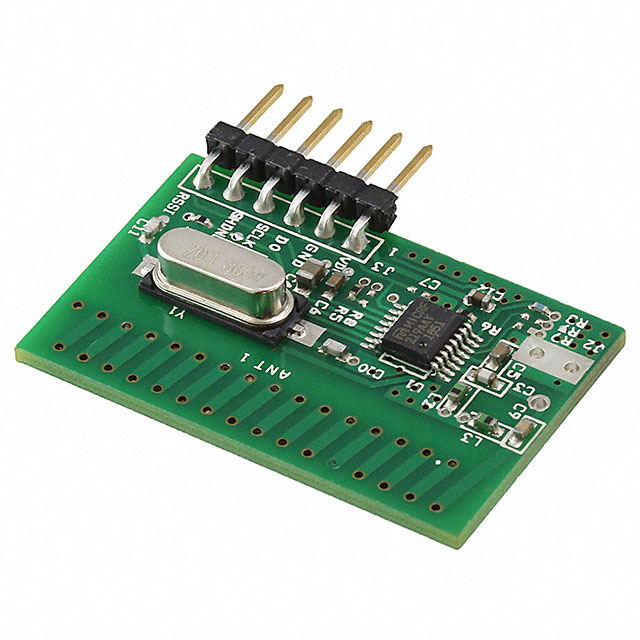
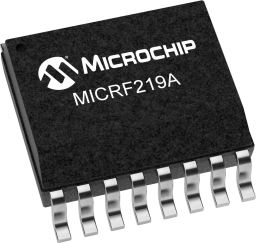
The MICRF219A is a 300MHz to 450MHz super-heterodyne, image-reject, RF receiver with automatic gain control, ASK/OOK demodulator, analog RSSI output, and integrated squelch features. It only requires a crystal and a minimum number of external components to implement. The MICRF219A is ideal for low-cost, low-power, RKE, TPMS, and remote actuation applications.
The MICRF219A achieves -110dBm sensitivity at a bit rate of 1kbps with 0.1% BER. Four demodulator filter bandwidths are selectable in binary steps from 1625Hz to 13kHz at 433.92MHz, allowing the device to support bit rates up to 20kbps.
The device operates from a supply voltage of 3.0V to 3.6V, and typically consumes 4.3mA of supply current at 315MHz and 6.0mA at 433.92MHz. A shutdown mode reduces supply current to 0.1µA typical. The squelch feature decreases the activity on the data output pin until valid bits are detected while maintaining overall receiver sensitivity.
Documents
Technical documentation and resources