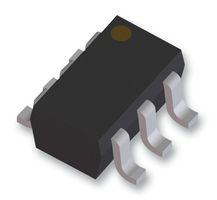
ADG779BKSZ-REEL
ActiveCMOS, LOW VOLTAGE 2.5 Ω SPDT SWITCH / 2:1 MUX
Deep-Dive with AI
Search across all available documentation for this part.
ADG779BKSZ-REEL
ActiveCMOS, LOW VOLTAGE 2.5 Ω SPDT SWITCH / 2:1 MUX
Deep-Dive with AI
Technical Specifications
Parameters and characteristics for this part
| Specification | ADG779BKSZ-REEL |
|---|---|
| -3db Bandwidth | 200 MHz |
| Channel Capacitance (CS(off), CD(off)) [custom] | 7 pF |
| Channel Capacitance (CS(off), CD(off)) [custom] | 7 pF |
| Channel-to-Channel Matching (ΔRon) | 100 mOhm |
| Crosstalk | -82 dB |
| Current - Leakage (IS(off)) (Max) | 10 pA |
| Mounting Type | Surface Mount |
| Multiplexer/Demultiplexer Circuit | 2:1 |
| Number of Circuits | 1 |
| On-State Resistance (Max) [Max] | 5 Ohms |
| Operating Temperature [Max] | 85 °C |
| Operating Temperature [Min] | -40 °C |
| Package / Case | 6-TSSOP, SC-88, SOT-363 |
| Supplier Device Package | SC-70-6 |
| Switch Circuit | SPDT |
| Switch Time (Ton, Toff) (Max) [x] | 14 ns |
| Switch Time (Ton, Toff) (Max) [y] | 3 ns |
| Voltage - Supply, Single (V+) [Max] | 5.5 V |
| Voltage - Supply, Single (V+) [Min] | 1.8 V |
Pricing
Prices provided here are for design reference only. For realtime values and availability, please visit the distributors directly
| Distributor | Package | Quantity | $ | |
|---|---|---|---|---|
| Digikey | Cut Tape (CT) | 1 | $ 2.41 | |
| 10 | $ 1.57 | |||
| 25 | $ 1.36 | |||
| 100 | $ 1.11 | |||
| 250 | $ 1.04 | |||
| Digi-Reel® | 1 | $ 2.41 | ||
| 10 | $ 1.57 | |||
| 25 | $ 1.36 | |||
| 100 | $ 1.11 | |||
| 250 | $ 1.04 | |||
| Tape & Reel (TR) | 10000 | $ 1.04 | ||
Description
General part information
ADG779 Series
The ADG779 is a monolithic CMOS SPDT switch. This switch is designed on a submicron process that provides low power dissipation yet gives high switching speed, low on resistance, low leakage currents and -3 dB bandwidths of greater than 200 MHz can be achieved.The ADG779 can operate from a single supply range of 1.8 V to 5.5 V, making it ideal for use in battery-powered instruments and with the new generation of DACs and ADCs from Analog Devices.