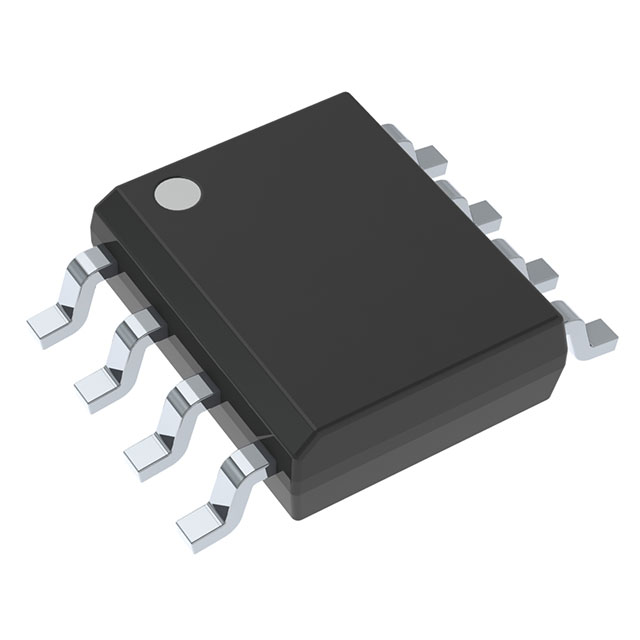
DS92LV010ATM/NOPB
ActiveBUS LVDS 3.3/5.0-V SINGLE TRANSCEIVER
Deep-Dive with AI
Search across all available documentation for this part.
DS92LV010ATM/NOPB
ActiveBUS LVDS 3.3/5.0-V SINGLE TRANSCEIVER
Technical Specifications
Parameters and characteristics for this part
| Specification | DS92LV010ATM/NOPB |
|---|---|
| Data Rate | 100 Mbps |
| Duplex | Half |
| Mounting Type | Surface Mount |
| Operating Temperature [Max] | 85 °C |
| Operating Temperature [Min] | -40 °C |
| Package / Case | 8-SOIC |
| Package / Case [x] | 0.154 in |
| Package / Case [y] | 3.9 mm |
| Protocol | LVDS |
| Supplier Device Package | 8-SOIC |
| Type | Transceiver |
| Voltage - Supply [Max] | 5.5 V |
| Voltage - Supply [Min] | 3 V |
Pricing
Prices provided here are for design reference only. For realtime values and availability, please visit the distributors directly
| Distributor | Package | Quantity | $ | |
|---|---|---|---|---|
| Digikey | Tube | 1 | $ 4.85 | |
| 10 | $ 4.36 | |||
| 95 | $ 3.57 | |||
| 285 | $ 3.39 | |||
| 570 | $ 3.04 | |||
| 1045 | $ 2.56 | |||
| 2565 | $ 2.44 | |||
| Newark | Each | 1 | $ 6.03 | |
| 10 | $ 5.67 | |||
| 25 | $ 5.37 | |||
| 50 | $ 5.13 | |||
| 190 | $ 4.91 | |||
| 285 | $ 4.67 | |||
| 570 | $ 4.59 | |||
| Texas Instruments | TUBE | 1 | $ 3.77 | |
| 100 | $ 3.30 | |||
| 250 | $ 2.31 | |||
| 1000 | $ 1.86 | |||
Description
General part information
DS92LV010A Series
The DS92LV010A is one in a series of transceivers designed specifically for the high speed, low power proprietary bus backplane interfaces. The device operates from a single 3.3V or 5.0V power supply and includes one differential line driver and one receiver. To minimize bus loading the driver outputs and receiver inputs are internally connected. The logic interface provides maximum flexibility as 4 separate lines are provided (DIN, DE,RE, and ROUT). The device also features flow through which allows easy PCB routing for short stubs between the bus pins and the connector. The driver has 10 mA drive capability, allowing it to drive heavily loaded backplanes, with impedance as low as 27 Ohms.
The driver translates between TTL levels (single-ended) to Low Voltage Differential Signaling levels. This allows for high speed operation, while consuming minimal power with reduced EMI. In addition the differential signaling provides common mode noise rejection of ±1V.
The receiver threshold is ±100mV over a ±1V common mode range and translates the low voltage differential levels to standard (CMOS/TTL) levels.
Documents
Technical documentation and resources