| Microcontrollers | 5 | Active | |
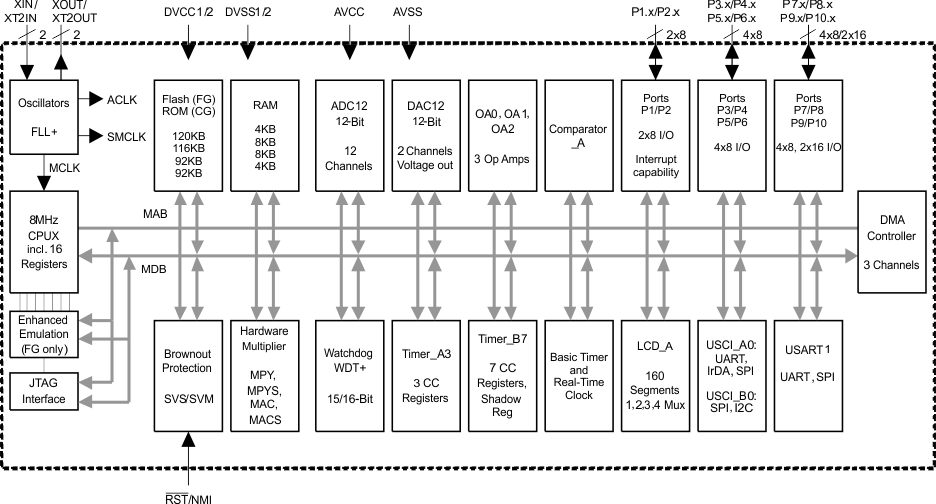
MSP430FG46188 MHz MCU with 116KB Flash, 8KB SRAM, 12-bit ADC, Dual DAC, DMA, 3 OpAmp, 160 seg LCD | Microcontrollers | 8 | Active | The TI MSP430™ family of ultra-low-power microcontrollers consists of several devices featuring different sets of peripherals targeted for various applications. The architecture, combined with five low-power modes, is optimized to achieve extended battery life in portable measurement applications. The device features a powerful 16-bit RISC CPU, 16-bit registers, and constant generators that contribute to maximum code efficiency. The digitally controlled oscillator (DCO) allows the device to wake up from low-power modes to active mode in less than 6 µs.
The MSP430xG461x series are microcontroller configurations with two 16-bit timers, a high-performance 12-bit ADC, dual 12-bit DACs, three configurable operational amplifiers, one universal serial communication interface (USCI), one universal synchronous/asynchronous communication interface (USART), DMA, 80 I/O pins, and a segment liquid crystal display (LCD) driver with regulated charge pump.
For complete module descriptions, see theMSP430x4xx Family User’s Guide.
The TI MSP430™ family of ultra-low-power microcontrollers consists of several devices featuring different sets of peripherals targeted for various applications. The architecture, combined with five low-power modes, is optimized to achieve extended battery life in portable measurement applications. The device features a powerful 16-bit RISC CPU, 16-bit registers, and constant generators that contribute to maximum code efficiency. The digitally controlled oscillator (DCO) allows the device to wake up from low-power modes to active mode in less than 6 µs.
The MSP430xG461x series are microcontroller configurations with two 16-bit timers, a high-performance 12-bit ADC, dual 12-bit DACs, three configurable operational amplifiers, one universal serial communication interface (USCI), one universal synchronous/asynchronous communication interface (USART), DMA, 80 I/O pins, and a segment liquid crystal display (LCD) driver with regulated charge pump.
For complete module descriptions, see theMSP430x4xx Family User’s Guide. |
MSP430FG46198 MHz MCU with 120KB Flash, 4KB SRAM, 12-bit ADC, Dual DAC, DMA, 3 OpAmp, 160 seg LCD | Microcontrollers | 3 | Active | The TI MSP430™ family of ultra-low-power microcontrollers consists of several devices featuring different sets of peripherals targeted for various applications. The architecture, combined with five low-power modes, is optimized to achieve extended battery life in portable measurement applications. The device features a powerful 16-bit RISC CPU, 16-bit registers, and constant generators that contribute to maximum code efficiency. The digitally controlled oscillator (DCO) allows the device to wake up from low-power modes to active mode in less than 6 µs.
The MSP430xG461x series are microcontroller configurations with two 16-bit timers, a high-performance 12-bit ADC, dual 12-bit DACs, three configurable operational amplifiers, one universal serial communication interface (USCI), one universal synchronous/asynchronous communication interface (USART), DMA, 80 I/O pins, and a segment liquid crystal display (LCD) driver with regulated charge pump.
For complete module descriptions, see theMSP430x4xx Family User’s Guide.
The TI MSP430™ family of ultra-low-power microcontrollers consists of several devices featuring different sets of peripherals targeted for various applications. The architecture, combined with five low-power modes, is optimized to achieve extended battery life in portable measurement applications. The device features a powerful 16-bit RISC CPU, 16-bit registers, and constant generators that contribute to maximum code efficiency. The digitally controlled oscillator (DCO) allows the device to wake up from low-power modes to active mode in less than 6 µs.
The MSP430xG461x series are microcontroller configurations with two 16-bit timers, a high-performance 12-bit ADC, dual 12-bit DACs, three configurable operational amplifiers, one universal serial communication interface (USCI), one universal synchronous/asynchronous communication interface (USART), DMA, 80 I/O pins, and a segment liquid crystal display (LCD) driver with regulated charge pump.
For complete module descriptions, see theMSP430x4xx Family User’s Guide. |
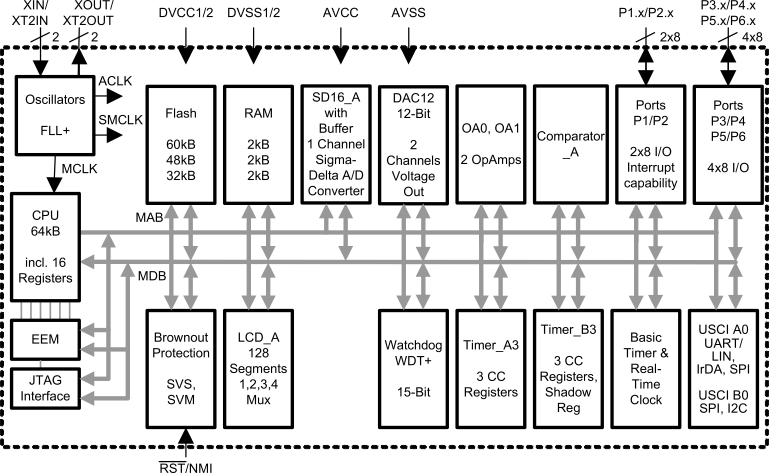
MSP430FG4778 MHz MCU with 32KB Flash, 2KB SRAM, 16-bit sigma-delta ADC, Dual DAC, 2 OpAmp, 128 seg LCD | Embedded | 2 | Active | The Texas Instruments MSP430™ family of ultra-low-power microcontrollers consists of several devices featuring different sets of peripherals targeted for various applications. The architecture, combined with five low-power modes, is optimized to achieve extended battery life in portable measurement applications. The device features a powerful 16-bit RISC CPU, 16-bit registers, and constant generators that contribute to maximum code efficiency.The digitally controlled oscillator (DCO) allows wake-up from low-power modes to active mode in less than 6 µs.
The MSP430FG47x is a microcontroller configuration with two 16-bit timers, a basic timer with a real-time clock, a high-performance 16-bit sigma-delta ADC, dual 12-bit DACs, two configurable operational amplifiers, two universal serial communication interface, 48 I/O pins, and a liquid crystal display driver.
For complete module descriptions, see theMSP430x4xx Family User’s Guide.
The Texas Instruments MSP430™ family of ultra-low-power microcontrollers consists of several devices featuring different sets of peripherals targeted for various applications. The architecture, combined with five low-power modes, is optimized to achieve extended battery life in portable measurement applications. The device features a powerful 16-bit RISC CPU, 16-bit registers, and constant generators that contribute to maximum code efficiency.The digitally controlled oscillator (DCO) allows wake-up from low-power modes to active mode in less than 6 µs.
The MSP430FG47x is a microcontroller configuration with two 16-bit timers, a basic timer with a real-time clock, a high-performance 16-bit sigma-delta ADC, dual 12-bit DACs, two configurable operational amplifiers, two universal serial communication interface, 48 I/O pins, and a liquid crystal display driver.
For complete module descriptions, see theMSP430x4xx Family User’s Guide. |
MSP430FG4788 MHz MCU with 48KB Flash, 2KB SRAM, 16-bit sigma-delta ADC, Dual DAC, 2 OpAmp, 128 seg LCD | Integrated Circuits (ICs) | 3 | Active | The Texas Instruments MSP430™ family of ultra-low-power microcontrollers consists of several devices featuring different sets of peripherals targeted for various applications. The architecture, combined with five low-power modes, is optimized to achieve extended battery life in portable measurement applications. The device features a powerful 16-bit RISC CPU, 16-bit registers, and constant generators that contribute to maximum code efficiency.The digitally controlled oscillator (DCO) allows wake-up from low-power modes to active mode in less than 6 µs.
The MSP430FG47x is a microcontroller configuration with two 16-bit timers, a basic timer with a real-time clock, a high-performance 16-bit sigma-delta ADC, dual 12-bit DACs, two configurable operational amplifiers, two universal serial communication interface, 48 I/O pins, and a liquid crystal display driver.
For complete module descriptions, see theMSP430x4xx Family User’s Guide.
The Texas Instruments MSP430™ family of ultra-low-power microcontrollers consists of several devices featuring different sets of peripherals targeted for various applications. The architecture, combined with five low-power modes, is optimized to achieve extended battery life in portable measurement applications. The device features a powerful 16-bit RISC CPU, 16-bit registers, and constant generators that contribute to maximum code efficiency.The digitally controlled oscillator (DCO) allows wake-up from low-power modes to active mode in less than 6 µs.
The MSP430FG47x is a microcontroller configuration with two 16-bit timers, a basic timer with a real-time clock, a high-performance 16-bit sigma-delta ADC, dual 12-bit DACs, two configurable operational amplifiers, two universal serial communication interface, 48 I/O pins, and a liquid crystal display driver.
For complete module descriptions, see theMSP430x4xx Family User’s Guide. |
MSP430FG4798 MHz MCU with 60KB Flash, 2KB SRAM, 16-bit sigma-delta ADC, Dual DAC, 2 OpAmp, 128 seg LCD | Microcontrollers | 3 | Active | The Texas Instruments MSP430™ family of ultra-low-power microcontrollers consists of several devices featuring different sets of peripherals targeted for various applications. The architecture, combined with five low-power modes, is optimized to achieve extended battery life in portable measurement applications. The device features a powerful 16-bit RISC CPU, 16-bit registers, and constant generators that contribute to maximum code efficiency.The digitally controlled oscillator (DCO) allows wake-up from low-power modes to active mode in less than 6 µs.
The MSP430FG47x is a microcontroller configuration with two 16-bit timers, a basic timer with a real-time clock, a high-performance 16-bit sigma-delta ADC, dual 12-bit DACs, two configurable operational amplifiers, two universal serial communication interface, 48 I/O pins, and a liquid crystal display driver.
For complete module descriptions, see theMSP430x4xx Family User’s Guide.
The Texas Instruments MSP430™ family of ultra-low-power microcontrollers consists of several devices featuring different sets of peripherals targeted for various applications. The architecture, combined with five low-power modes, is optimized to achieve extended battery life in portable measurement applications. The device features a powerful 16-bit RISC CPU, 16-bit registers, and constant generators that contribute to maximum code efficiency.The digitally controlled oscillator (DCO) allows wake-up from low-power modes to active mode in less than 6 µs.
The MSP430FG47x is a microcontroller configuration with two 16-bit timers, a basic timer with a real-time clock, a high-performance 16-bit sigma-delta ADC, dual 12-bit DACs, two configurable operational amplifiers, two universal serial communication interface, 48 I/O pins, and a liquid crystal display driver.
For complete module descriptions, see theMSP430x4xx Family User’s Guide. |
MSP430FG642620 MHz MCU with 128KB Flash, 10KB SRAM, 16-bit Sigma-Delta ADC, dual DAC, DMA, 2 OpAmp, 160 | Microcontrollers | 1 | Active | The Texas Instruments MSP430FG662x and MSP430FG642x microcontrollers (MCUs) are part of the MSP430TM Metrology and Monitoring portfolio. The architecture and integrated peripherals, combined with five extensive low-power modes, are optimized to achieve extended battery life in portable and battery-powered measurement applications. The device features a powerful 16-bit RISC CPU, 16-bit registers, and constant generators that contribute to maximum code efficiency. The digitally controlled oscillator (DCO) allows the devices to wake up from low-power modes to active mode in less than 5 µs.
The MSP430FG662x MCUs are targeted at small signal-monitoring applications and include a 16-bit sigma-delta ADC, dual low-power operational amplifiers, dual 12-bit DACs, voltage comparator, four USCIs (two USCI_A modules and two USCI_B modules), four 16-bit timers, a hardware multiplier, a DMA module, an RTC module, an LCD driver with integrated contrast control for up to 160 segments, integrated full-speed USB, an auxiliary supply system, up to 128KB flash, 10KB SRAM and 73 I/O pins in 100‑pin devices and 113‑pin devices.
The MSP430FG642x MCUs are targeted at small-signal monitoring applications and include a 16-bit sigma-delta ADC, dual low-power operational amplifiers, dual 12-bit DACs, voltage comparator, four USCIs (two USCI_A modules and two USCI_B modules), four 16-bit timers, a hardware multiplier, a DMA module, an RTC module, an LCD driver with integrated contrast control for up to 160 segments, an auxiliary supply system, up to 128KB of flash, 10KB of SRAM, and 73 I/O pins in 100‑pin devices and 113‑pin devices.
Typical applications for these microcontrollers include small signal-monitoring applications such as handheld test and measurement equipment, field transmitters, and blood glucose meters. These microcontrollers can reduce overall system cost through high analog integration and enable long battery life by low-power operation.
The MSP430FG662x and MSP430FG642x MCUs are supported by an extensive hardware and software ecosystem with reference designs and code examples to get your design started quickly. Development kits include theMSP-TS430PZ100AUSB100-pin target development board. TI also provides freeMSP430Ware™software, which is available as a component ofCode Composer Studio™ IDEdesktop and cloud versions withinTI Resource Explorer. The MSP430 MCUs are also supported by extensive online collateral, training, and online support through theTI E2E™ support forums.
For complete module descriptions, see theMSP430F5xx and MSP430F6xx Family User’s Guide.
The Texas Instruments MSP430FG662x and MSP430FG642x microcontrollers (MCUs) are part of the MSP430TM Metrology and Monitoring portfolio. The architecture and integrated peripherals, combined with five extensive low-power modes, are optimized to achieve extended battery life in portable and battery-powered measurement applications. The device features a powerful 16-bit RISC CPU, 16-bit registers, and constant generators that contribute to maximum code efficiency. The digitally controlled oscillator (DCO) allows the devices to wake up from low-power modes to active mode in less than 5 µs.
The MSP430FG662x MCUs are targeted at small signal-monitoring applications and include a 16-bit sigma-delta ADC, dual low-power operational amplifiers, dual 12-bit DACs, voltage comparator, four USCIs (two USCI_A modules and two USCI_B modules), four 16-bit timers, a hardware multiplier, a DMA module, an RTC module, an LCD driver with integrated contrast control for up to 160 segments, integrated full-speed USB, an auxiliary supply system, up to 128KB flash, 10KB SRAM and 73 I/O pins in 100‑pin devices and 113‑pin devices.
The MSP430FG642x MCUs are targeted at small-signal monitoring applications and include a 16-bit sigma-delta ADC, dual low-power operational amplifiers, dual 12-bit DACs, voltage comparator, four USCIs (two USCI_A modules and two USCI_B modules), four 16-bit timers, a hardware multiplier, a DMA module, an RTC module, an LCD driver with integrated contrast control for up to 160 segments, an auxiliary supply system, up to 128KB of flash, 10KB of SRAM, and 73 I/O pins in 100‑pin devices and 113‑pin devices.
Typical applications for these microcontrollers include small signal-monitoring applications such as handheld test and measurement equipment, field transmitters, and blood glucose meters. These microcontrollers can reduce overall system cost through high analog integration and enable long battery life by low-power operation.
The MSP430FG662x and MSP430FG642x MCUs are supported by an extensive hardware and software ecosystem with reference designs and code examples to get your design started quickly. Development kits include theMSP-TS430PZ100AUSB100-pin target development board. TI also provides freeMSP430Ware™software, which is available as a component ofCode Composer Studio™ IDEdesktop and cloud versions withinTI Resource Explorer. The MSP430 MCUs are also supported by extensive online collateral, training, and online support through theTI E2E™ support forums.
For complete module descriptions, see theMSP430F5xx and MSP430F6xx Family User’s Guide. |
MSP430FG662520 MHz MCU with 64KB Flash, 10KB SRAM, 16-bit Sigma-Delta ADC, dual DAC, DMA, 2 OpAmp, 160 s | Microcontrollers | 2 | Active | The Texas Instruments MSP430FG662x and MSP430FG642x microcontrollers (MCUs) are part of the MSP430TM Metrology and Monitoring portfolio. The architecture and integrated peripherals, combined with five extensive low-power modes, are optimized to achieve extended battery life in portable and battery-powered measurement applications. The device features a powerful 16-bit RISC CPU, 16-bit registers, and constant generators that contribute to maximum code efficiency. The digitally controlled oscillator (DCO) allows the devices to wake up from low-power modes to active mode in less than 5 µs.
The MSP430FG662x MCUs are targeted at small signal-monitoring applications and include a 16-bit sigma-delta ADC, dual low-power operational amplifiers, dual 12-bit DACs, voltage comparator, four USCIs (two USCI_A modules and two USCI_B modules), four 16-bit timers, a hardware multiplier, a DMA module, an RTC module, an LCD driver with integrated contrast control for up to 160 segments, integrated full-speed USB, an auxiliary supply system, up to 128KB flash, 10KB SRAM and 73 I/O pins in 100‑pin devices and 113‑pin devices.
The MSP430FG642x MCUs are targeted at small-signal monitoring applications and include a 16-bit sigma-delta ADC, dual low-power operational amplifiers, dual 12-bit DACs, voltage comparator, four USCIs (two USCI_A modules and two USCI_B modules), four 16-bit timers, a hardware multiplier, a DMA module, an RTC module, an LCD driver with integrated contrast control for up to 160 segments, an auxiliary supply system, up to 128KB of flash, 10KB of SRAM, and 73 I/O pins in 100‑pin devices and 113‑pin devices.
Typical applications for these microcontrollers include small signal-monitoring applications such as handheld test and measurement equipment, field transmitters, and blood glucose meters. These microcontrollers can reduce overall system cost through high analog integration and enable long battery life by low-power operation.
The MSP430FG662x and MSP430FG642x MCUs are supported by an extensive hardware and software ecosystem with reference designs and code examples to get your design started quickly. Development kits include theMSP-TS430PZ100AUSB100-pin target development board. TI also provides freeMSP430Ware™software, which is available as a component ofCode Composer Studio™ IDEdesktop and cloud versions withinTI Resource Explorer. The MSP430 MCUs are also supported by extensive online collateral, training, and online support through theTI E2E™ support forums.
For complete module descriptions, see theMSP430F5xx and MSP430F6xx Family User’s Guide.
The Texas Instruments MSP430FG662x and MSP430FG642x microcontrollers (MCUs) are part of the MSP430TM Metrology and Monitoring portfolio. The architecture and integrated peripherals, combined with five extensive low-power modes, are optimized to achieve extended battery life in portable and battery-powered measurement applications. The device features a powerful 16-bit RISC CPU, 16-bit registers, and constant generators that contribute to maximum code efficiency. The digitally controlled oscillator (DCO) allows the devices to wake up from low-power modes to active mode in less than 5 µs.
The MSP430FG662x MCUs are targeted at small signal-monitoring applications and include a 16-bit sigma-delta ADC, dual low-power operational amplifiers, dual 12-bit DACs, voltage comparator, four USCIs (two USCI_A modules and two USCI_B modules), four 16-bit timers, a hardware multiplier, a DMA module, an RTC module, an LCD driver with integrated contrast control for up to 160 segments, integrated full-speed USB, an auxiliary supply system, up to 128KB flash, 10KB SRAM and 73 I/O pins in 100‑pin devices and 113‑pin devices.
The MSP430FG642x MCUs are targeted at small-signal monitoring applications and include a 16-bit sigma-delta ADC, dual low-power operational amplifiers, dual 12-bit DACs, voltage comparator, four USCIs (two USCI_A modules and two USCI_B modules), four 16-bit timers, a hardware multiplier, a DMA module, an RTC module, an LCD driver with integrated contrast control for up to 160 segments, an auxiliary supply system, up to 128KB of flash, 10KB of SRAM, and 73 I/O pins in 100‑pin devices and 113‑pin devices.
Typical applications for these microcontrollers include small signal-monitoring applications such as handheld test and measurement equipment, field transmitters, and blood glucose meters. These microcontrollers can reduce overall system cost through high analog integration and enable long battery life by low-power operation.
The MSP430FG662x and MSP430FG642x MCUs are supported by an extensive hardware and software ecosystem with reference designs and code examples to get your design started quickly. Development kits include theMSP-TS430PZ100AUSB100-pin target development board. TI also provides freeMSP430Ware™software, which is available as a component ofCode Composer Studio™ IDEdesktop and cloud versions withinTI Resource Explorer. The MSP430 MCUs are also supported by extensive online collateral, training, and online support through theTI E2E™ support forums.
For complete module descriptions, see theMSP430F5xx and MSP430F6xx Family User’s Guide. |
MSP430FG662620 MHz MCU with 128KB Flash, 10KB SRAM, 16-bit Sigma-Delta ADC, dual DAC, DMA, 2 OpAmp, 160 seg L | Microcontrollers | 6 | Active | The Texas Instruments MSP430FG662x and MSP430FG642x microcontrollers (MCUs) are part of the MSP430TM Metrology and Monitoring portfolio. The architecture and integrated peripherals, combined with five extensive low-power modes, are optimized to achieve extended battery life in portable and battery-powered measurement applications. The device features a powerful 16-bit RISC CPU, 16-bit registers, and constant generators that contribute to maximum code efficiency. The digitally controlled oscillator (DCO) allows the devices to wake up from low-power modes to active mode in less than 5 µs.
The MSP430FG662x MCUs are targeted at small signal-monitoring applications and include a 16-bit sigma-delta ADC, dual low-power operational amplifiers, dual 12-bit DACs, voltage comparator, four USCIs (two USCI_A modules and two USCI_B modules), four 16-bit timers, a hardware multiplier, a DMA module, an RTC module, an LCD driver with integrated contrast control for up to 160 segments, integrated full-speed USB, an auxiliary supply system, up to 128KB flash, 10KB SRAM and 73 I/O pins in 100‑pin devices and 113‑pin devices.
The MSP430FG642x MCUs are targeted at small-signal monitoring applications and include a 16-bit sigma-delta ADC, dual low-power operational amplifiers, dual 12-bit DACs, voltage comparator, four USCIs (two USCI_A modules and two USCI_B modules), four 16-bit timers, a hardware multiplier, a DMA module, an RTC module, an LCD driver with integrated contrast control for up to 160 segments, an auxiliary supply system, up to 128KB of flash, 10KB of SRAM, and 73 I/O pins in 100‑pin devices and 113‑pin devices.
Typical applications for these microcontrollers include small signal-monitoring applications such as handheld test and measurement equipment, field transmitters, and blood glucose meters. These microcontrollers can reduce overall system cost through high analog integration and enable long battery life by low-power operation.
The MSP430FG662x and MSP430FG642x MCUs are supported by an extensive hardware and software ecosystem with reference designs and code examples to get your design started quickly. Development kits include theMSP-TS430PZ100AUSB100-pin target development board. TI also provides freeMSP430Ware™software, which is available as a component ofCode Composer Studio™ IDEdesktop and cloud versions withinTI Resource Explorer. The MSP430 MCUs are also supported by extensive online collateral, training, and online support through theTI E2E™ support forums.
For complete module descriptions, see theMSP430F5xx and MSP430F6xx Family User’s Guide.
The Texas Instruments MSP430FG662x and MSP430FG642x microcontrollers (MCUs) are part of the MSP430TM Metrology and Monitoring portfolio. The architecture and integrated peripherals, combined with five extensive low-power modes, are optimized to achieve extended battery life in portable and battery-powered measurement applications. The device features a powerful 16-bit RISC CPU, 16-bit registers, and constant generators that contribute to maximum code efficiency. The digitally controlled oscillator (DCO) allows the devices to wake up from low-power modes to active mode in less than 5 µs.
The MSP430FG662x MCUs are targeted at small signal-monitoring applications and include a 16-bit sigma-delta ADC, dual low-power operational amplifiers, dual 12-bit DACs, voltage comparator, four USCIs (two USCI_A modules and two USCI_B modules), four 16-bit timers, a hardware multiplier, a DMA module, an RTC module, an LCD driver with integrated contrast control for up to 160 segments, integrated full-speed USB, an auxiliary supply system, up to 128KB flash, 10KB SRAM and 73 I/O pins in 100‑pin devices and 113‑pin devices.
The MSP430FG642x MCUs are targeted at small-signal monitoring applications and include a 16-bit sigma-delta ADC, dual low-power operational amplifiers, dual 12-bit DACs, voltage comparator, four USCIs (two USCI_A modules and two USCI_B modules), four 16-bit timers, a hardware multiplier, a DMA module, an RTC module, an LCD driver with integrated contrast control for up to 160 segments, an auxiliary supply system, up to 128KB of flash, 10KB of SRAM, and 73 I/O pins in 100‑pin devices and 113‑pin devices.
Typical applications for these microcontrollers include small signal-monitoring applications such as handheld test and measurement equipment, field transmitters, and blood glucose meters. These microcontrollers can reduce overall system cost through high analog integration and enable long battery life by low-power operation.
The MSP430FG662x and MSP430FG642x MCUs are supported by an extensive hardware and software ecosystem with reference designs and code examples to get your design started quickly. Development kits include theMSP-TS430PZ100AUSB100-pin target development board. TI also provides freeMSP430Ware™software, which is available as a component ofCode Composer Studio™ IDEdesktop and cloud versions withinTI Resource Explorer. The MSP430 MCUs are also supported by extensive online collateral, training, and online support through theTI E2E™ support forums.
For complete module descriptions, see theMSP430F5xx and MSP430F6xx Family User’s Guide. |
| Embedded | 4 | Active | |