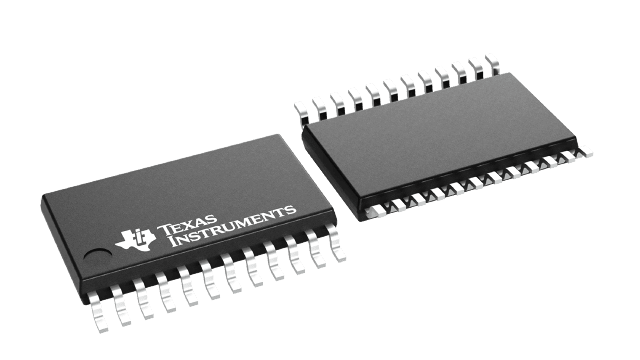
74ABT651Octal Bus Transceivers And Registers With 3-State Outputs | Integrated Circuits (ICs) | 6 | Active | These devices consist of bus-transceiver circuits, D-type flip-flops, and control circuitry arranged for multiplexed transmission of data directly from the data bus or from the internal storage registers. Output-enable (OEAB and OEBA\) inputs are provided to control the transceiver functions. The select-control (SAB and SBA) inputs are provided to select whether real-time or stored data is transferred. A low input level selects real-time data, and a high input level selects stored data. Figure 1 illustrates the four fundamental bus-management functions that can be performed with the 'ABT651 devices.
Data on the A or B bus, or both, can be stored in the internal D flip-flops by low-to-high transitions at the appropriate clock (CLKAB or CLKBA) inputs, regardless of the select- or enable-control pins. When SAB and SBA are in the real-time transfer mode, it also is possible to store data without using the internal D-type flip-flops by simultaneously enabling OEAB and OEBA\. In this configuration, each output reinforces its input. When all the other data sources to the two sets of bus lines are at high impedance, each set remains at its last state.
To ensure the high-impedance state during power up or power down, OEBA\ should be tied to VCCthrough a pullup resistor; the minimum value of the resistor is determined by the current-sinking capability of the driver (B to A). OEAB should be tied to GND through a pulldown resistor; the minimum value of the resistor is determined by the current-sourcing capability of the driver (A to B).
The SN54ABT651 is characterized for operation over the full military temperature range of -55°C to 125°C. The SN74ABT651 is characterized for operation from -40°C to 85°C.
The data output functions may be enabled or disabled by a variety of level combinations at OEAB or OEBA\. Data input functions are always enabled; i.e., data at the bus terminals is stored on every low-to-high transition of the clock inputs.
When select control is low, clocks can occur simultaneously if allowances are made for propagation delays from A to B (B to A) plus setup and hold times. When select control is high, clocks must be staggered to load both registers.
These devices consist of bus-transceiver circuits, D-type flip-flops, and control circuitry arranged for multiplexed transmission of data directly from the data bus or from the internal storage registers. Output-enable (OEAB and OEBA\) inputs are provided to control the transceiver functions. The select-control (SAB and SBA) inputs are provided to select whether real-time or stored data is transferred. A low input level selects real-time data, and a high input level selects stored data. Figure 1 illustrates the four fundamental bus-management functions that can be performed with the 'ABT651 devices.
Data on the A or B bus, or both, can be stored in the internal D flip-flops by low-to-high transitions at the appropriate clock (CLKAB or CLKBA) inputs, regardless of the select- or enable-control pins. When SAB and SBA are in the real-time transfer mode, it also is possible to store data without using the internal D-type flip-flops by simultaneously enabling OEAB and OEBA\. In this configuration, each output reinforces its input. When all the other data sources to the two sets of bus lines are at high impedance, each set remains at its last state.
To ensure the high-impedance state during power up or power down, OEBA\ should be tied to VCCthrough a pullup resistor; the minimum value of the resistor is determined by the current-sinking capability of the driver (B to A). OEAB should be tied to GND through a pulldown resistor; the minimum value of the resistor is determined by the current-sourcing capability of the driver (A to B).
The SN54ABT651 is characterized for operation over the full military temperature range of -55°C to 125°C. The SN74ABT651 is characterized for operation from -40°C to 85°C.
The data output functions may be enabled or disabled by a variety of level combinations at OEAB or OEBA\. Data input functions are always enabled; i.e., data at the bus terminals is stored on every low-to-high transition of the clock inputs.
When select control is low, clocks can occur simultaneously if allowances are made for propagation delays from A to B (B to A) plus setup and hold times. When select control is high, clocks must be staggered to load both registers. |
| Logic | 8 | Active | |
| Integrated Circuits (ICs) | 4 | Active | |
| FIFOs Memory | 10 | Obsolete | |
| FIFOs Memory | 8 | Obsolete | |
74ABT82110-Bit Bus Interface Flip-Flops With 3-State Outputs | Integrated Circuits (ICs) | 6 | Active | These 10-bit flip-flops feature 3-state outputs designed specifically for driving highly capacitive or relatively low-impedance loads. They are particularly suitable for implementing wider buffer registers, I/O ports, bidirectional bus drivers with parity, and working registers.
The ten flip-flops are edge-triggered D-type flip-flops. On the positive transition of the clock (CLK) input, the devices provide true data at the Q outputs.
A buffered output-enable (OE\) input can be used to place the ten outputs in either a normal logic state (high or low logic levels) or a high-impedance state. In the high-impedance state, the outputs neither load nor drive the bus lines significantly. The high-impedance state and increased drive provide the capability to drive bus lines without need for interface or pullup components.
OE\ does not affect the internal operations of the latch. Previously stored data can be retained or new data can be entered while the outputs are in the high-impedance state.
When VCCis between 0 and 2.1 V, the device is in the high-impedance state during power up or power down. However, to ensure the high-impedance state above 2.1 V, OE\ should be tied to VCCthrough a pullup resistor; the minimum value of the resistor is determined by the current-sinking capability of the driver.
The SN54ABT821 is characterized for operation over the full military temperature range of -55°C to 125°C. The SN74ABT821A is characterized for operation from -40°C to 85°C.
These 10-bit flip-flops feature 3-state outputs designed specifically for driving highly capacitive or relatively low-impedance loads. They are particularly suitable for implementing wider buffer registers, I/O ports, bidirectional bus drivers with parity, and working registers.
The ten flip-flops are edge-triggered D-type flip-flops. On the positive transition of the clock (CLK) input, the devices provide true data at the Q outputs.
A buffered output-enable (OE\) input can be used to place the ten outputs in either a normal logic state (high or low logic levels) or a high-impedance state. In the high-impedance state, the outputs neither load nor drive the bus lines significantly. The high-impedance state and increased drive provide the capability to drive bus lines without need for interface or pullup components.
OE\ does not affect the internal operations of the latch. Previously stored data can be retained or new data can be entered while the outputs are in the high-impedance state.
When VCCis between 0 and 2.1 V, the device is in the high-impedance state during power up or power down. However, to ensure the high-impedance state above 2.1 V, OE\ should be tied to VCCthrough a pullup resistor; the minimum value of the resistor is determined by the current-sinking capability of the driver.
The SN54ABT821 is characterized for operation over the full military temperature range of -55°C to 125°C. The SN74ABT821A is characterized for operation from -40°C to 85°C. |
| Logic | 7 | Active | |
74ABT8245Scan Test Devices With Octal Bus Transceivers | Specialty Logic | 4 | Active | The 'ABT8245 scan test devices with octal bus transceivers are members of the Texas Instruments SCOPETMtestability integrated-circuit family. This family of devices supports IEEE Standard 1149.1-1990 boundary scan to facilitate testing of complex circuit-board assemblies. Scan access to the test circuitry is accomplished via the 4-wire test access port (TAP) interface.
In the normal mode, these devices are functionally equivalent to the 'F245 and 'ABT245 octal bus transceivers. The test circuitry can be activated by the TAP to take snapshot samples of the data appearing at the device pins or to perform a self test on the boundary-test cells. Activating the TAP in normal mode does not affect the functional operation of the SCOPETMoctal bus transceivers.
Data flow is controlled by the direction-control (DIR) and output-enable () inputs. Data transmission is allowed from the A bus to the B bus or from the B bus to the A bus, depending on the logic level at DIR. The output-enable () input can be used to disable the device so that the buses are effectively isolated.
In the test mode, the normal operation of the SCOPETMbus transceivers is inhibited and the test circuitry is enabled to observe and control the I/O boundary of the device. When enabled, the test circuitry can perform boundary-scan test operations as described in IEEE Standard 1149.1-1990.
Four dedicated test pins control the operation of the test circuitry: test data input (TDI), test data output (TDO), test mode select (TMS), and test clock (TCK). Additionally, the test circuitry performs other testing functions such as parallel-signature analysis (PSA) on data inputs and pseudo-random pattern generation (PRPG) from data outputs. All testing and scan operations are synchronized to the TAP interface.
The SN54ABT8245 is characterized for operation over the full military temperature range of -55°C to 125°C. The SN74ABT8245 is characterized for operation from -40°C to 85°C.
The 'ABT8245 scan test devices with octal bus transceivers are members of the Texas Instruments SCOPETMtestability integrated-circuit family. This family of devices supports IEEE Standard 1149.1-1990 boundary scan to facilitate testing of complex circuit-board assemblies. Scan access to the test circuitry is accomplished via the 4-wire test access port (TAP) interface.
In the normal mode, these devices are functionally equivalent to the 'F245 and 'ABT245 octal bus transceivers. The test circuitry can be activated by the TAP to take snapshot samples of the data appearing at the device pins or to perform a self test on the boundary-test cells. Activating the TAP in normal mode does not affect the functional operation of the SCOPETMoctal bus transceivers.
Data flow is controlled by the direction-control (DIR) and output-enable () inputs. Data transmission is allowed from the A bus to the B bus or from the B bus to the A bus, depending on the logic level at DIR. The output-enable () input can be used to disable the device so that the buses are effectively isolated.
In the test mode, the normal operation of the SCOPETMbus transceivers is inhibited and the test circuitry is enabled to observe and control the I/O boundary of the device. When enabled, the test circuitry can perform boundary-scan test operations as described in IEEE Standard 1149.1-1990.
Four dedicated test pins control the operation of the test circuitry: test data input (TDI), test data output (TDO), test mode select (TMS), and test clock (TCK). Additionally, the test circuitry performs other testing functions such as parallel-signature analysis (PSA) on data inputs and pseudo-random pattern generation (PRPG) from data outputs. All testing and scan operations are synchronized to the TAP interface.
The SN54ABT8245 is characterized for operation over the full military temperature range of -55°C to 125°C. The SN74ABT8245 is characterized for operation from -40°C to 85°C. |
74ABT82710-ch, 4.5-V to 5.5-V buffers with TTL-compatible CMOS inputs and 3-state outputs | Logic | 7 | Active | These 10-bit buffers or bus drivers provide a high-performance bus interface for wide data paths or buses carrying parity.
The 3-state control gate is a 2-input AND gate with active-low inputs so that if either output-enable (OE1\ or OE2\) input is high, all ten outputs are in the high-impedance state. The 'ABT827 provide true data at the outputs.
When VCCis between 0 and 2.1 V, the device is in the high-impedance state during power up or power down. However, to ensure the high-impedance state above 2.1 V, OE\ should be tied to VCCthrough a pullup resistor; the minimum value of the resistor is determined by the current-sinking capability of the driver.
The SN54ABT827 is characterized for operation over the full military temperature range of -55°C to 125°C. The SN74ABT827 is characterized for operation from -40°C to 85°C.
These 10-bit buffers or bus drivers provide a high-performance bus interface for wide data paths or buses carrying parity.
The 3-state control gate is a 2-input AND gate with active-low inputs so that if either output-enable (OE1\ or OE2\) input is high, all ten outputs are in the high-impedance state. The 'ABT827 provide true data at the outputs.
When VCCis between 0 and 2.1 V, the device is in the high-impedance state during power up or power down. However, to ensure the high-impedance state above 2.1 V, OE\ should be tied to VCCthrough a pullup resistor; the minimum value of the resistor is determined by the current-sinking capability of the driver.
The SN54ABT827 is characterized for operation over the full military temperature range of -55°C to 125°C. The SN74ABT827 is characterized for operation from -40°C to 85°C. |
| Logic | 3 | Active | |