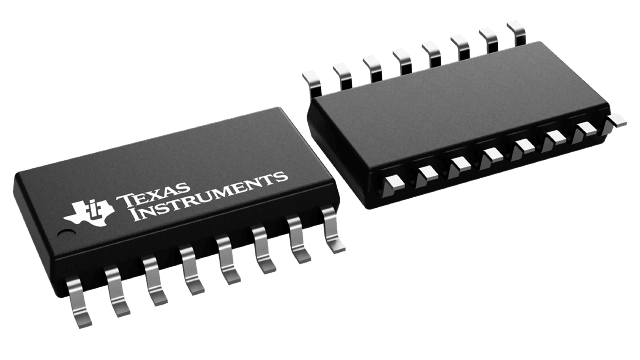
74ALS163Synchronous 4-Bit Binary Counters | Logic | 7 | Active | These synchronous, presettable, 4-bit decade and binary counters feature an internal carry look-ahead circuitry for application in high-speed counting designs. The SN54ALS162B is a 4-bit decade counter. The \x92ALS161B, \x92ALS163B, \x92AS161, and \x92AS163 devices are 4-bit binary counters. Synchronous operation is provided by having all flip-flops clocked simultaneously so that the outputs change coincidentally with each other when instructed by the count-enable (ENP, ENT) inputs and internal gating. This mode of operation eliminates the output counting spikes normally associated with asynchronous (ripple-clock) counters. A buffered clock (CLK) input triggers the four flip-flops on the rising (positive-going) edge of the clock input waveform.
These counters are fully programmable; they can be preset to any number between 0 and 9 or 15. Because presetting is synchronous, setting up a low level at the load (LOAD\) input disables the counter and causes the outputs to agree with the setup data after the next clock pulse, regardless of the levels of the enable inputs.
The clear function for the \x92ALS161B and \x92AS161 devices is asynchronous. A low level at the clear (CLR\) input sets all four of the flip-flop outputs low, regardless of the levels of the CLK, LOAD\, or enable inputs. The clear function for the SN54ALS162B, \x92ALS163B, and \x92AS163 devices is synchronous, and a low level at CLR sets all four of the flip-flop outputs low after the next clock pulse, regardless of the levels of the enable inputs. This synchronous clear allows the count length to be modified easily by decoding the Q outputs for the maximum count desired. The active-low output of the gate used for decoding is connected to CLR\ to synchronously clear the counter to 0000 (LLLL).
The carry look-ahead circuitry provides for cascading counters for n-bit synchronous applications without additional gating. ENP and ENT inputs and a ripple-carry (RCO) output are instrumental in accomplishing this function. Both ENP and ENT must be high to count, and ENT is fed forward to enable RCO. RCO, thus enabled, produces a high-level pulse while the count is maximum (9 or 15, with QAhigh). The high-level overflow ripple-carry pulse can be used to enable successive cascaded stages. Transitions at ENP or ENT are allowed, regardless of the level of CLK.
These counters feature a fully independent clock circuit. Changes at control inputs (ENP, ENT, or LOAD\) that modify the operating mode have no effect on the contents of the counter until clocking occurs. The function of the counter (whether enabled, disabled, loading, or counting) is dictated solely by the conditions meeting the stable setup and hold times.
The SN54ALS161B, SN54ALS162B, SN54ALS163B, SN54AS161, and SN54AS163 are characterized for operation over the full military temperature range of \x9655°C to 125°C. The SN74ALS161B, SN74ALS163B, SN74AS161, and SN74AS163 are characterized for operation from 0°C to 70°C.
These synchronous, presettable, 4-bit decade and binary counters feature an internal carry look-ahead circuitry for application in high-speed counting designs. The SN54ALS162B is a 4-bit decade counter. The \x92ALS161B, \x92ALS163B, \x92AS161, and \x92AS163 devices are 4-bit binary counters. Synchronous operation is provided by having all flip-flops clocked simultaneously so that the outputs change coincidentally with each other when instructed by the count-enable (ENP, ENT) inputs and internal gating. This mode of operation eliminates the output counting spikes normally associated with asynchronous (ripple-clock) counters. A buffered clock (CLK) input triggers the four flip-flops on the rising (positive-going) edge of the clock input waveform.
These counters are fully programmable; they can be preset to any number between 0 and 9 or 15. Because presetting is synchronous, setting up a low level at the load (LOAD\) input disables the counter and causes the outputs to agree with the setup data after the next clock pulse, regardless of the levels of the enable inputs.
The clear function for the \x92ALS161B and \x92AS161 devices is asynchronous. A low level at the clear (CLR\) input sets all four of the flip-flop outputs low, regardless of the levels of the CLK, LOAD\, or enable inputs. The clear function for the SN54ALS162B, \x92ALS163B, and \x92AS163 devices is synchronous, and a low level at CLR sets all four of the flip-flop outputs low after the next clock pulse, regardless of the levels of the enable inputs. This synchronous clear allows the count length to be modified easily by decoding the Q outputs for the maximum count desired. The active-low output of the gate used for decoding is connected to CLR\ to synchronously clear the counter to 0000 (LLLL).
The carry look-ahead circuitry provides for cascading counters for n-bit synchronous applications without additional gating. ENP and ENT inputs and a ripple-carry (RCO) output are instrumental in accomplishing this function. Both ENP and ENT must be high to count, and ENT is fed forward to enable RCO. RCO, thus enabled, produces a high-level pulse while the count is maximum (9 or 15, with QAhigh). The high-level overflow ripple-carry pulse can be used to enable successive cascaded stages. Transitions at ENP or ENT are allowed, regardless of the level of CLK.
These counters feature a fully independent clock circuit. Changes at control inputs (ENP, ENT, or LOAD\) that modify the operating mode have no effect on the contents of the counter until clocking occurs. The function of the counter (whether enabled, disabled, loading, or counting) is dictated solely by the conditions meeting the stable setup and hold times.
The SN54ALS161B, SN54ALS162B, SN54ALS163B, SN54AS161, and SN54AS163 are characterized for operation over the full military temperature range of \x9655°C to 125°C. The SN74ALS161B, SN74ALS163B, SN74AS161, and SN74AS163 are characterized for operation from 0°C to 70°C. |
74ALS165Parallel-Load 8-Bit Serial Shift Registers | Logic | 3 | Active | The 'ALS165 are parallel-load 8-bit serial shift registers that, when clocked, shift the data toward serial (QHand Q\H) outputs. Parallel-in access to each stage is provided by eight individual direct data (A-H) inputs that are enabled by a low level at the shift/load (SH/LD\) input. The 'ALS165 have a clock-inhibit function and complemented serial outputs.
Clocking is accomplished by a low-to-high transition of the clock (CLK) input while SH/LD\ is held high and the clock inhibit (CLK INH) input is held low. The functions of CLK and CLK INH are interchangeable. Since a low CLK and a low-to-high transition of CLK INH also accomplishes clocking, CLK INH should be changed to the high level only while CLK is high. Parallel loading is inhibited when SH/LD\ is held high. The parallel inputs to the register are enabled while SH/LD\ is low independently of the levels of the CLK, CLK INH, or serial (SER) inputs.
The SN54ALS165 is characterized for operation over the full military temperature range of -55°C to 125°C. The SN74ALS165 is characterized for operation from 0°C to 70°C.
The 'ALS165 are parallel-load 8-bit serial shift registers that, when clocked, shift the data toward serial (QHand Q\H) outputs. Parallel-in access to each stage is provided by eight individual direct data (A-H) inputs that are enabled by a low level at the shift/load (SH/LD\) input. The 'ALS165 have a clock-inhibit function and complemented serial outputs.
Clocking is accomplished by a low-to-high transition of the clock (CLK) input while SH/LD\ is held high and the clock inhibit (CLK INH) input is held low. The functions of CLK and CLK INH are interchangeable. Since a low CLK and a low-to-high transition of CLK INH also accomplishes clocking, CLK INH should be changed to the high level only while CLK is high. Parallel loading is inhibited when SH/LD\ is held high. The parallel inputs to the register are enabled while SH/LD\ is low independently of the levels of the CLK, CLK INH, or serial (SER) inputs.
The SN54ALS165 is characterized for operation over the full military temperature range of -55°C to 125°C. The SN74ALS165 is characterized for operation from 0°C to 70°C. |
74ALS1694-Bit Synchronous Up/Down Binary Counters | Counters, Dividers | 2 | Active | These synchronous 4-bit up/down binary presettable counters feature an internal carry look-ahead circuitry for cascading in high-speed counting applications. Synchronous operation is provided by having all flip-flops clocked simultaneously so that the outputs change coincident with each other when so instructed by the count-enable (,) inputs and internal gating. This mode of operation eliminates the output counting spikes normally associated with asynchronous (ripple-clock) counters. A buffered clock (CLK) input triggers the four flip-flops on the rising (positive-going) edge of the clock waveform.
These counters are fully programmable; that is, they may be preset to either level. The load-input circuitry allows loading with the carry-enable output of cascaded counters. Because loading is synchronous, setting up a low level at the load (LOAD\) input disables the counter and causes the outputs to agree with the data inputs after the next clock pulse.
The internal carry look-ahead circuitry provides for cascading counters for n-bit synchronous application without additional gating.andinputs and a ripple-carry output () are instrumental in accomplishing this function. Bothandmust be low to count. The direction of the count is determined by the level of the up/down (U/D\) input. When U/D\ is high, the counter counts up; when low, it counts down.is fed forward to enable., thus enabled, produces a low-level pulse while the count is zero (all inputs low) counting down or maximum (15) counting up. This low-level overflow ripple-carry pulse can be used to enable successive cascaded stages. Transitions atorare allowed regardless of the level of the clock input. All inputs are diode clamped to minimize transmission-line effects, thereby simplifying system design.
These counters feature a fully independent clock circuit. Changes at control inputs (,,, or U/D\) that modify the operating mode have no effect on the contents of the counter until clocking occurs. The function of the counter (whether enabled, disabled, loading, or counting) is dictated solely by the conditions meeting the stable setup and hold times.
The SN54ALS169B and SN54AS169A are characterized for operation over the full military temperature range of -55°C to 125°C. The SN74ALS169B and SN74AS169A are characterized for operation from 0°C to 70°C.
These synchronous 4-bit up/down binary presettable counters feature an internal carry look-ahead circuitry for cascading in high-speed counting applications. Synchronous operation is provided by having all flip-flops clocked simultaneously so that the outputs change coincident with each other when so instructed by the count-enable (,) inputs and internal gating. This mode of operation eliminates the output counting spikes normally associated with asynchronous (ripple-clock) counters. A buffered clock (CLK) input triggers the four flip-flops on the rising (positive-going) edge of the clock waveform.
These counters are fully programmable; that is, they may be preset to either level. The load-input circuitry allows loading with the carry-enable output of cascaded counters. Because loading is synchronous, setting up a low level at the load (LOAD\) input disables the counter and causes the outputs to agree with the data inputs after the next clock pulse.
The internal carry look-ahead circuitry provides for cascading counters for n-bit synchronous application without additional gating.andinputs and a ripple-carry output () are instrumental in accomplishing this function. Bothandmust be low to count. The direction of the count is determined by the level of the up/down (U/D\) input. When U/D\ is high, the counter counts up; when low, it counts down.is fed forward to enable., thus enabled, produces a low-level pulse while the count is zero (all inputs low) counting down or maximum (15) counting up. This low-level overflow ripple-carry pulse can be used to enable successive cascaded stages. Transitions atorare allowed regardless of the level of the clock input. All inputs are diode clamped to minimize transmission-line effects, thereby simplifying system design.
These counters feature a fully independent clock circuit. Changes at control inputs (,,, or U/D\) that modify the operating mode have no effect on the contents of the counter until clocking occurs. The function of the counter (whether enabled, disabled, loading, or counting) is dictated solely by the conditions meeting the stable setup and hold times.
The SN54ALS169B and SN54AS169A are characterized for operation over the full military temperature range of -55°C to 125°C. The SN74ALS169B and SN74AS169A are characterized for operation from 0°C to 70°C. |