A
Analog Devices
| Series | Category | # Parts | Status | Description |
|---|---|---|---|---|
| Part | Spec A | Spec B | Spec C | Spec D | Description |
|---|---|---|---|---|---|



| Series | Category | # Parts | Status | Description |
|---|---|---|---|---|
| Part | Spec A | Spec B | Spec C | Spec D | Description |
|---|---|---|---|---|---|
| Series | Category | # Parts | Status | Description |
|---|---|---|---|---|
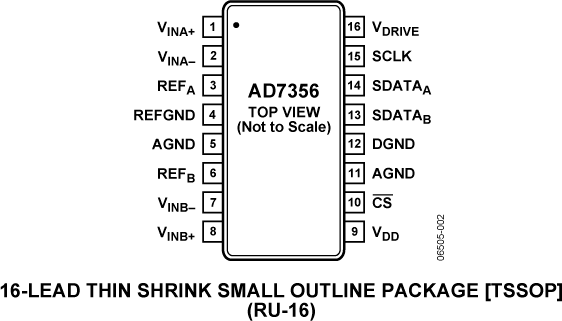
AD7356Differential Input, Dual, Simultaneous Sampling, 5 MSPS, 12-Bit, SAR ADC | Data Acquisition | 4 | Active | The AD7356 is a dual, 12-bit, high speed, low power, successive approximation ADC that operates from a single 2.5 V power supply and features throughput rates up to 5 MSPS. The part contains two ADCs, each preceded by a low noise, wide bandwidth track-and-hold circuit that can handle input frequencies in excess of 110 MHz.The conversion process and data acquisition use standard control inputs allowing for easy interfacing to microprocessors or DSPs. The input signal is sampled on the falling edge ofCS; a conversion is also initiated at this point. The conversion time is determined by the SCLK frequency.The AD7356 uses advanced design techniques to achieve very low power dissipation at high throughput rates. With a 2.5 V supply and a 5 MSPS throughput rate, the part consumes typically 14 mA. The part also offers a flexible power/throughput rate management option.The analog input range for the part is the differential common mode ±VREF/2. The AD7356 has an on-chip 2.048 V reference that can be overdriven when an external reference is preferred.The AD7356 is available in a 16-lead thin shrink small outline package (TSSOP).PRODUCT HIGHLIGHTSTwo Complete ADC Functions.These functions allow simultaneous sampling and conversion of two channels. The conversion result of both channels is simultaneously available on separate data lines or in succession on one data line if only one serial port is available.High Throughput with Low Power Consumption.The AD7356 offers a 5 MSPS throughput rate with 36 mW power consumption.No Conversion Latency.The AD7356 features two standard successive approximation ADCs with accurate control of the sampling instant via aCSinput and, once off, conversion control.APPLICATIONSData acquisition systemsMotion controlI and Q demodulation |
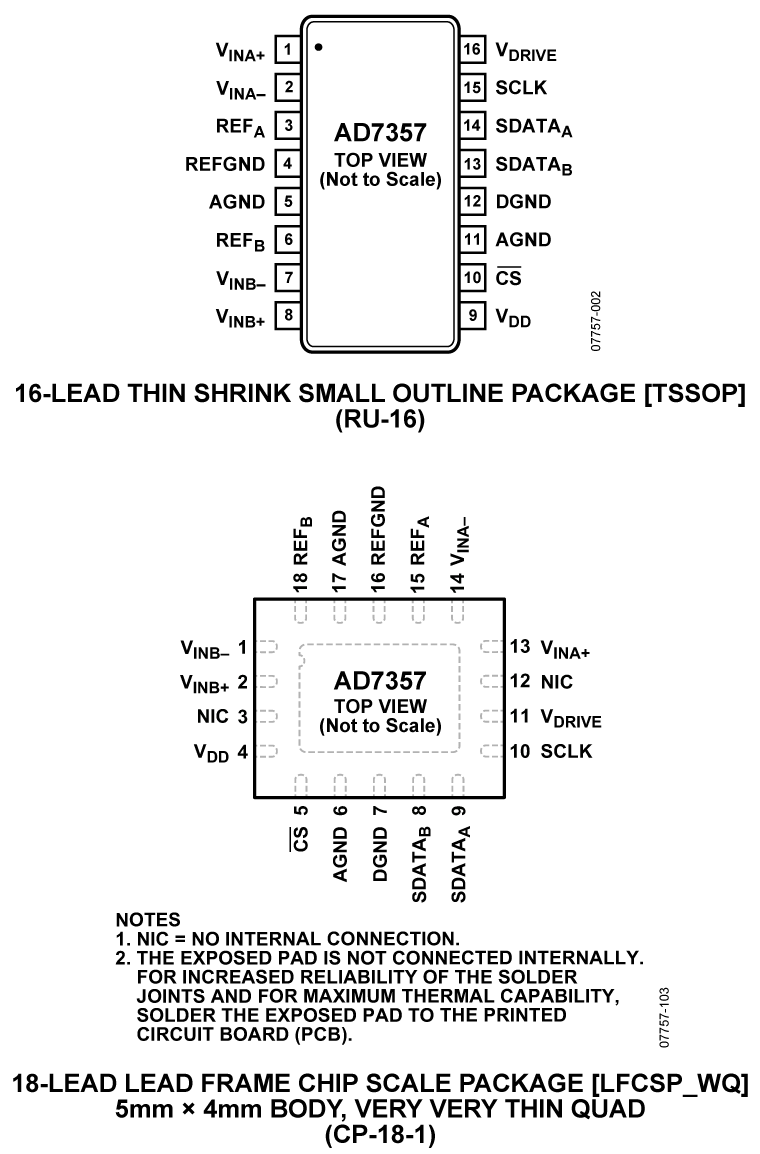
AD7357Differential Input, Dual, Simultaneous Sampling, 4.25 MSPS, 14-Bit, SAR ADC | Analog to Digital Converters (ADC) | 4 | Active | The AD7357 is a dual, 14-bit, high speed, low power, successive approximation ADC that operates from a single 2.5 V power supply and features throughput rates of up to 4.2 MSPS. The part contains two ADCs, each preceded by a low noise, wide bandwidth track-and-hold circuit that can handle input frequencies in excess of 110 MHz.The conversion process and data acquisition use standard control inputs allowing for easy interfacing to microprocessors or DSPs. The input signal is sampled on the falling edge ofCS; conversion is also initiated at this point. The conversion time is determined by the SCLK frequency.The AD7357 uses advanced design techniques to achieve very low power dissipation at high throughput rates. With a 2.5 V supply and a 4.2 MSPS throughput rate, the device consumes 14 mA typically. The part also offers flexible power/throughput rate management when operating in normal mode as the quiescent current consumption is so low.The analog input range for the device is the differential common mode ±VREF/2. The AD7357 has an on-chip 2.048 V reference that can be overdriven when an external reference is preferred.The AD7357 is available in a 16-lead thin shrink small outline package (TSSOP) and an 18-lead lead frame chip scale package (LFCSP).PRODUCT HIGHLIGHTSTwo Complete ADC Functions.These functions allow simultaneous sampling and conversion of two channels. The conversion result of both channels is simultaneously available on separate data lines or in succession on one data line if only one serial port is available.High Throughput with Low Power Consumption.The AD7357 offers a 4.2 MSPS throughput rate with 36 mW power consumption.Simultaneous Sampling.The part features two standard successive approximation ADCs with accurate control of the sampling instant via aCSinput and once off conversion control.APPLICATIONSAutomotive radarData acquisition systemsMotion controlI and Q demodulationRFID readers |
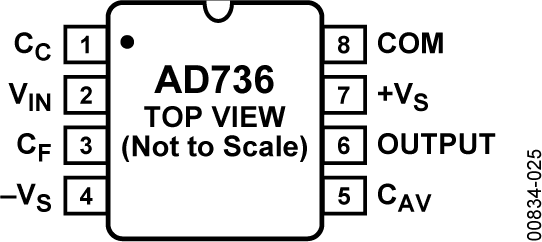
AD736Low Cost, Low Power, True RMS-to-DC Converter | Evaluation and Demonstration Boards and Kits | 11 | Active | The AD736 is a low power, precision, monolithic true rms-to-dc converter. It is laser trimmed to provide a maximum error of ±0.3 mV ± 0.3% of reading with sine wave inputs. Furthermore, it maintains high accuracy while measuring a wide range of input waveforms, including variable duty-cycle pulses and triac (phase)-controlled sine waves. The low cost and small size of this converter make it suitable for upgrading the performance of non-rms precision rectifiers in many applications. Compared to these circuits, the AD736 offers higher accuracy at an equal or lower cost.The AD736 can compute the rms value of both ac and dc input voltages. It can also be operated as an ac-coupled device by adding one external capacitor. In this mode, the AD736 can resolve input signal levels of 100 μV rms or less, despite variations in temperature or supply voltage. High accuracy is also maintained for input waveforms with crest factors of 1 to 3. In addition, crest factors as high as 5 can be measured (introducing only 2.5% additional error) at the 200 mV full-scale input level.The AD736 has its own output buffer amplifier, thereby pro-viding a great deal of design flexibility. Requiring only 200 μA of power supply current, the AD736 is optimized for use in portable multimeters and other battery-powered applications.The AD736 allows the choice of two signal input terminals: a high impedance FET input (1012Ω) that directly interfaces with High-Z input attenuators and a low impedance input (8 kΩ) that allows the measurement of 300 mV input levels while operating from the minimum power supply voltage of +2.8 V, −3.2 V. The two inputs can be used either single ended or differentially.The AD736 has a 1% reading error bandwidth that exceeds 10 kHz for the input amplitudes from 20 mV rms to 200 mV rms while consuming only 1 mW.The AD736 is available in four performance grades. The AD736J and AD736K grades are rated over the 0°C to +70°C and −20°C to +85°C commercial temperature ranges. The AD736A and AD736B grades are rated over the −40°C to +85°C industrial temperature range. The AD736 is available in three low cost, 8-lead packages: PDIP, SOIC, and CERDIP.PRODUCT HIGHLIGHTSThe AD736 is capable of computing the average rectified value, absolute value, or true rms value of various input signals.Only one external component, an averaging capacitor, is required for the AD736 to perform true rms measurement.The low power consumption of 1 mW makes the AD736 suitable for many battery-powered applications.A high input impedance of 1012Ω eliminates the need for an external buffer when interfacing with input attenuators.A low impedance input is available for those applications that require an input signal up to 300 mV rms operating from low power supply voltages. |
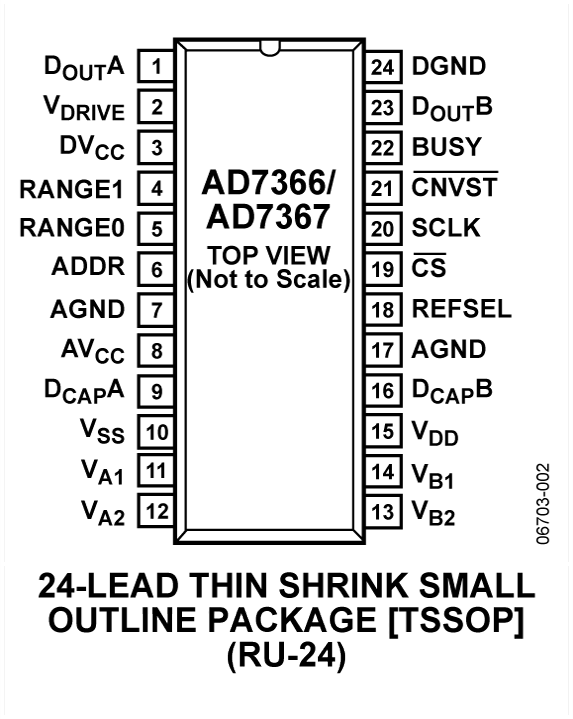
AD7366True Bipolar Input, Dual 12-Bit, 2-Channel, Simultaneous Sampling SAR ADC | Evaluation Boards | 3 | Active | The AD7366 /AD7367are dual 12-bit/14-bit, high speed, low power, successive approximation analog-to-digital converters (ADCs) that feature throughput rates up to 1 MSPS. The device contains two ADCs, each preceded by a 2-channel multiplexer, and a low noise, wide bandwidth track-and-hold amplifier.The AD7366 / AD7367 are fabricated on the Analog Devices, Inc., industrial CMOS process (iCMOS), which is a technology platform combining the advantages of low and high voltage CMOS. TheiCMOS process allows the AD7366 / AD7367 to accept high voltage bipolar signals in addition to reducing power consumption and package size. The AD7366 / AD7367 can accept true bipolar analog input signals in the ±10 V range, ±5 V range, and 0 V to 10 V range.The AD7366 / AD7367 have an on-chip 2.5 V reference that can be disabled to allow the use of an external reference. If a 3 V reference is applied to the DCAPA and DCAPB pins, the AD7366 / AD7367 can accept a true bipolar ±12 V analog input. Minimum ±12 V VDDand VSSsupplies are required for the ±12 V input range.PRODUCT HIGHLIGHTSThe AD7366/AD7367 can accept true bipolar analog input signals, as well as ±10 V, ±5 V, ±12 V (with external reference), and 0 V to 10 V unipolar signals.Two complete ADC functions allow simultaneous sampling and conversion of two channels.1 MSPS serial interface: SPI-/QSPI-/DSP-/MICROWIRE-compatible interface. |
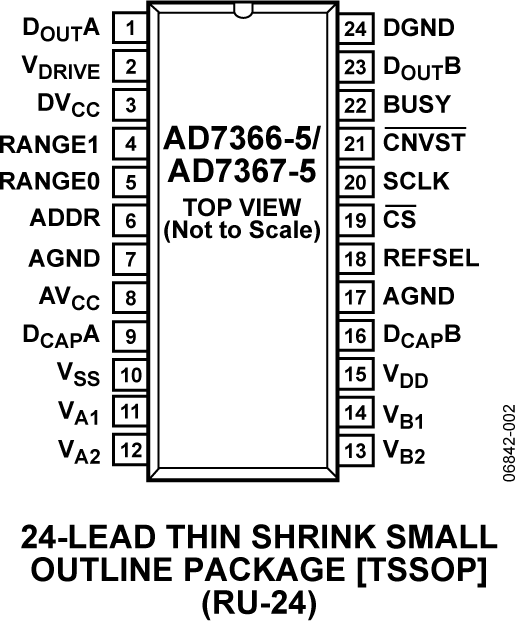
AD7367-5True Bipolar Input, 14-Bit, 2-Channel, Simultaneous Sampling SAR ADC | Integrated Circuits (ICs) | 4 | Active | TheAD7366-5/ AD7367-5 are dual, 12-/14-bit, low power, successive approximation analog-to-digital converters (ADCs) that feature throughput rates up to 500 kSPS. Each device contains two ADCs, which are both preceded by a 2-channel multiplexer, and a low noise, wide bandwidth, track-and-hold amplifier.The AD7366-5 / AD7367-5 are fabricated on the Analog Devices, Inc., industrial CMOS process (iCMOS®), which is a technology platform combining the advantages of low and high voltage CMOS. The process allows the parts to accept high voltage bipolar signals in addition to reducing power consumption and package size. The AD7366-5 / AD7367-5 can accept true bipolar analog input signals in the ±10 V range, ±5 V range, and 0 V to +10 V range.The devices have an on-chip 2.5 V reference that can be disabled to allow the use of an external reference. If a 3 V reference is applied to the DCAPA and DCAPB pins, the AD7366-5 / AD7367-5 can accept a true bipolar ±12 V analog input. Minimum ±12 V VDDand VSSsupplies are required for the ±12 V input range.PRODUCT HIGHLIGHTSTrue bipolar analog input signals can be accepted, as well as ±10 V, ±5 V, ±12 V (with external reference), and 0 V to +10 V unipolar signals.Two complete ADC functions allow simultaneous sampling and conversion of two channels.A 500 kSPS serial interface is SPI-/QSPI™-/MICROWIRE™-/ DSP-compatible. |
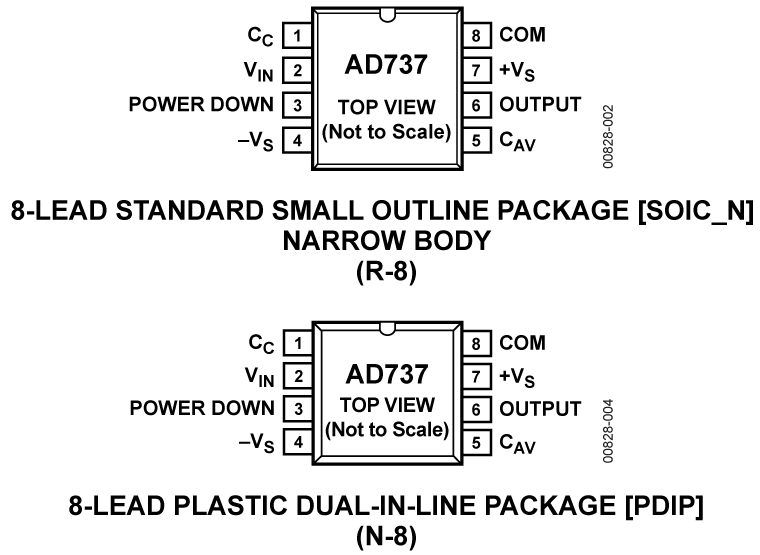
AD737Low Cost, Low Power, True RMS-to-DC Converter | Evaluation Boards | 19 | Active | The AD737 is a low power, precision, monolithic, true rms-to-dc converter. It is laser trimmed to provide a maximum error of ±0.2 mV ± 0.3% of reading with sine wave inputs. Furthermore, it maintains high accuracy while measuring a wide range of input waveforms, including variable duty cycle pulses and triac (phase) controlled sine waves. The low cost and small physical size of this converter make it suitable for upgrading the performance of non-rms precision rectifiers in many applications. Compared to these circuits, the AD737 offers higher accuracy at equal or lower cost.The AD737 computes the rms value of both the ac and dc input voltages, and is ac-coupled by adding an input capacitor. In this mode, the AD737 can resolve input signal levels of 100 μV rms or less, despite variations in temperature or supply voltage. High accuracy is maintained for input waveforms with crest factors of 1 to 3 and crest factors at 2.5% or less with respect to full-scale input level.The AD737 has no output buffer amplifier, thereby significantly reducing dc offset errors occurring at the output, which makes the device highly compatible with high input impedance ADCs.Requiring only 160 μA of power supply current, the AD737 is optimized for use in portable multimeters and other battery-powered applications. In power-down mode, the standby supply current in is typically 25 μA.The AD737 has both high (1012Ω) and low impedance input options. The high-Z FET input connects high source impedance input attenuators, and a low impedance (8 kΩ) input accepts rms voltages of up to 0.9 V while operating from the minimum power supply voltage of ±2.5 V. The two inputs can be used either single ended or differentially.The AD737 achieves 1% of reading error bandwidth, exceeding 10 kHz for input amplitudes from 20 mV rms to 200 mV rms, while consuming only 0.72 mW.The AD737 is available in two performance grades. The AD737J and AD737K grades operate over the commercial temperature range of 0°C to 70°C. The AD737JR-5 is tested with supply voltages of ±2.5 V dc. The AD737A grade operates over the industrial temperature range of −40°C to +85°C. The AD737 is available in two low cost, 8-lead packages: PDIP and SOIC_N.PRODUCT HIGHLIGHTSComputes average rectified, absolute, or true rms value of a signal regardless of waveform.Only one external component, an averaging capacitor, is required for the AD737 to perform true rms measurement.The standby power consumption of 125 μW makes the AD737 suitable for battery-powered applications. |
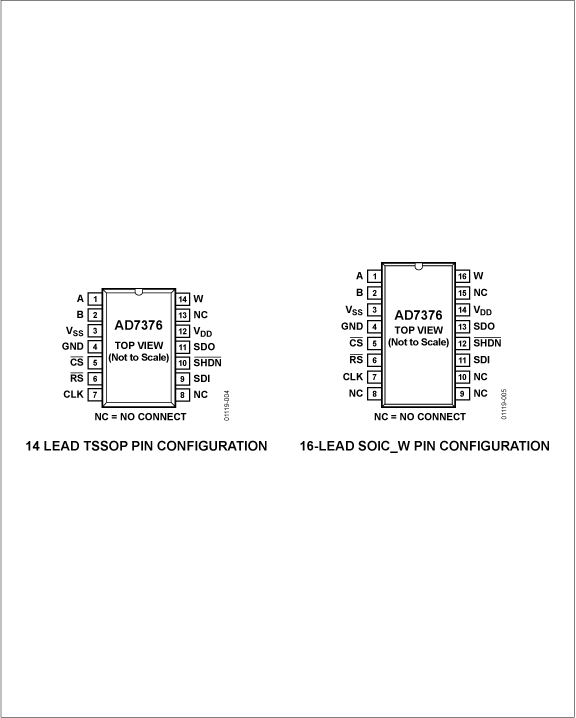
AD7376+30 V/±15 V Operation 128-Position Digital Potentiometer | Evaluation and Demonstration Boards and Kits | 7 | Active | The AD7376 is one of the few high voltage, high performance digital potentiometers on the market. This device can be used as a programmable resistor or resistor divider. The AD7376 performs the same electronic adjustment function as mechanical potentiometers, variable resistors, and trimmers with enhanced resolution, solid-state reliability, and programmability. With digital rather than manual control, the AD7376 provides layout flexibility and allows closed-loop dynamic controllability.The AD7376 features sleep-mode programmability in shutdown that can be used to program the preset before device activation, thus providing an alternative to costly EEPROM solutions.The AD7376 is available in 14-lead TSSOP and 16-lead wide body SOIC packages in 10 kΩ, 50 kΩ, and 100 kΩ options. All parts are guaranteed to operate over the −40°C to +85°C extended industrial temperature range.APPLICATIONSHigh voltage DACProgrammable power supplyProgrammable gain and offset adjustmentProgrammable filters, delaysActuator controlAudio volume controlMechanical potentiometer replacement |
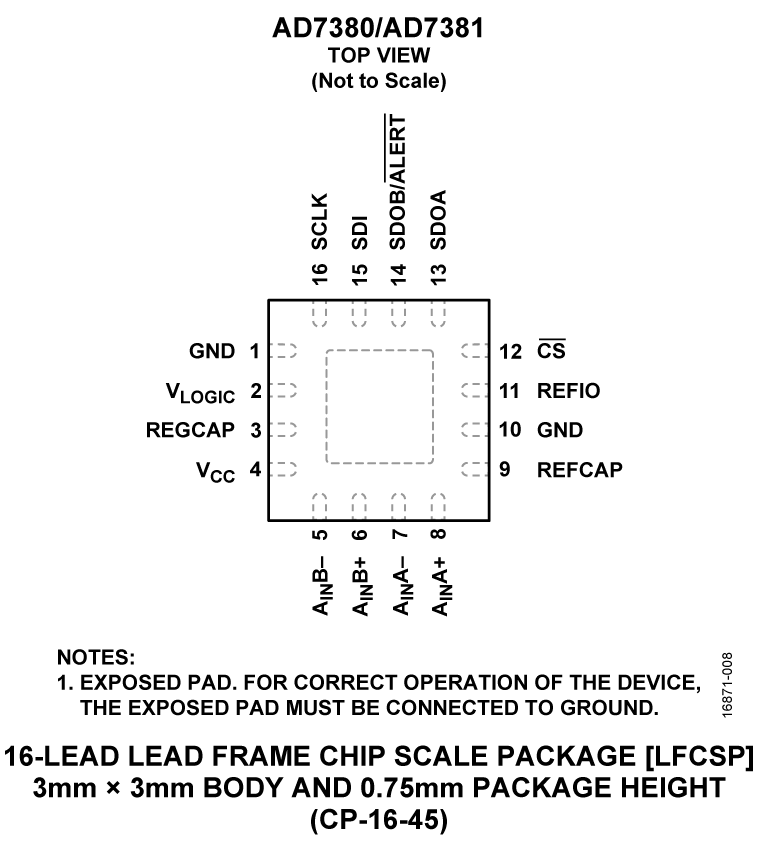
AD73804MSPS Dual Simultaneous Sampling, 16-BIT SAR ADC, Differential Input | Evaluation Boards | 3 | Active | The AD7380/AD7381 are a 16-bit and 14-bit pin-compatible family of dual simultaneous sampling, high speed, low power, successive approximation register (SAR) analog-to-digital converters (ADCs) that operate from a 3.0 V to 3.6 V power supply and feature throughput rates up to 4 MSPS. The analog input type is differential, accepts a wide common-mode input voltage, and is sampled and converted on the falling edge ofCS.An integrated on-chip oversampling block improves dynamic range and reduces noise at lower bandwidths. A buffered internal 2.5 V reference is included. Alternatively, an external reference up to 3.3 V can be used.The conversion process and data acquisition use standard control inputs allowing simple interfacing to microprocessors or digital signal processors (DSPs). The device is compatible with 1.8 V, 2.5 V, and 3.3 V interfaces using the separate logic supply.The AD7380/AD7381 are available in a 16-lead lead frame chip scale package (LFCSP) with operation specified from −40°C to +125°C.Product highlightsDual simultaneous sampling and conversion with two complete ADC functions.Pin-compatible product family.High 4 MSPS throughput rate.Space saving 3 mm × 3 mm LFCSP.An integrated oversampling block to increase dynamic range, reduce noise, and reduce SCLK speed requirements.Differential analog inputs with wide common-mode range.Small sampling capacitor reduces amplifier drive burden.ApplicationsMotor control position feedbackMotor control current senseSonarPower qualityData acquisition systemsErbium doped fiber amplifier (EDFA) applicationsI and Q demodulation |
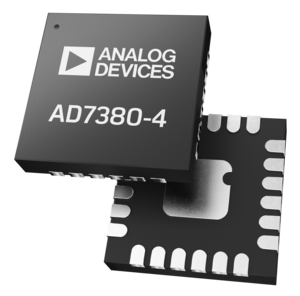
AD7380-4Differential Input, Quad, External Reference Simultaneous Sampling, 16-Bit, SAR ADC | Analog to Digital Converters (ADC) | 2 | Active | The AD7380-4 is a 16-bit compatible, quad, simultaneous sampling, high speed, successive approximation register (SAR), analog-to-digital converters (ADC) operating from a 3.3 V power supply with throughput rates up to 4 MSPS. The differential analog input accepts a wide common-mode input voltage and is sampled and converted on the falling edge ofCS.The AD7380-4 has on-chip oversampling blocks to improve dynamic range and reduce noise at lower bandwidths. The oversampling can boost up to two bits of added resolution. The REFIN pin can have a reference voltage of 2.5 V to 3.3 V.The conversion process and data acquisition use standard control inputs allowing easy interfacing to microprocessors or digital signal processors (DSPs). The conversion result can clock out simultaneously via 4-wire mode for faster throughput, or via 1-wire serial mode when slower throughput is allowed. The device is compatible with 1.8 V, 2.5 V, and 3.3 V interfaces using the separate logic supply.The AD7380-4 is available in a 24-lead lead frame chip scale package (LFCSP) and operates over a temperature range of −40°C to +125°C.ApplicationsMotor control position feedbackMotor control current senseData acquisition systemsErbium doped fiber amplifier (EDFA) applicationsIn phase and quadrature demodulationProduct HighlightsQuad simultaneous sampling and conversionPin-compatible product family.High throughput rate, 4 MSPS at 16-bit.Space-saving, 4 mm × 4 mm LFCSP.Integrated oversampling block to increase dynamic range, reduce noise and reduce SCLK speed requirements.Differential analog inputs with wide common-mode range.Small sampling capacitor reduces amplifier drive burden. |
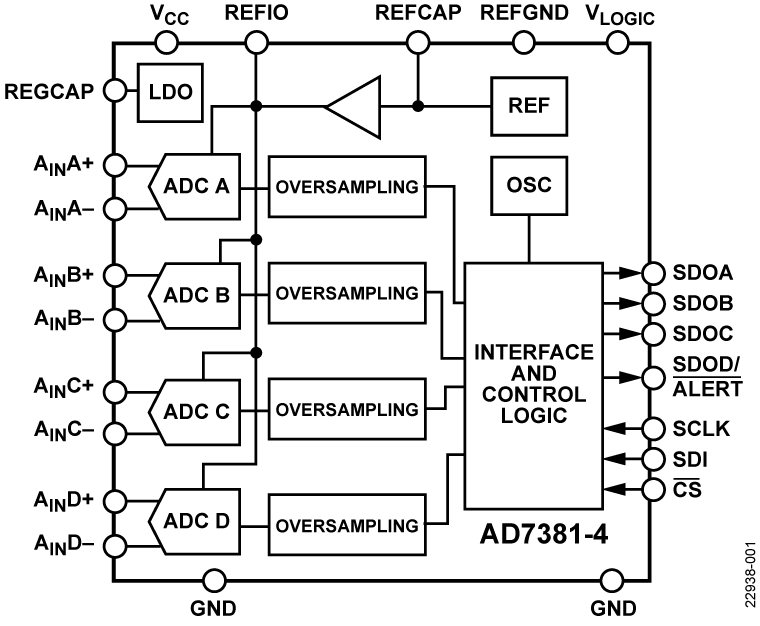
AD7381-4Differential Input, Quad,14-Bit, Simultaneous Sampling, SAR ADC | Analog to Digital Converters (ADC) | 3 | Active | The AD7381-4 a 16-bit, quad, simultaneous sampling, high speed, successive approximation register (SAR), analog-to-digital converter (ADC) that operates from a 3.0 V to 3.6 V power supply and features throughput rates up to 4 MSPS. The analog input type is differential, accepts a wide common-mode input voltage, and the analog inputs are sampled and converted on the falling edge ofCS.The AD7381-4 has on-chip oversampling blocks to improve dynamic range and reduce noise at lower bandwidths. The oversampling can boost up to two bits of added resolution. A buffered internal 2.5 V reference (10 ppm/°C) is included. Alternatively, an external reference up to 3.3 V can be used.The conversion process and data acquisition use standard control inputs allowing for easy interfacing to microprocessors or digital signal processors (DSPs). The conversion result can clock out simultaneously via 4-wire mode for faster throughput or via 1-wire serial mode when slower throughput is allowed. The device is compatible with 1.8 V, 2.5 V, and 3.3 V interfaces, using the separate logic supply.APPLICATIONSMotor control position feedbackMotor control current senseData acquisition systemsErbium doped fiber amplifier (EDFA) applicationsIn phase and quadrature demodulationPRODUCT HIGHLIGHTSQuad simultaneous sampling and conversion.Pin-compatible product family.High throughput rate, 4 MSPS at 14-bit.Space-saving, 4 mm × 4 mm LFCSP.Integrated oversampling block to increase dynamic range, reduce noise and reduce SCLK speed requirements.Differential analog inputs with wide common-mode range.Small sampling capacitor reduces amplifier drive burden. |
| Part | Category | Description |
|---|---|---|
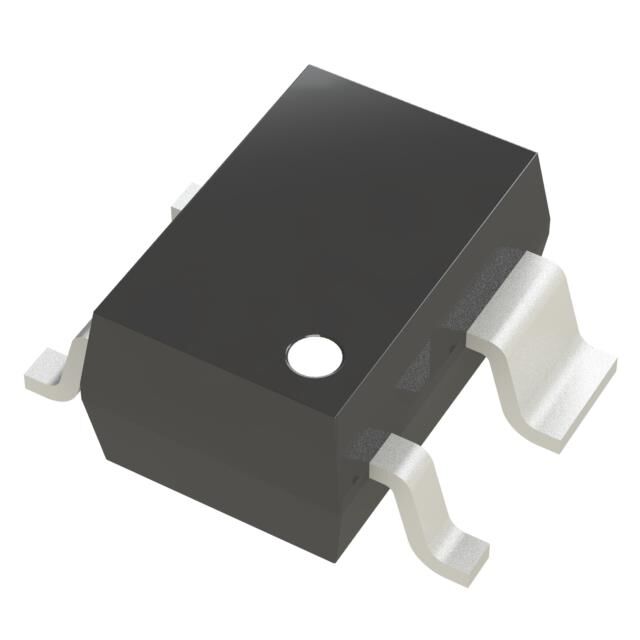 Analog Devices ADM6713RAKSZ-REELObsolete | Integrated Circuits (ICs) | IC SUPERVISOR 1 CHANNEL SC70-4 |
Analog Devices | RF and Wireless | RF AMP SINGLE GENERAL PURPOSE RF AMPLIFIER 20GHZ 3.6V 22-PIN DIE TRAY |
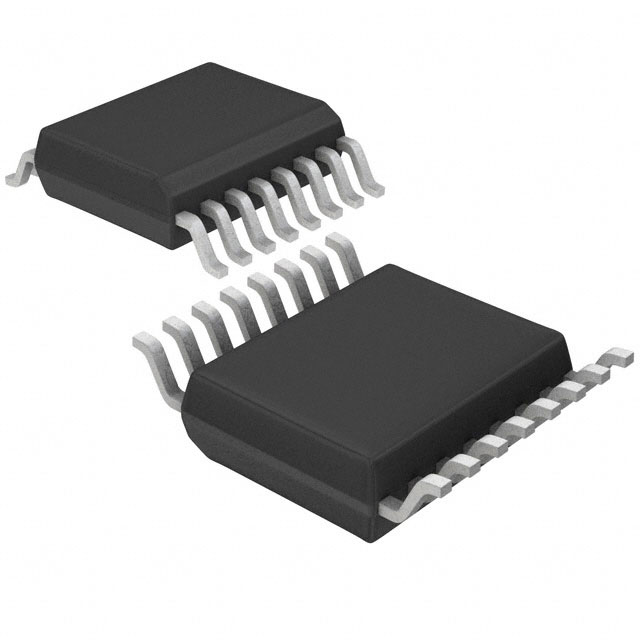 Analog Devices | Integrated Circuits (ICs) | LOW NOISE, SWITCHED CAPACITOR REGULATED VOLTAGE INVERTERS |
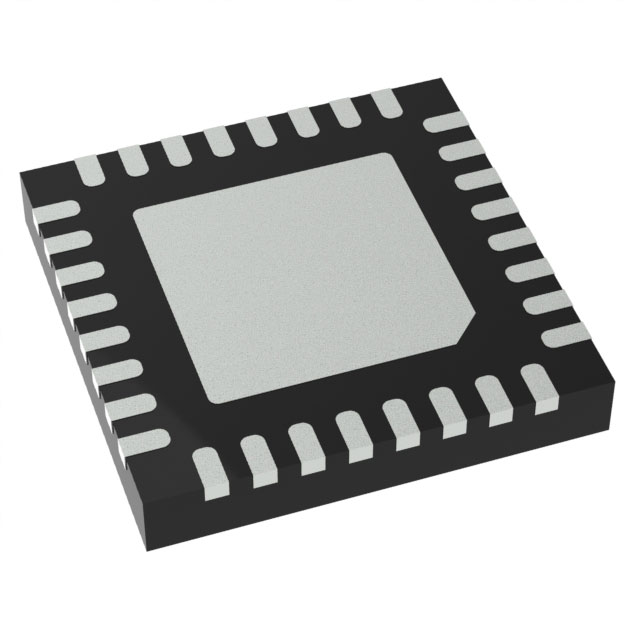 Analog Devices | Integrated Circuits (ICs) | QUAD 16-BIT/12-BIT ±10V VOUTSOFTSPAN DACS WITH 10PPM/°C MAX REFERENCE |
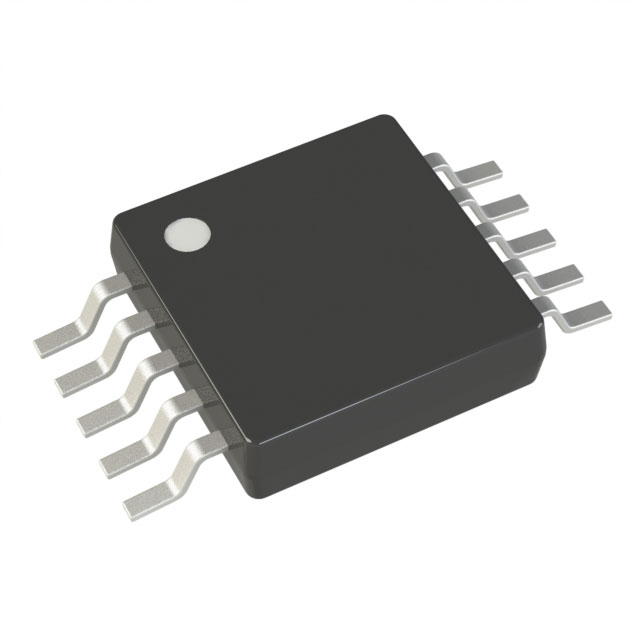 Analog Devices | Integrated Circuits (ICs) | SERIAL 14-BIT, 3.5MSPS SAMPLING ADC WITH BIPOLAR INPUTS |
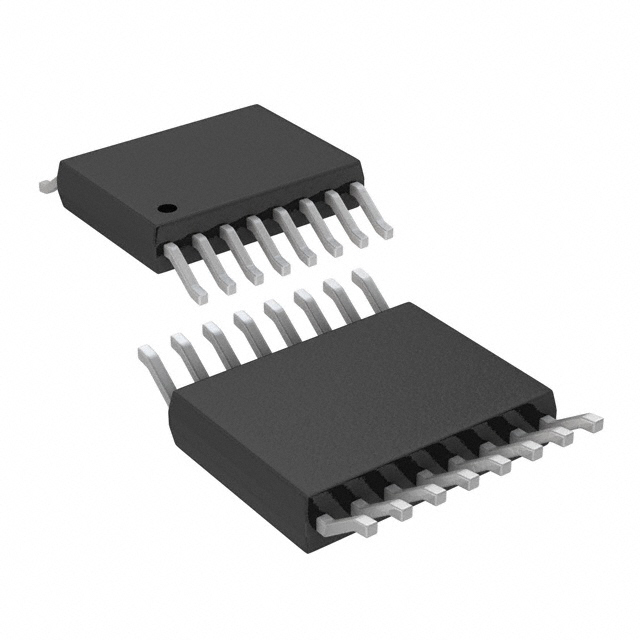 Analog Devices | Integrated Circuits (ICs) | ISOSPI ISOLATED COMMUNICATIONS INTERFACE |
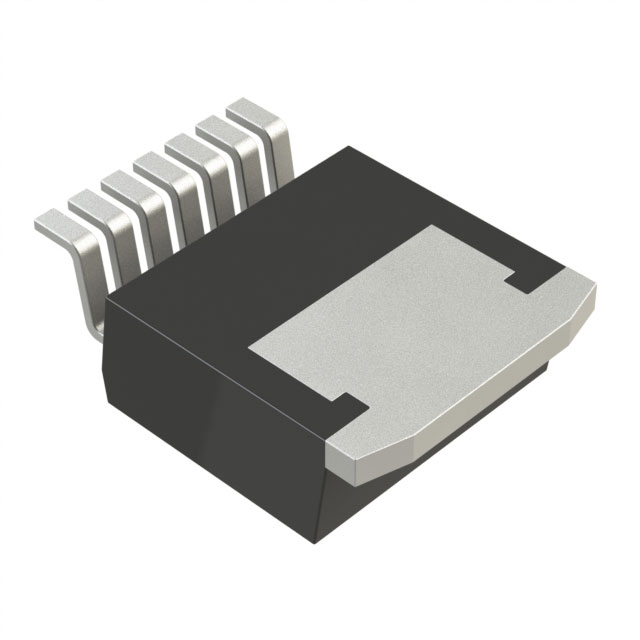 Analog Devices | Integrated Circuits (ICs) | 4.5A, 500KHZ STEP-DOWN SWITCHING REGULATOR |
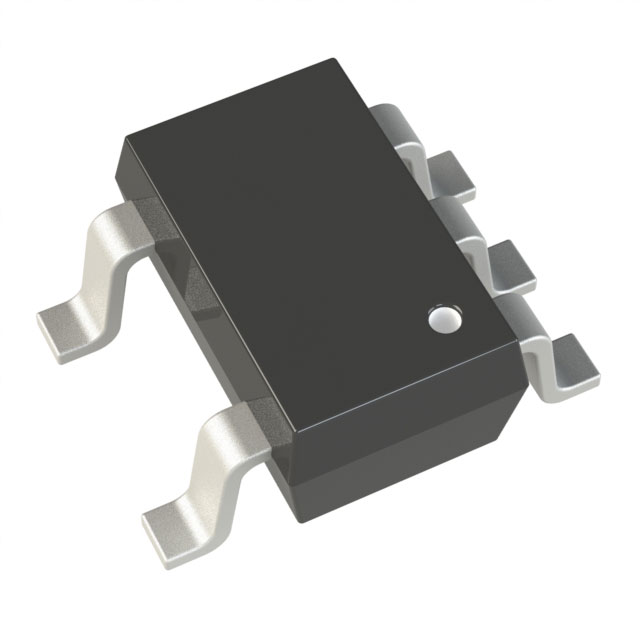 Analog Devices | Integrated Circuits (ICs) | 300 MA, LOW QUIESCENT CURRENT, ADJUSTABLE OUTPUT, CMOS LINEAR REGULATOR |
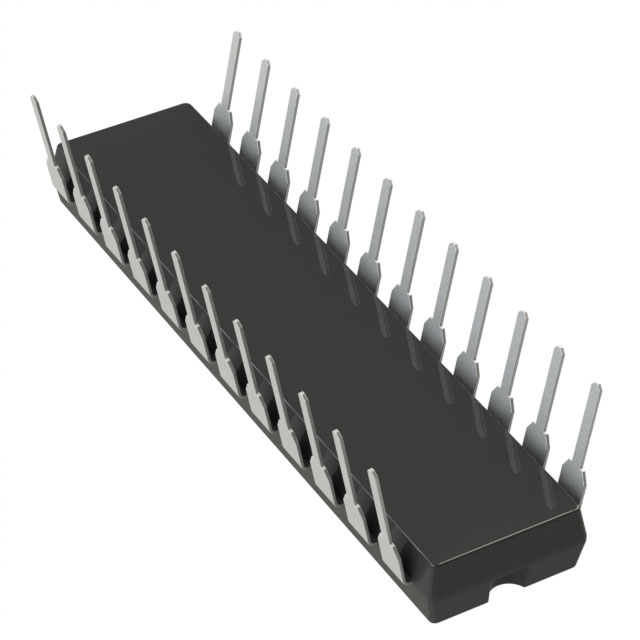 Analog Devices AD767KNObsolete | Integrated Circuits (ICs) | IC DAC 12BIT V-OUT 24DIP |
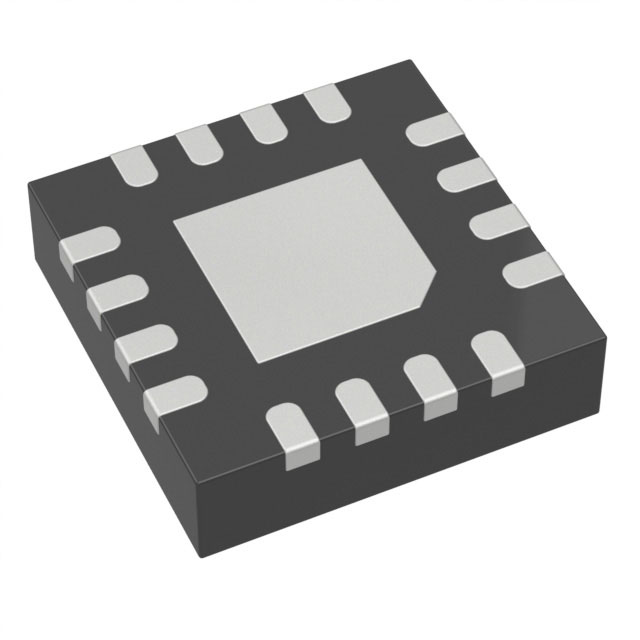 Analog Devices | Integrated Circuits (ICs) | QUAD 12-/10-/8-BIT RAIL-TO-RAIL DACS WITH 10PPM/°C REFERENCE |