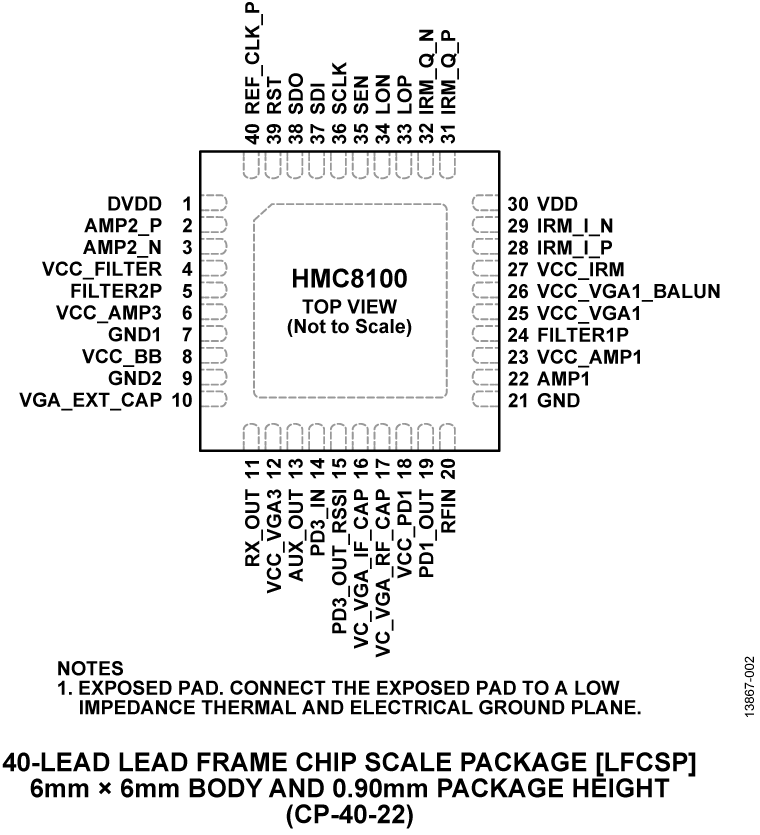
HMC8100Intermediate Frequency Receiver 800 MHz - 4000 MHz | RF and Wireless | 2 | Active | The HMC8100LP6JE is a highly integrated IF receiver chip that converts radio frequency (RF) input signals ranging from 800 MHz to 4000 MHz down to a single ended intermediate frequency (IF) signal of 140 MHz at its output.The IF receiver chip is housed in a compact 6 mm x 6 mm LFCSP package and supports complex modulations up to 1024 QAM. The HMC8100LP6JE device includes two VGAs, three power detectors, a programmable AGC block, and selected integrated bandpass filters with 14 MHz, 28 MHz, 56 MHz, and 112 MHz bandwidth. The HMC8100LP6JE also supports baseband IQ interfaces after the mixer so that the chips can be used in the full ODU configuration. The HMC8100LP6JE supports all of the standard microwave frequency bands from 6 to 42 GHz.ApplicationsPoint to point communicationsSatellite communicationsWireless microwave backhaul systemsPlease also view complimentary productHMC8200, Intermediate Frequency Transmitter 800 MHz - 4000 MHz. |
| RF Misc ICs and Modules | 3 | Active | |
| RF and Wireless | 3 | Obsolete | |
| RF and Wireless | 3 | Obsolete | |
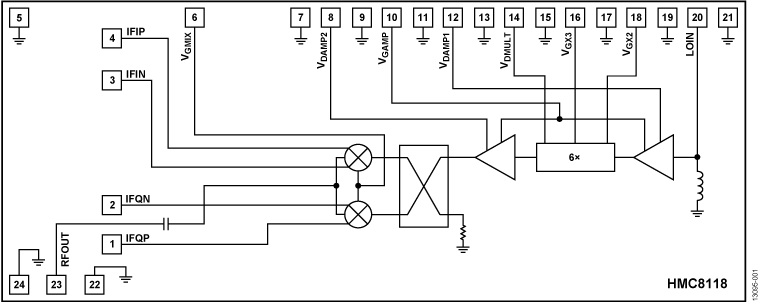
HMC811871 GHz to 76 GHz, E-Band I/Q Upconverter | RF Amplifiers | 2 | Active | The HMC8118 is an integrated E-band gallium arsenide (GaAs) monolithic microwave integrated circuit (MMIC) in-phase/ quadrature (I/Q) upconverter chip that operates from 71 GHz to 76 GHz. The HMC8118 provides a small signal conversion loss of 11 dB with 33 dBc of sideband rejection across the frequency band. The device uses an image rejection mixer that is driven by a 6× LO multiplier. Differential I and Q mixer inputs are provided. The inputs can be driven with differential I and Q baseband waveforms for direct conversion applications. Alternatively, the inputs can be driven using an external 90° hybrid and two external 180° hybrids for single sideband applications. All data includes the effect of a 1 mil gold wire wedge bond on the intermediate frequency (IF) port.ApplicationsE-band communication systemsHigh capacity wireless backhaulTest and measurement |
HMC811981 GHz to 86 GHz, E-Band I/Q Upconverter | RF and Wireless | 2 | Active | The HMC8119 is an integrated E-band gallium arsenide (GaAs) pseudomorphic (pHEMT) monolithic microwave integrated circuit (MMIC), in-phase/quadrature (I/Q) upconverter chip that operates from 81 GHz to 86 GHz. The HMC8119 provides a small signal conversion loss of 10 dB with 22 dBc of sideband rejection across the frequency band. The device uses an image rejection mixer that is driven by a 6× LO multiplier. Differential I and Q mixer inputs are provided. The inputs can be driven with differential I and Q baseband waveforms for direct conversion applications. Alternatively, the inputs can be driven using an external 90° hybrid and two external 180° hybrids for single-sideband applications. All data includes the effect of a 1 mil gold wire wedge bond on the intermediate frequency (IF) ports.ApplicationsE-band communication systemsHigh capacity wireless backhaulTest and measurement |
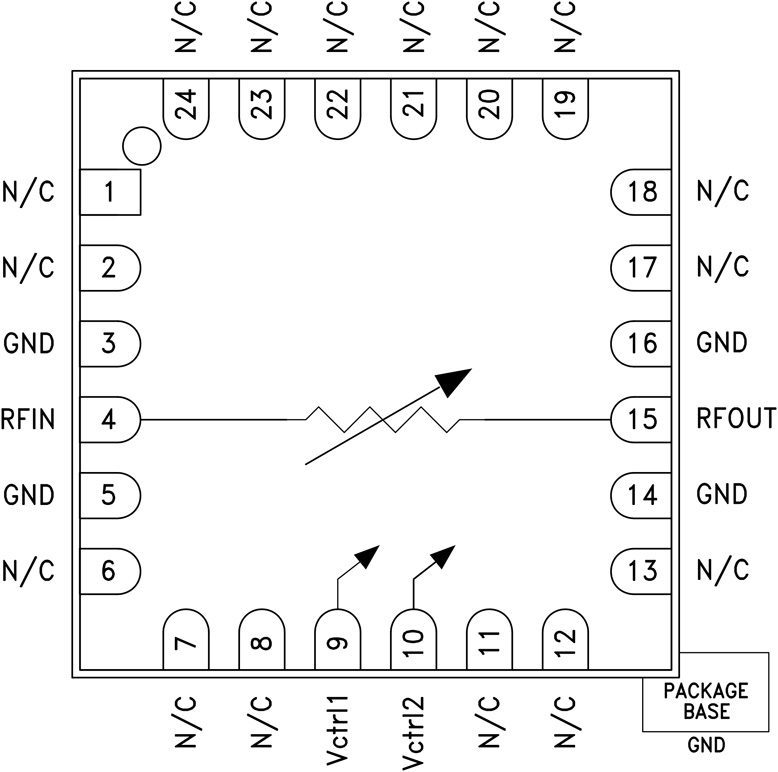
HMC812Voltage Variable Attenuator SMT, 5 - 30 GHz | Development Boards, Kits, Programmers | 4 | Active | The HMC812LC4 is an absorptive Voltage Variable Attenuator (VVA) which operates from 5 - 30 GHz and is ideal in designs where an analog DC control signal must be used to control RF signal levels over a 30 dB amplitude range. It features two shunt-type attenuators which are controlled by two analog voltages, Vctrl1 and Vctrl2. Optimum linearity performance of the attenuator is achieved by first varying Vctrl1 of the 1st attenuation stage from -3V to 0V with Vctrl2 fixed at -3V. The control voltage of the 2nd attenuation stage, Vctrl2, should then be varied from -3V to 0V, with Vctrl1 fixed at 0V. The HMC812LC4 is housed in a RoHS compliant 4x4 mm QFN leadless ceramic package.However, if the Vctrl1 and Vctrl2 pins are connected together it is possible to achieve the full analog attenuation range with only a small degradation in input IP3 performance. Applications include AGC circuits and temperature compensation of multiple gain stages in microwave point-to-point and VSAT radios.ApplicationsPoint-to-Point RadioVSAT RadioTest InstrumentationMicrowave SensorsMilitary, ECM & Radar |
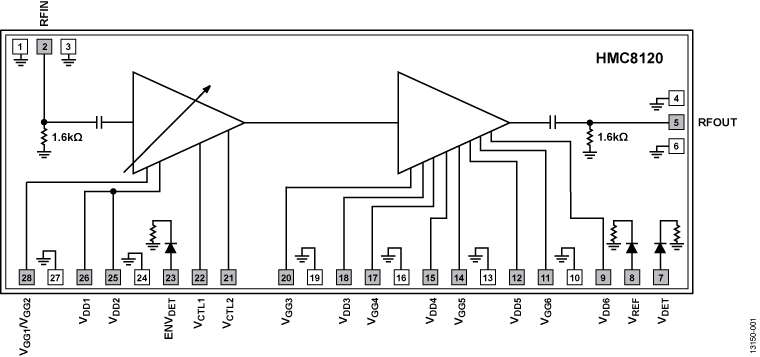
HMC812071 GHz to 76 GHz, E-Band Variable Gain Amplifier | RF Amplifiers | 2 | Active | The HMC8120 is an integrated E-band, gallium arsenide (GaAs), pseudomorphic (pHEMT), monolithic microwave integrated circuit (MMIC) variable gain amplifier and/or driver amplifier that operates from 71 GHz to 76 GHz. The HMC8120 provides up to 22 dB of gain, 21 dBm of output P1dB, 30 dBm of OIP3, and 22 dBm of PSATwhile requiring only 250 mA from a 4 V power supply. Two gain control voltages (VCTL1and VCTL2) are provided to allow up to 15 dB of variable gain control. The HMC8120 exhibits excellent linearity and is optimized for E-band communications and high capacity wireless backhaul radio systems. All data is taken with the chip in a 50 Ω test fixture connected via a 3 mil wide × 0.05 mil thick × 7 mil long ribbon on each port.ApplicationsE-band communication systemsHigh capacity wireless backhaul radio systemsTest and measurement |
| RF and Wireless | 2 | Active | |
HMC812AGaAs MMIC Voltage-Variable Attenuator, 5 - 30 GHz | Evaluation Boards | 1 | Unknown | The HMC812ALC4 is an absorptive Voltage Variable Attenuator (VVA) which operates from 5 - 30 GHz and is ideal in designs where an analog DC control signal must be used to control RF signal levels over a 30 dB amplitude range. It features two shunt-type attenuators which are controlled by two analog voltages, Vctrl1 and Vctrl2. Optimum linearity performance of the attenuator is achieved by first varying Vctrl1 of the 1st attenuation stage from -5V to 0V with Vctrl2 fixed at -5V. The control voltage of the 2nd attenuation stage, Vctrl2, should then be varied from -5V to 0V, with Vctrl1 fixed at 0V. The HMC812ALC4 is housed in a RoHS compliant 4x4 mm QFN leadless ceramic package.Furthermore, if the Vctrl1 and Vctrl2 pins are connected together it is possible to achieve the full analog attenuation range with only a small degradation in input IP3 performance. Applications include AGC circuits and temperature compensation of multiple gain stages in microwave point-to-point and VSAT radios.ApplicationsPoint-to-Point RadioVSAT RadioTest InstrumentationMicrowave SensorsMilitary, ECM & Radar |