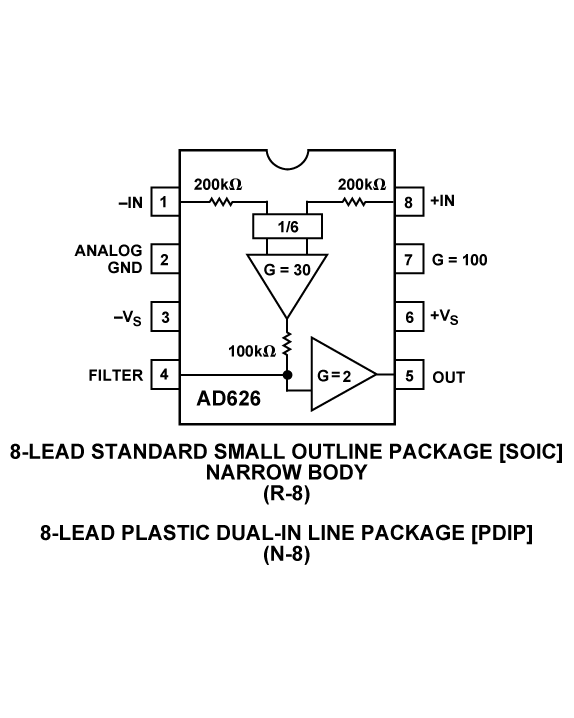
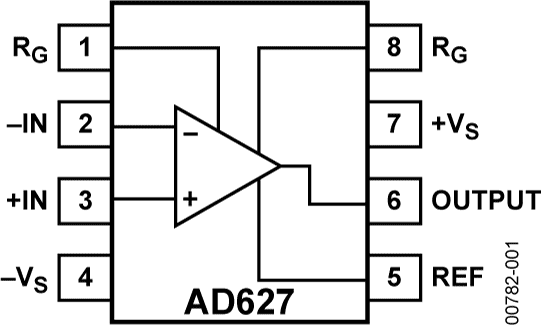
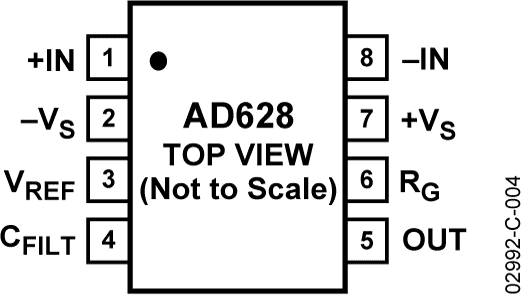
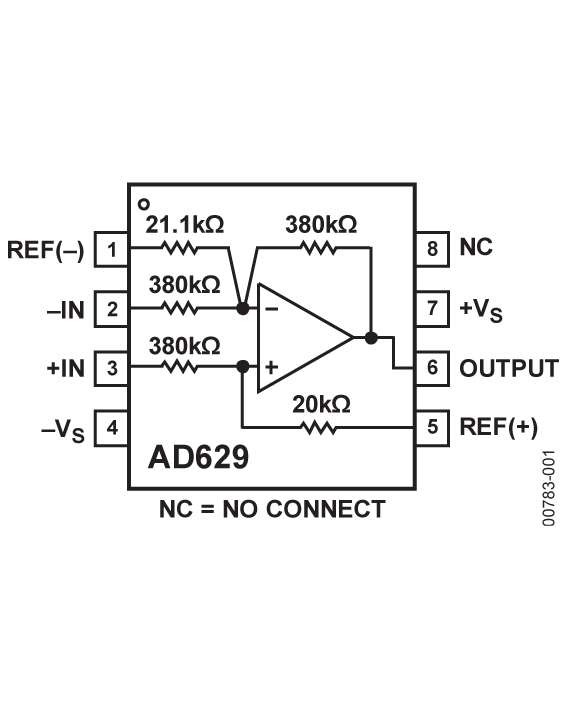
AD626Low Cost, Single-Supply Differential Amplifier | Instrumentation, Op Amps, Buffer Amps | 8 | Active | The AD626 is a low cost, true single supply differential amplifier designed for amplifying and low-pass filtering small differential voltages from sources having a large common-mode voltage.The AD626 can operate from either a single supply of +2.4 V to +10 V, or dual supplies of ±1.2 V to ±6 V. The input common-mode range of this amplifier is equal to 6 (+VS- 1 V) which provides a +24 V CMR while operating from a +5 V supply. Furthermore, the AD626 features a CMR of 90 dB typ.The amplifier's inputs are protected against continuous overload of up to 50 V, and RFI filters are included in the attenuator network. The output range is +0.03 V to +4.9 V using a +5 V supply. The amplifier provides a preset gain of 10, but gains between 10 to 100 can be easily configured with an external resistor. Furthermore, a gain of 100 is available by connecting the G = 100 pin to analog ground. The AD626 also offers low-pass filter capability by connecting a capacitor between the filter pin and analog ground.The AD626A and AD626B operate over the industrial temperature range of -40°C to +85°C. The AD626 is available in two 8-pin packages: a plastic mini-DIP and SOIC. |
| Integrated Circuits (ICs) | 11 | Active | |
| Instrumentation, Op Amps, Buffer Amps | 3 | Active | |
| Amplifiers | 4 | Active | |
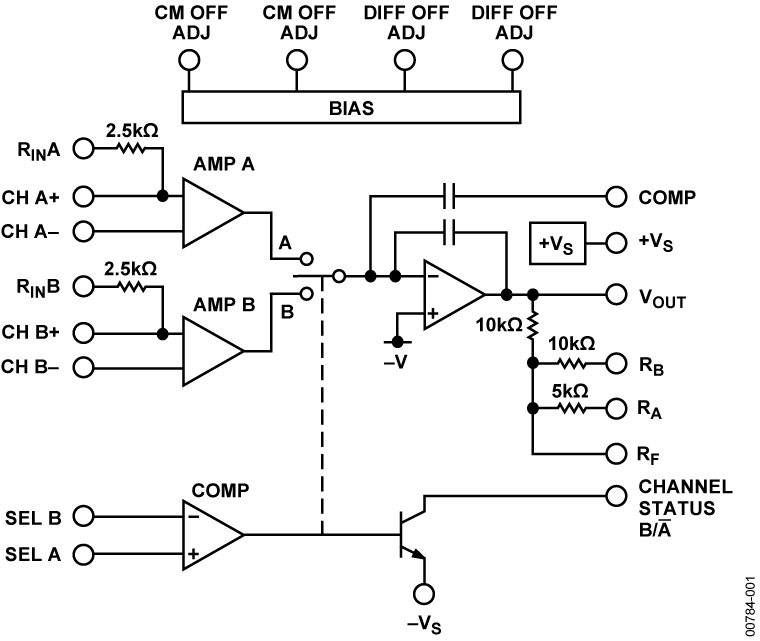
AD630Balanced Modulator/Demodulator | RF and Wireless | 13 | Active | The AD630 is a high precision balanced modulator/demodulator that combines a flexible commutating architecture with the accuracy and temperature stability afforded by laser wafer trimmed thin film resistors. A network of on-board applications resistors provides precision closed-loop gains of ±1 and ±2 with 0.05% accuracy (AD630B). These resistors may also be used to accurately configure multiplexer gains of 1, 2, 3, or 4. External feedback enables high gain or complex switched feedback topologies.The AD630 can be thought of as a precision op amp with two independent differential input stages and a precision comparator that is used to select the active front end. The rapid response time of this comparator coupled with the high slew rate and fast settling of the linear amplifiers minimize switching distortion.The AD630 is used in precision signal processing and instrumentation applications that require wide dynamic range. When used as a synchronous demodulator in a lock-in amplifier configuration, the AD630 can recover a small signal from 100 dB of interfering noise (see the Lock-In Amplifier Applications section). Although optimized for operation up to 1 kHz, the circuit is useful at frequencies up to several hundred kilohertz.Other features of the AD630 include pin programmable frequency compensation; optional input bias current compensation resistors, common-mode and differential-offset voltage adjustment, and a channel status output that indicates which of the two differential inputs is active.Product HighlightsThe application flexibility of the AD630 makes it the best choice for applications that require precisely fixed gain, switched gain, multiplexing, integrating-switching functions, and high speed precision amplification.The 100 dB dynamic range of the AD630 exceeds that of any hybrid or IC balanced modulator/demodulator and is comparable to that of costly signal processing instruments.The op amp format of the AD630 ensures easy implementation of high gain or complex switched feedback functions. The application resistors facilitate the implementation of most common applications with no additional parts.The AD630 can be used as a 2-channel multiplexer with gains of 1, 2, 3, or 4. The channel separation of 100 dB at 10 kHz approaches the limit achievable with an empty IC package.Laser trimming of the comparator and amplifying channel offsets eliminate the need for external nulling in most cases.ApplicationsBalanced modulation and demodulationSynchronous detectionPhase detectionQuadrature detectionPhase sensitive detectionLock in amplificationSquare wave multiplication |
| Linear | 13 | Active | |
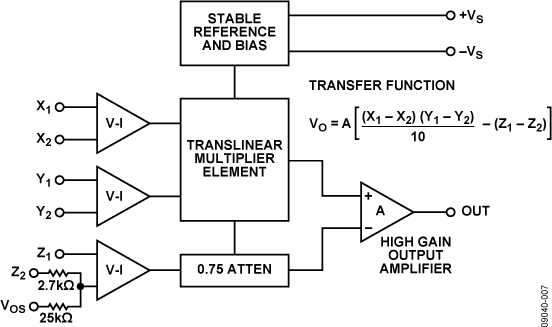
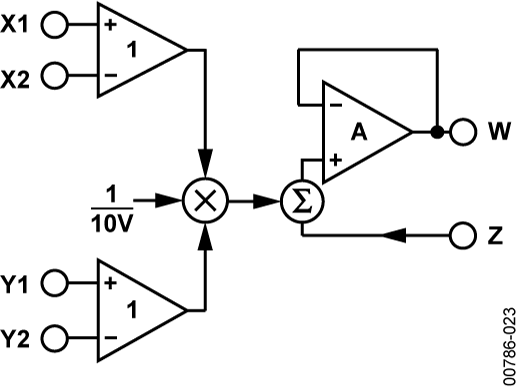
AD633Low Cost Analog Multiplier | Development Boards, Kits, Programmers | 12 | Active | The AD633 is a functionally complete, four-quadrant, analog multiplier. It includes high impedance, differential X and Y inputs, and a high impedance summing input (Z). The low impedance output voltage is a nominal 10 V full scale provided by a buried Zener. The AD633 is the first product to offer these features in modestly priced 8-lead PDIP and SOIC packages.The AD633 is laser calibrated to a guaranteed total accuracy of 2% of full scale. Nonlinearity for the Y input is typically less than 0.1% and noise referred to the output is typically less than 100 μV rms in a 10 Hz to 10 kHz bandwidth. A 1 MHz bandwidth, 20 V/μs slew rate, and the ability to drive capacitive loads make the AD633 useful in a wide variety of applications where simplicity and cost are key concerns.The versatility of the AD633 is not compromised by its simplicity. The Z input provides access to the output buffer amplifier, enabling the user to sum the outputs of two or more multipliers, increase the multiplier gain, convert the output voltage to a current, and configure a variety of applications.The AD633 is available in 8-lead PDIP and SOIC packages. It is specified to operate over the 0°C to 70°C commercial temperature range (J Grade) or the −40°C to +85°C industrial temperature range (A Grade).Product HighlightsThe AD633 is a complete four-quadrant multiplier offered in low cost 8-lead SOIC and PDIP packages. The result is a product that is cost effective and easy to apply.No external components or expensive user calibration are required to apply the AD633.Monolithic construction and laser calibration make the device stable and reliable.High (10 MΩ) input resistances make signal source loading negligible.Power supply voltages can range from ±8 V to ±18 V. The internal scaling voltage is generated by a stable Zener diode; multiplier accuracy is essentially supply insensitive.ApplicationsMultiplication, division, squaringModulation/demodulation, phase detectionVoltage-controlled amplifiers/attenuators/filters |
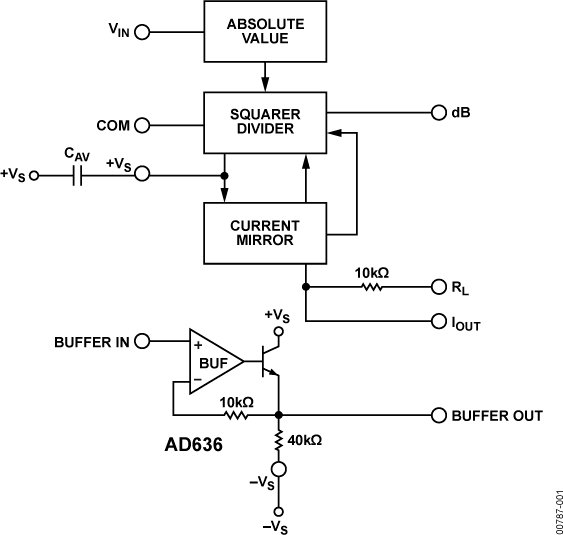
AD636Low Level, True RMS-to-DC Converter | PMIC | 5 | Active | The AD636 is a low power monolithic IC that performs true rms-to-dc conversion on low level signals. It offers performance that is comparable or superior to that of hybrid and modular converters costing much more. The AD636 is specified for a signal range of 0 mV to 200 mV rms. Crest factors up to 6 can be accommodated with less than 0.5% additional error, allowing accurate measurement of complex input waveforms.The low power supply current requirement of the AD636, typically 800 μA, is ideal for battery-powered portable instruments. It operates from a wide range of dual and single power supplies, from ±2.5 V to ±16.5 V or from +5 V to +24 V. The input and output terminals are fully protected; the input signal can exceed the power supply with no damage to the device (allowing the presence of input signals in the absence of supply voltage), and the output buffer amplifier is short-circuit protected.The AD636 includes an auxiliary dB output derived from an internal circuit point that represents the logarithm of the rms output. The 0 dB reference level is set by an externally supplied current and can be selected to correspond to any input level from 0 dBm (774.6 mV) to −20 dBm (77.46 mV). Frequency response ranges from 1.2 MHz at 0 dBm to greater than 10 kHz at −50 dBm.The AD636 is easy to use. The device is factory-trimmed at the wafer level for input and output offset, positive and negative waveform symmetry (dc reversal error), and full-scale accuracy at 200 mV rms. Therefore, no external trims are required to achieve full-rated accuracy.The AD636 is available in two accuracy grades. The total error of the J-version is typically less than ±0.5 mV ± 1.0% of reading, while the total error of the AD636K is less than ±0.2 mV to ±0.5% of reading. Both versions are temperature rated for operation between 0°C and 70°C and available in 14-lead SBDIP and 10-lead TO-100 metal can.The AD636 computes the true root-mean-square of a complex ac (or ac plus dc) input signal and gives an equivalent dc output level. The true rms value of a waveform is a more useful quantity than the average rectified value because it is a measure of the power in the signal. The rms value of an ac-coupled signal is also its standard deviation.The 200 mV full-scale range of the AD636 is compatible with many popular display-oriented ADCs. The low power supply current requirement permits use in battery-powered hand-held instruments. An averaging capacitor is the only external component required to perform measurements to the fully specified accuracy is. Its value optimizes the trade-off between low frequency accuracy, ripple, and settling time.An optional on-chip amplifier acts as a buffer for the input or the output signals. Used in the input, it provides accurate performance from standard 10 MΩ input attenuators. As an output buffer, it sources up to 5 mA. |
| Evaluation and Demonstration Boards and Kits | 23 | Active | |
| Integrated Circuits (ICs) | 5 | Active | |