| Development Boards, Kits, Programmers | 6 | Active | |
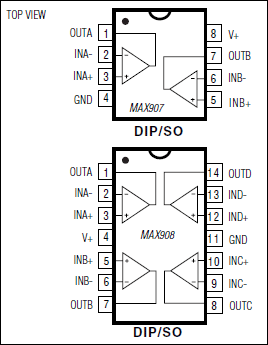
MAX907Dual/Quad/Single, High-Speed, Ultra-Low-Power, Single-Supply TTL Comparators | Integrated Circuits (ICs) | 13 | Active | The MAX907/MAX908/MAX909 are dual/quad/single, high-speed, ultra-low-power voltage comparators designed for use in systems powered from a single +5V supply; the MAX909 also accepts dual ±5V supplies. Their 40ns propagation delay (with 5mV input overdrive) is achieved with a power consumption of only 3.5mW per comparator. The wide input common-mode range extends from 200mV below ground (below the negative supply rail for the MAX909) to within 1.5V of the positive supply rail.Because they are micropower, high-speed comparators that operate from a single +5V supply and include built-in hysteresis, these devices replace a variety of older comparators in a wide range of applications. MAX907/MAX908/MAX909 outputs are TTL-compatible, requiring no external pullup circuitry. All inputs and outputs can be continuously shorted to either supply rail without damage. These easy-to-use comparators incorporate internal hysteresis to ensure clean output switching even when the devices are driven by a slow-moving input signal.The MAX909 features complementary outputs and an output latch. A separate supply pin for extending the analog input range down to -5V is also provided.The dual MAX907 and single MAX909 are available in 8-pin DIP and SO packages, and the quad MAX908 is available in 14-pin DIP and SO packages. These comparators are ideal for single +5V-supply applications that require the combination of high speed, precision, and ultra-low power dissipation.ApplicationsBattery-Powered SystemsHigh-Speed A/D ConvertersHigh-Speed Sampling CircuitsHigh-Speed V/F ConvertersLine ReceiversThreshold Detectors/DiscriminatorsZero-Crossing Detectors |
| Linear | 7 | Active | |
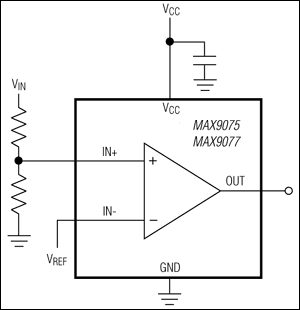
MAX9077Low-Cost, Ultra-Small, 3µA Single-Supply Comparators | Comparators | 10 | Active | The MAX9075/MAX9077 single/dual comparators are optimized for 3V and 5V single-supply applications. These comparators have a 580ns propagation delay and consume just 3µA per comparator. The combination of low-power, single-supply operation down to 2.1V, and ultra-small footprint makes these devices ideal for all portable applications.The MAX9075/MAX9077 have a common-mode input voltage range of -0.2V to VCC- 1.2V. Unlike many comparators, there is no differential clamp between the inputs, allowing the differential input voltage range to extend rail-to-rail. All inputs and outputs tolerate a continuous short-circuit fault condition to either rail.The design of the output stage limits supply-current surges while switching (typical of many other comparators), minimizing power consumption under dynamic conditions. Large internal push-pull output drivers allow rail-to-rail output swing with loads up to 2mA, making these devices ideal for interface with TTL/CMOS logic.The MAX9075 single comparator is available in 5-pin SC70 and SOT23 packages, while the MAX9077 dual comparator is available in 8-pin SOT23, µMAX®, and SO packages.ApplicationsBattery-Powered SystemsDigital-Line ReceiversIR ReceiversKeyless EntryThreshold Detectors/Discriminators |
MAX908Dual/Quad/Single, High-Speed, Ultra-Low-Power, Single-Supply TTL Comparators | Linear | 10 | Active | The MAX907/MAX908/MAX909 are dual/quad/single, high-speed, ultra-low-power voltage comparators designed for use in systems powered from a single +5V supply; the MAX909 also accepts dual ±5V supplies. Their 40ns propagation delay (with 5mV input overdrive) is achieved with a power consumption of only 3.5mW per comparator. The wide input common-mode range extends from 200mV below ground (below the negative supply rail for the MAX909) to within 1.5V of the positive supply rail.Because they are micropower, high-speed comparators that operate from a single +5V supply and include built-in hysteresis, these devices replace a variety of older comparators in a wide range of applications. MAX907/MAX908/MAX909 outputs are TTL-compatible, requiring no external pullup circuitry. All inputs and outputs can be continuously shorted to either supply rail without damage. These easy-to-use comparators incorporate internal hysteresis to ensure clean output switching even when the devices are driven by a slow-moving input signal.The MAX909 features complementary outputs and an output latch. A separate supply pin for extending the analog input range down to -5V is also provided.The dual MAX907 and single MAX909 are available in 8-pin DIP and SO packages, and the quad MAX908 is available in 14-pin DIP and SO packages. These comparators are ideal for single +5V-supply applications that require the combination of high speed, precision, and ultra-low power dissipation.ApplicationsBattery-Powered SystemsHigh-Speed A/D ConvertersHigh-Speed Sampling CircuitsHigh-Speed V/F ConvertersLine ReceiversThreshold Detectors/DiscriminatorsZero-Crossing Detectors |
| Integrated Circuits (ICs) | 3 | Active | |
| Integrated Circuits (ICs) | 3 | Active | |
| Comparators | 4 | Active | |
| Comparators | 4 | Active | |
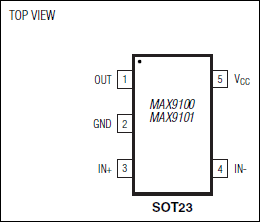
MAX9100+1.0V Micropower SOT23 Comparators | Integrated Circuits (ICs) | 5 | Active | The MAX9100/MAX9101 micropower comparators are optimized for single-cell systems, and are fully specified for operation from a single supply of 1.0V to 5.5V. This ultra-low voltage operation, 5µA quiescent current consumption, and small footprint make the MAX9100/MAX9101 ideal for use in battery-powered systems. A wide-input common-mode range that includes the negative rail and rail-to-rail output swing allows almost all of the power supply to be used for signal voltage. In addition, propagation delay is less than 4µs, and rise and fall times are 100ns.The MAX9100 features a push-pull CMOS output stage that sinks and sources current with large internal output drivers that allow rail-to-rail output swings with loads up to 5mA.The MAX9101 has an open-drain output stage that makes it suitable for mixed-voltage designs.The MAX9100/MAX9101 are available in tiny SOT23-5 packages.ApplicationsBattery-Powered ApplicationsClosed Sensor ApplicationsPagersPortable Communication DevicesPortable Electronic EquipmentSingle-Cell Systems |