


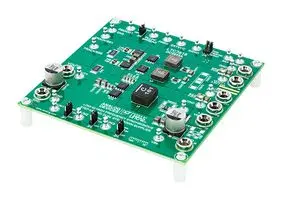
DC2855A
ActiveDEMO BOARD, LTC7818EUJ#PBF, SYNCHRONOUS BUCK & BOOST CONVERTER, POWER MANAGEMENT
Deep-Dive with AI
Search across all available documentation for this part.
DC2855A
ActiveDEMO BOARD, LTC7818EUJ#PBF, SYNCHRONOUS BUCK & BOOST CONVERTER, POWER MANAGEMENT
Deep-Dive with AI
Technical Specifications
Parameters and characteristics for this part
| Specification | DC2855A |
|---|---|
| Board Type | Fully Populated |
| Current - Output | 10 A |
| Frequency - Switching | 2.2 MHz |
| Main Purpose | DC/DC, Step Down |
| Outputs and Type | Non-Isolated |
| Outputs and Type | 3 |
| Regulator Topology | Buck |
| Supplied Contents | Board(s) |
| Utilized IC / Part | LTC7818 |
| Voltage - Input [Max] | 36 V |
| Voltage - Input [Min] | 4.5 V |
| Voltage - Output | 10 V, 5 V, 3.3 V |
Pricing
Prices provided here are for design reference only. For realtime values and availability, please visit the distributors directly
Description
General part information
DC2855 Series
Demonstration circuit DC2855A is a triple output synchronous step-up/dual step-down supply featuring the LTC®7818. The demonstration circuit is designed for two buck outputs 5V/10A, 3.3V/10A supplied by a boosted 10V output. Benefiting from this feature, the buck outputs are able to maintain regulation over a wide input voltage range of 4.5V to 36V which is suitable for automotive or other battery fed applications. Also, the demonstration circuit uses a drop-in layout whereas the main buck circuit components fit in an area of ¾" by 1½", while the main boost circuit area is ¾" by 1¾". The package style for the LTC7818 is a 40-pin exposed pad QFN. The main features of the board include rail tracking (buck channels only), an internal 5V linear regulator for bias, separated RUN pins for each output, a PGOOD signal (CH1 only), an overvoltage indicator for CH3 and a mode selector that allow the converter to run in CCM, pulse skipping or burst mode operation.
Documents
Technical documentation and resources