


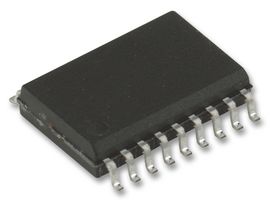
STPM10BTR
LTBPROGRAMMABLE ENERGY-TO-FREQUENCY CONVERTER, 3.165 V TO 5.5 V, 20 PINS, TSSOP
Deep-Dive with AI
Search across all available documentation for this part.
STPM10BTR
LTBPROGRAMMABLE ENERGY-TO-FREQUENCY CONVERTER, 3.165 V TO 5.5 V, 20 PINS, TSSOP
Deep-Dive with AI
Technical Specifications
Parameters and characteristics for this part
| Specification | STPM10BTR |
|---|---|
| Current - Supply | 5 mA |
| Input Impedance | 100 kOhm |
| Measurement Error | 0.1 % |
| Meter Type | Single Phase |
| Mounting Type | Surface Mount |
| Operating Temperature [Max] | 85 °C |
| Operating Temperature [Min] | -40 C |
| Package / Case | 20-TSSOP |
| Package / Case [x] | 0.173 " |
| Package / Case [y] | 4.4 mm |
| Supplier Device Package | 20-TSSOP |
| Voltage - I/O High | 1.5 V |
| Voltage - I/O Low | 0.8 V |
| Voltage - Supply [Max] | 5.5 V |
| Voltage - Supply [Min] | 3.165 V |
Pricing
Prices provided here are for design reference only. For realtime values and availability, please visit the distributors directly
Description
General part information
STPM10 Series
The STPM10 is designed for effective measurement of active, reactive and apparent energy in a power line system using current transformer and shunt sensors. The device can be implemented for peripheral measurement in a microcontroller-based single-phase or poly-phase energy meter. The STPM10 consists of two main sections: analog and digital. The analog part is composed of preamplifier and first-order sigma-delta A/D converter blocks, a band-gap voltage reference and low-drop voltage regulator. The digital part is composed of system control, oscillator, hard-wired DSP and SPI interface. There is also an internal volatile memory, which is controlled through the SPI by means of a dedicated command set. The configured bits are used for configuration and calibration purposes. From a pair of sigma-delta output signals produced by the analog section, the DSP unit computes the amount of active, reactive and apparent energy consumed, as well as the RMS and instantaneous voltage and current values. The results of the computation are available as pulse frequencies and states on the digital outputs of the device, or as data bits in a data stream, which can be read from the device by means of the SPI interface. The system bus interface is also used for temporary programming of bits of internal volatile memory. The STPM10 generates an output signal with a pulse frequency proportional to the energy, and this signal is used in the calibration phase of the energy metering application.