


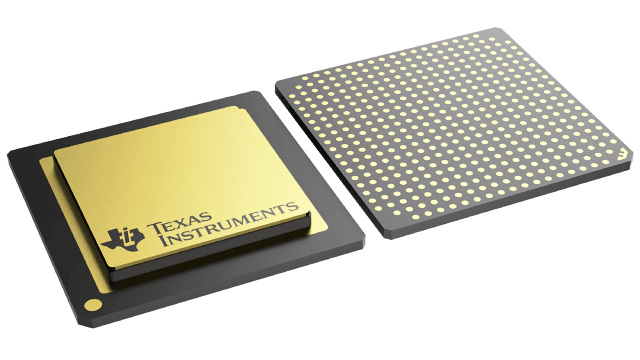
SM320C6701GLPS16
ActiveSINGLE CORE C67X FLOATING-POINT DSP FOR MILITARY APPLICATIONS - UP TO 167MHZ
Deep-Dive with AI
Search across all available documentation for this part.
SM320C6701GLPS16
ActiveSINGLE CORE C67X FLOATING-POINT DSP FOR MILITARY APPLICATIONS - UP TO 167MHZ
Deep-Dive with AI
Technical Specifications
Parameters and characteristics for this part
| Specification | SM320C6701GLPS16 |
|---|---|
| Clock Rate | 167 MHz |
| Interface | McBSP, HPI, DMA, EMIF, SPI |
| Mounting Type | Surface Mount |
| Non-Volatile Memory | 128 kB |
| On-Chip RAM | 128 kB |
| Operating Temperature [Max] | 90 °C |
| Operating Temperature [Min] | -40 °C |
| Package / Case | FCBGA, 429-BCBGA |
| Supplier Device Package | 429-CFCBGA (27x27) |
| Type | Floating Point |
| Voltage - Core | 1.9 V |
| Voltage - I/O | 3.3 V |
Pricing
Prices provided here are for design reference only. For realtime values and availability, please visit the distributors directly
| Distributor | Package | Quantity | $ | |
|---|---|---|---|---|
| Texas Instruments | JEDEC TRAY (5+1) | 1 | $ 1639.65 | |
| 100 | $ 1484.17 | |||
| 250 | $ 1441.77 | |||
| 1000 | $ 1413.49 | |||
Description
General part information
SM320C6701 Series
The SMJ320C67x DSPs are the floating-point DSP family in the SMJ320C6000 platform. The SMJ320C6701 (’C6701) device is based on the high-performance, advanced VelociTI very-long-instruction-word (VLIW) architecture developed by Texas Instruments (TI™), making this DSP an excellent choice for multichannel and multifunction applications. With performance of up to 1 giga floating-point operations per second (GFLOPS) at a clock rate of 167 MHz, the ’C6701 offers cost-effective solutions to high-performance DSP programming challenges. The ’C6701 DSP possesses the operational flexibility of high-speed controllers and the numerical capability of array processors. This processor has 32 general-purpose registers of 32-bit word length and eight highly independent functional units. The eight functional units provide four floating-/fixed-point ALUs, two fixed-point ALUs, and two floating-/fixed-point multipliers. The ’C6701 can produce two multiply-accumulates (MACs) per cycle for a total of 334 million MACs per second (MMACS). The ’C6701 DSP also has application-specific hardware logic, on-chip memory, and additional on-chip peripherals.
The ’C6701 includes a large bank of on-chip memory and has a powerful and diverse set of peripherals. Program memory consists of a 64K-byte block that is user-configurable as cache or memory-mapped program space. Data memory consists of two 32K-byte blocks of RAM. The peripheral set includes two multichannel buffered serial ports (McBSPs), two general-purpose timers, a host-port interface (HPI), and a glueless external memory interface (EMIF) capable of interfacing to SDRAM or SBSRAM and asynchronous peripherals.
The ’C6701 has a complete set of development tools which includes: a new C compiler, an assembly optimizer to simplify programming and scheduling, and a Windows. debugger interface for visibility into source code execution.