


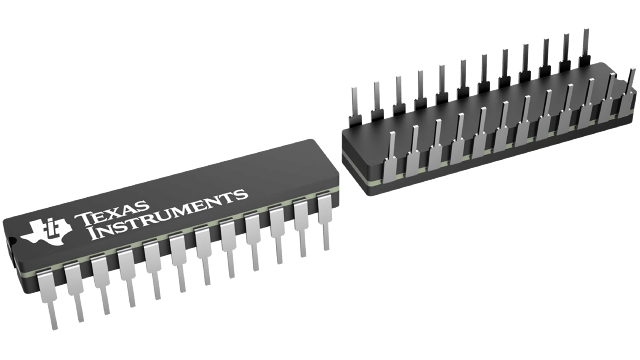
SNJ54AS823AJT
Active9-BIT BUS INTERFACE FLIP-FLOPS WITH 3-STATE OUTPUTS
Deep-Dive with AI
Search across all available documentation for this part.
SNJ54AS823AJT
Active9-BIT BUS INTERFACE FLIP-FLOPS WITH 3-STATE OUTPUTS
Deep-Dive with AI
Technical Specifications
Parameters and characteristics for this part
| Specification | SNJ54AS823AJT |
|---|---|
| Current - Output High, Low [custom] | 32 mA |
| Current - Output High, Low [custom] | 24 mA |
| Current - Quiescent (Iq) | 103 mA |
| Max Propagation Delay @ V, Max CL | 14 ns |
| Mounting Type | Through Hole |
| Number of Bits per Element | 9 |
| Number of Elements | 1 |
| Operating Temperature [Max] | 125 °C |
| Operating Temperature [Min] | -55 °C |
| Output Type | Tri-State, Non-Inverted |
| Package / Case | 24-CDIP |
| Supplier Device Package | 24-CDIP |
| Trigger Type | Positive Edge |
| Type | D-Type |
| Voltage - Supply [Max] | 5.5 V |
| Voltage - Supply [Min] | 4.5 V |
Pricing
Prices provided here are for design reference only. For realtime values and availability, please visit the distributors directly
| Distributor | Package | Quantity | $ | |
|---|---|---|---|---|
| Texas Instruments | TUBE | 1 | $ 38.97 | |
| 100 | $ 34.63 | |||
| 250 | $ 28.47 | |||
| 1000 | $ 25.47 | |||
Description
General part information
SN54AS823A Series
These 9-bit flip-flops feature 3-state outputs designed specifically for driving highly capacitive or relatively low-impedance loads. These devices are particularly suitable for implementing wider buffer registers, I/O ports, bidirectional bus drivers, parity bus interfacing, and working registers.
With the clock-enable () input low, the nine D-type edge-triggered flip-flops enter data on the low-to-high transitions of the clock (CLK) input. Takinghigh disables the clock buffer, latching the outputs. The SN54AS823A and SN74AS823A have noninverting data (D) inputs and the SN74AS824A has inverting (D\) inputs. Taking the clear () input low causes the nine Q outputs to go low independently of the clock.
A buffered output-enable () input can be used to place the nine outputs in either a normal logic state (high or low logic level) or the high-impedance state. In the high-impedance state, the outputs neither load nor drive the bus lines significantly. The high-impedance state and increased drive provide the capability to drive bus lines without interface or pullup components.
Documents
Technical documentation and resources