


Deep-Dive with AI
Search across all available documentation for this part.
Deep-Dive with AI
Technical Specifications
Parameters and characteristics for this part
| Specification | LX34211QPW-TR |
|---|---|
| Input Type | Digital, Analog |
| Mounting Type | Surface Mount |
| Operating Temperature [Max] | 125 °C |
| Operating Temperature [Min] | -40 °C |
| Output Type | Analog |
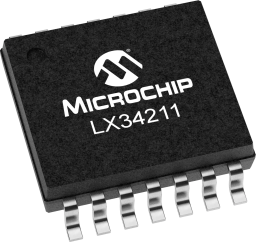
| Package / Case | 14-TSSOP |
| Package / Case [custom] | 0.173 " |
| Package / Case [custom] | 4.4 mm |
| Supplier Device Package | 14-TSSOP |
| Type | Sensor Interface |
Pricing
Prices provided here are for design reference only. For realtime values and availability, please visit the distributors directly
| Distributor | Package | Quantity | $ | |
|---|---|---|---|---|
| Digikey | Cut Tape (CT) | 1 | $ 2.13 | |
| 25 | $ 1.76 | |||
| 100 | $ 1.61 | |||
| Digi-Reel® | 1 | $ 2.13 | ||
| 25 | $ 1.76 | |||
| 100 | $ 1.61 | |||
| Tape & Reel (TR) | 2500 | $ 1.61 | ||
| Microchip Direct | T/R | 1 | $ 2.13 | |
| 25 | $ 1.76 | |||
| 100 | $ 1.61 | |||
| 1000 | $ 1.55 | |||
| 5000 | $ 1.53 | |||
Description
General part information
LX34211 Series
The LX34211 is a highly accurate inductive position sensor interface IC with features that simplify the sensor design for a wide range of applications. This IC has more automatic gain control (AGC) in and a dynamic calibration algorithm that makes it easier to design accurate sensors with larger air gap and more mechanical tolerances with less current.
The device includes an integrated oscillator circuit for driving the primary coil of an inductive sensor, along with two independent analog conversion paths for conditioning, converting, and processing of sine and cosine analog signals from the secondary coils of the sensor. The output signal is an DAC analog or PWM signal that represents the position with 12 bit measurement range resolution.
Each analog signal path includes adjustable AGC gain and digital calibration capability to match the mechanical system variation and maximize accuracy. The AGC unit has improved gain for an even wider range of target-to-sensor airgap applications. In addition, a unique dynamic calibration algorithm corrects for errors before the on board linearization stage, maintaining accuracy over a wider range of airgaps.
Documents
Technical documentation and resources
No documents available