


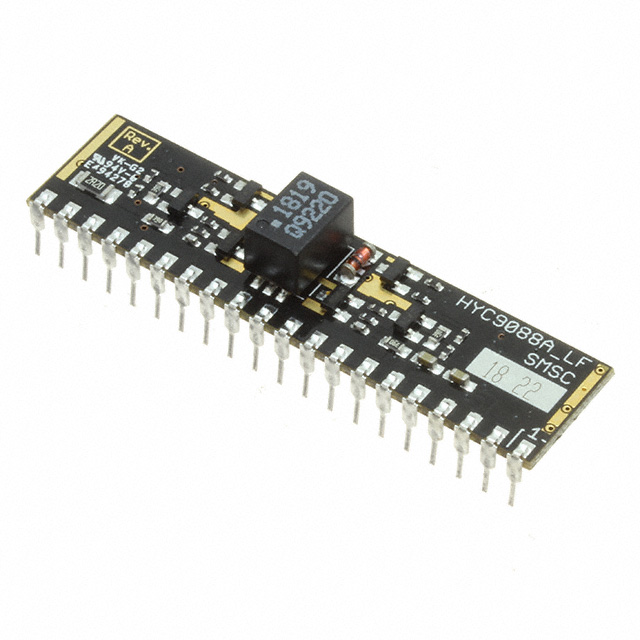
HYC9088AR-LF
ActiveSPECIALIZED INTERFACE, TWISTED PAIR/COAX OR COMBINATION NETWORKS, 5.25V TO 4.75V, SIP-20
Deep-Dive with AI
Search across all available documentation for this part.
HYC9088AR-LF
ActiveSPECIALIZED INTERFACE, TWISTED PAIR/COAX OR COMBINATION NETWORKS, 5.25V TO 4.75V, SIP-20
Deep-Dive with AI
Technical Specifications
Parameters and characteristics for this part
| Specification | HYC9088AR-LF |
|---|---|
| Current - Supply | 190 mA |
| Function | Controller |
| Operating Temperature [Max] | 70 °C |
| Operating Temperature [Min] | 0 °C |
| Package / Case | 20-SIP Formed Leads |
| Protocol | ARCNET |
| Supplier Device Package | 20-SDIP |
Pricing
Prices provided here are for design reference only. For realtime values and availability, please visit the distributors directly
| Distributor | Package | Quantity | $ | |
|---|---|---|---|---|
| Digikey | Tray | 1 | $ 50.62 | |
| 25 | $ 42.19 | |||
| 100 | $ 40.77 | |||
| Microchip Direct | TRAY | 1 | $ 50.62 | |
| 25 | $ 42.19 | |||
| 100 | $ 38.36 | |||
| 1000 | $ 37.05 | |||
| 5000 | $ 36.63 | |||
| Newark | Each | 25 | $ 42.97 | |
| 100 | $ 39.51 | |||
Description
General part information
HYC9088A Series
The HYC9088 Twisted Pair and Coaxial Compatible High Impedance Transceiver (HIT) is a hybrid module that interfaces an ARCNET Local Area Network controller to one twisted pair or coaxial cable. The HIT interfaces directly with Standard Microsystems Corporation's ARCNET LAN controllers operating at 2.5 Mbps and connects to a variety of shielded and unshielded twisted pair or coaxial cables via an on-board transformer. The network topologies supported by the HIT are daisy chain, star, and bus configurations.
During data transmission, the HIT converts the digital pulse information provided by the LAN controller into analog signals and drives them onto the cable. The transmitted signals are filtered to eliminate undesirable frequencies. The receiver section of the HYC9088 identifies dipulse signals on the cable and converts them into TTL signals to be supplied to the LAN controller.
The HIT supports ARCNET's Dipulse Encoding Scheme and is 100% compatible with all existing coax-based ARCNET networks. This provides an ARCNET network designer with flexibility to easily combine coax and twisted pair cabling.
Documents
Technical documentation and resources