


Deep-Dive with AI
Search across all available documentation for this part.
Deep-Dive with AI
Technical Specifications
Parameters and characteristics for this part
| Specification | LX34050QPW |
|---|---|
| Actuator Type | Inductive Target |
| Mounting Type | Surface Mount |
| Output Signal | Sine, Cosine |
| Package / Case | 14-TSSOP |
| Package / Case [custom] | 0.173 " |
| Package / Case [custom] | 4.4 mm |
| Supplier Device Package | 14-TSSOP |
| Technology | Inductive |
| Termination Style | Gull Wing |
| Voltage - Supply [Max] | 6 V |
| Voltage - Supply [Min] | 4 V |
Pricing
Prices provided here are for design reference only. For realtime values and availability, please visit the distributors directly
| Distributor | Package | Quantity | $ | |
|---|---|---|---|---|
| Digikey | Tube | 1 | $ 2.04 | |
| 25 | $ 1.70 | |||
| 100 | $ 1.64 | |||
| Microchip Direct | TUBE | 1 | $ 2.04 | |
| 25 | $ 1.70 | |||
| 100 | $ 1.55 | |||
| 1000 | $ 1.49 | |||
| 5000 | $ 1.48 | |||
Description
General part information
LX34050 Series
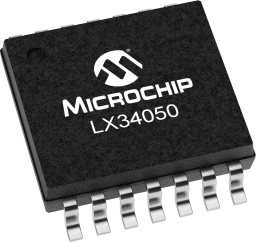
The LX34050 is a integrated programmable data conversion IC designed for interfacing to and managing printed circuit board (PCB) based inductive position sensors. Inductive position sensors are ideal replacements for magnet based position and speed sensors (i.e Hall Effect Sensors), optical encoders, and Magnetic resolvers. They excel with improved accuracy, magnetic noise immunity and don't require a magnet as a target.
The sensor itself is just a PCB, with primary and secondary windings placed to detect the movement of a metal target. The device includes an integrated oscillator circuit for driving the primary coil of an inductive sensor, along with two independent analog conversion paths for conditioning, converting, and processing of two analog signals from the secondary coils of the sensor. Each path includes an EMI filter, de-modulator,and programmable amplifier.
Great for embedded applications, the LX34050 output interface include two single ended Sin(x) and Cos(x) signals that change as the metal target is moved over the sensor. The position of the target is then calculated by using the ratio of these signals.
Documents
Technical documentation and resources
No documents available