


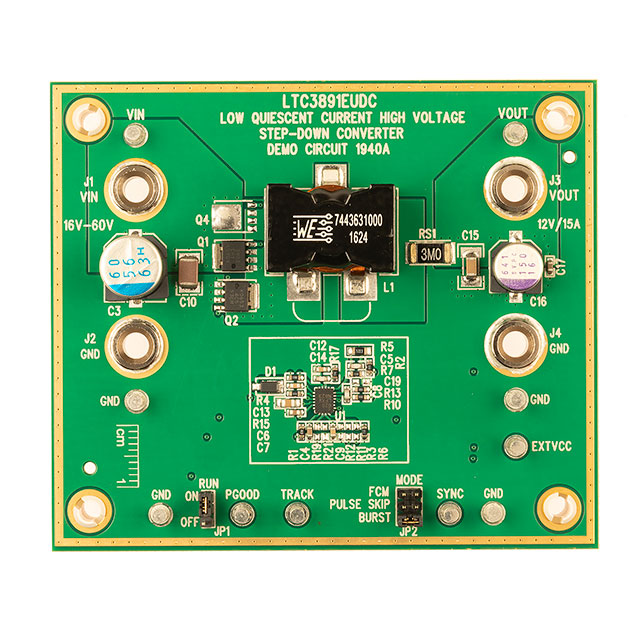
DC1940A
ActiveDEMO BOARD, LTC3891EUDC, SYNCHRONOUS BUCK CONVERTER, POWER MANAGEMENT
Deep-Dive with AI
Search across all available documentation for this part.
DC1940A
ActiveDEMO BOARD, LTC3891EUDC, SYNCHRONOUS BUCK CONVERTER, POWER MANAGEMENT
Deep-Dive with AI
Technical Specifications
Parameters and characteristics for this part
| Specification | DC1940A |
|---|---|
| Board Type | Fully Populated |
| Current - Output | 15 A |
| Frequency - Switching | 125 kHz |
| Main Purpose | DC/DC, Step Down |
| Outputs and Type | Non-Isolated |
| Outputs and Type | 1 |
| Regulator Topology | Buck |
| Supplied Contents | Board(s) |
| Utilized IC / Part | LTC3891 |
| Voltage - Input [Max] | 60 V |
| Voltage - Input [Min] | 16 V |
| Voltage - Output | 12 V |
Pricing
Prices provided here are for design reference only. For realtime values and availability, please visit the distributors directly
Description
General part information
DC1940 Series
Demonstration circuit 1940A is a low quiescent current, synchronous buck converter featuring the LTC®3891EUDC. This demo board converts a 16V to 60V voltage to a 12V at 15A output. The main features of this board include an internal LDO for gate drive power from VIN or EXTVCC, RUN and PGOOD pins, a mode selector that allows the converter to run in constant current mode (CCM), pulse-skipping or Burst Mode® operation, and selectable current limit. The wide input voltage range of 16V to 60V is suitable for double battery automotive and distributed DC power systems where low quiescent current is important. 60V avalanche rated MOSFETs, which are used on DC1940A, can be operated at their rated voltage. However, if application derating requirements are stricter, MOSFETs with higher voltage rating can be used. DC1940A supports the following MOSFET packages: LFPAK, PowerPAK SO-8 and Power 56. The subsequent logic level (SV gate) MOSFETs can be used with DC1940A.
Documents
Technical documentation and resources