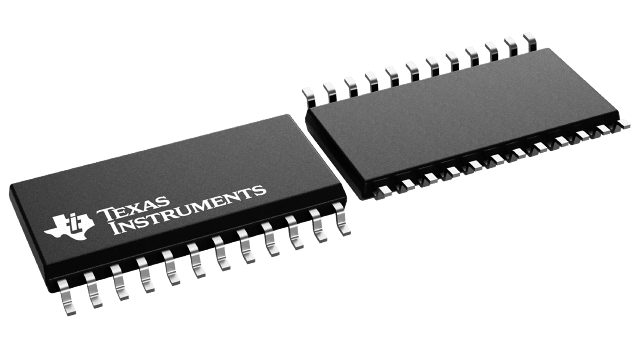
SN74ABT8996DWR
ObsoleteADDRESSABLE SCAN PORT -40°C TO 85°C 24-PIN SOIC T/R
Deep-Dive with AI
Search across all available documentation for this part.
SN74ABT8996DWR
ObsoleteADDRESSABLE SCAN PORT -40°C TO 85°C 24-PIN SOIC T/R
Deep-Dive with AI
Technical Specifications
Parameters and characteristics for this part
| Specification | SN74ABT8996DWR |
|---|---|
| Logic Type | Addressable Scan Ports |
| Mounting Type | Surface Mount |
| Number of Bits [custom] | 10 |
| Operating Temperature [Max] | 85 °C |
| Operating Temperature [Min] | -40 °C |
| Package / Case | 24-SOIC |
| Package / Case [custom] | 7.5 mm |
| Package / Case [custom] | 0.295 in |
| Supplier Device Package | 24-SOIC |
| Supply Voltage [Max] | 5.5 V |
| Supply Voltage [Min] | 4.5 V |
Pricing
Prices provided here are for design reference only. For realtime values and availability, please visit the distributors directly
| Distributor | Package | Quantity | $ | |
|---|---|---|---|---|
Description
General part information
SN74ABT8996 Series
The 'ABT8996 10-bit addressable scan ports (ASP) are members of the Texas Instruments (TITM) SCOPETMtestability integrated-circuit family. This family of devices supports IEEE Standard 1149.1-1990 boundary scan to facilitate testing of complex circuit assemblies. Unlike most SCOPETMdevices, the ASP is not a boundary-scannable device, rather, it applies TI's addressable-shadow-port technology to the IEEE Standard 1149.1-1990 (JTAG) test access port (TAP) to extend scan access beyond the board level.
Conceptually, the ASP is a simple switch that can be used to directly connect a set of multidrop primary TAP signals to a set of secondary TAP signals - for example, to interface backplane TAP signals to a board-level TAP. The ASP provides all signal buffering that might be required at these two interfaces. When primary and secondary TAPs are connected, only a moderate propagation delay is introduced - no storage/retiming elements are inserted. This minimizes the need for reformatting board-level test vectors for in-system use.
Most operations of the ASP are synchronous to the primary test clock (PTCK) input. This PTCK signal always is buffered directly onto the secondary test clock (STCK) output.
Documents
Technical documentation and resources
No documents available