


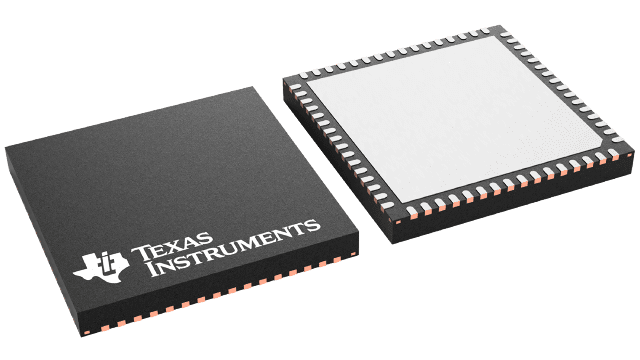
LMK05028RGCT
ActiveLOW-JITTER DUAL-CHANNEL NETWORK SYNCHRONIZER CLOCK
Deep-Dive with AI
Search across all available documentation for this part.
LMK05028RGCT
ActiveLOW-JITTER DUAL-CHANNEL NETWORK SYNCHRONIZER CLOCK
Deep-Dive with AI
Technical Specifications
Parameters and characteristics for this part
| Specification | LMK05028RGCT |
|---|---|
| Differential - Input:Output [custom] | True |
| Differential - Input:Output [custom] | True |
| Frequency - Max [Max] | 200 MHz, 750 MHz |
| Input | CML, LVDS, HCSL, LVPECL |
| Mounting Type | Surface Mount |
| Number of Circuits | 2 |
| Operating Temperature [Max] | 85 °C |
| Operating Temperature [Min] | -40 °C |
| Output | LVCMOS, CML, LVPECL, HCSL, LVDS |
| Package / Case | 64-VFQFN Exposed Pad |
| PLL | True |
| Ratio - Input:Output [custom] | 4:8 |
| Supplier Device Package | 64-VQFN (9x9) |
| Voltage - Supply [Max] | 3.465 V, 2.625 V, 1.89 V |
| Voltage - Supply [Min] | 2.375 V, 1.71 V, 3.135 V |
Pricing
Prices provided here are for design reference only. For realtime values and availability, please visit the distributors directly
| Distributor | Package | Quantity | $ | |
|---|---|---|---|---|
| Digikey | Cut Tape (CT) | 1 | $ 23.24 | |
| 10 | $ 21.43 | |||
| 25 | $ 21.20 | |||
| Digi-Reel® | 1 | $ 23.24 | ||
| 10 | $ 21.43 | |||
| 25 | $ 21.20 | |||
| Tape & Reel (TR) | 250 | $ 21.20 | ||
| Texas Instruments | SMALL T&R | 1 | $ 28.15 | |
| 100 | $ 24.59 | |||
| 250 | $ 18.96 | |||
| 1000 | $ 16.96 | |||
Description
General part information
LMK05028 Series
The LMK05028 is a high-performance network synchronizer clock device that provides jitter cleaning, clock generation, advanced clock monitoring, and good hitless switching performance to meet the stringent timing requirements of communications infrastructure and industrial applications. The low jitter and high PSNR of the device reduce bit error rates (BER) in high-speed serial links.
The device has two PLL channels and generates up to eight output clocks with 150-fs RMS jitter. Each PLL domain can select from any four reference inputs to synchronize the outputs.
The LMK05028 is a high-performance network synchronizer clock device that provides jitter cleaning, clock generation, advanced clock monitoring, and good hitless switching performance to meet the stringent timing requirements of communications infrastructure and industrial applications. The low jitter and high PSNR of the device reduce bit error rates (BER) in high-speed serial links.
Documents
Technical documentation and resources