TPS54KB23RZRR
Active4-V TO 16-V INPUT, 25-A REMOTE SENSE SYNCHRONOUS STEP-DOWN CONVERTER
Deep-Dive with AI
Search across all available documentation for this part.
TPS54KB23RZRR
Active4-V TO 16-V INPUT, 25-A REMOTE SENSE SYNCHRONOUS STEP-DOWN CONVERTER
Deep-Dive with AI
Technical Specifications
Parameters and characteristics for this part
| Specification | TPS54KB23RZRR |
|---|---|
| Current - Output | 25 A |
| Frequency - Switching | 1.4 MHz, 1.1 MHz, 800 kHz |
| Function | Step-Down |
| Mounting Type | Wettable Flank, Surface Mount |
| Number of Outputs | 1 |
| Operating Temperature [Max] | 125 °C |
| Operating Temperature [Min] | -40 C |
| Output Configuration | Positive |
| Output Type | Adjustable |
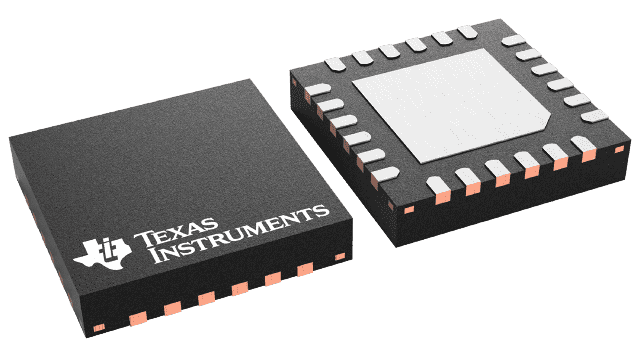
| Package / Case | 16-PowerWFQFN |
| Supplier Device Package | 16-WQFN-FCRLF (3x3.5) |
| Synchronous Rectifier | True |
| Topology | Buck |
| Voltage - Input (Max) [Max] | 16 V |
| Voltage - Input (Min) [Min] | 4 V |
| Voltage - Output (Max) [Max] | 5.5 V |
| Voltage - Output (Min/Fixed) [Min] | 0.5 V |
Pricing
Prices provided here are for design reference only. For realtime values and availability, please visit the distributors directly
| Distributor | Package | Quantity | $ | |
|---|---|---|---|---|
| Digikey | Cut Tape (CT) | 1 | $ 4.04 | |
| 10 | $ 3.63 | |||
| 25 | $ 3.43 | |||
| 100 | $ 2.97 | |||
| 250 | $ 2.82 | |||
| 500 | $ 2.53 | |||
| 1000 | $ 2.14 | |||
| 2500 | $ 2.03 | |||
| Digi-Reel® | 1 | $ 4.04 | ||
| 10 | $ 3.63 | |||
| 25 | $ 3.43 | |||
| 100 | $ 2.97 | |||
| 250 | $ 2.82 | |||
| 500 | $ 2.53 | |||
| 1000 | $ 2.14 | |||
| 2500 | $ 2.03 | |||
| N/A | 4970 | $ 4.48 | ||
| Tape & Reel (TR) | 5000 | $ 1.95 | ||
| Texas Instruments | LARGE T&R | 1 | $ 3.05 | |
| 100 | $ 2.67 | |||
| 250 | $ 1.87 | |||
| 1000 | $ 1.51 | |||
Description
General part information
TPS54 Series
The TPS54A24 is a full-featured 17-V, 10-A synchronous step-down DC/DC converter in a standard 4 mm × 4 mm WQFN package.
The device is optimized for small solution size through high efficiency and integrating the high-side and low-side MOSFETs. Further space savings are achieved through peak-current-mode control, which reduces component count, and by selecting a high switching frequency, reducing the inductor footprint.
The peak-current-mode control simplifies the loop compensation and provides fast transient response. Cycle-by-cycle peak current limiting on the high-side and low-side sourcing current limit protects the device in overload situations. Hiccup limits MOSFET power dissipation if a short circuit or over loading fault persists.
Documents
Technical documentation and resources