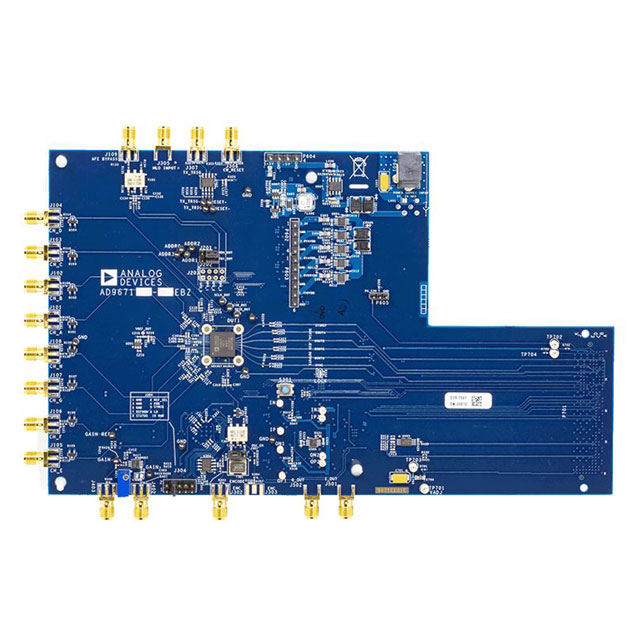
AD9671EBZ
ActiveEVALUATION BOARD, OCTAL ULTRASOUND AFE ROHS COMPLIANT: YES
Deep-Dive with AI
Search across all available documentation for this part.
AD9671EBZ
ActiveEVALUATION BOARD, OCTAL ULTRASOUND AFE ROHS COMPLIANT: YES
Deep-Dive with AI
Technical Specifications
Parameters and characteristics for this part
| Specification | AD9671EBZ |
|---|---|
| Function | Analog Front End (AFE) |
| Primary Attributes | 8-Channel (Octal) |
| Supplied Contents | Board(s) |
| Type | Interface |
| Utilized IC / Part | AD9671 |
Pricing
Prices provided here are for design reference only. For realtime values and availability, please visit the distributors directly
Description
General part information
AD9671 Series
The AD9671 is designed for low cost, low power, small size, and ease of use for medical ultrasound applications. It contains eight channels of a VGA with an LNA, a CW harmonic rejection I/Q demodulator with programmable phase rotation, an AAF, an ADC, and a digital demodulator and decimator for data processing and bandwidth reduction.Each channel features a maximum gain of up to 52 dB, a fully differential signal path, and an active input preamplifier termination. The channel is optimized for high dynamic performance and low power in applications where a small package size is critical.The LNA has a single-ended to differential gain that is selectable through the serial port interface (SPI). Assuming a 15 MHz noise bandwidth (NBW) and a 21.6 dB LNA gain, the LNA input SNR is 94 dB. In CW Doppler mode, each LNA output drives an I/Q demodulator that has independently programmable phase rotation with 16 phase settings.Power-down of individual channels is supported to increase battery life for portable applications. Standby mode allows quick power-up for power cycling. In CW Doppler operation, the VGA, AAF, and ADC are powered down. The ADC contains several features designed to maximize flexibility and minimize system cost, such as a programmable clock, data alignment, and programmable digital test pattern generation. The digital test patterns include built-in fixed patterns, built-in pseudorandom patterns, and custom user defined test patterns entered via the SPI.ApplicationsMedical imaging/ultrasoundNondestructive testing (NDT)
Documents
Technical documentation and resources