


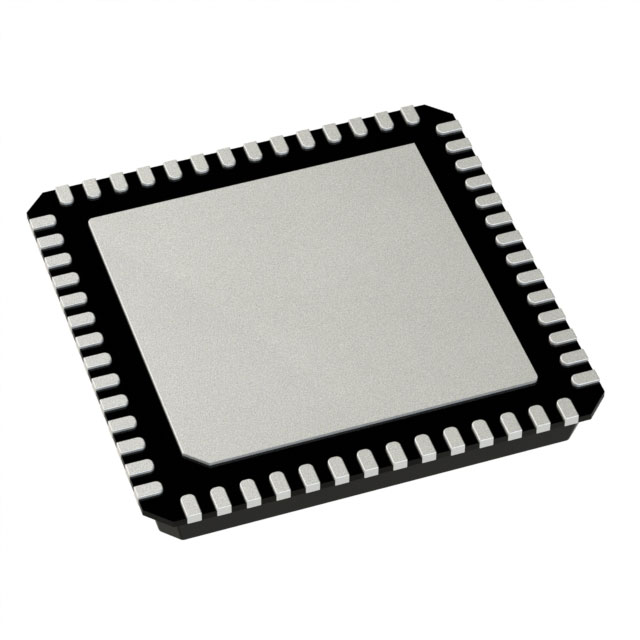
AD9911BCPZ
ActiveDIRECT DIGITAL SYNTHESIZER, 10-BIT DAC, 500 MSPS, 1.71 TO 1.89 V, -40 TO 85 DEG C, LFCSP-EP-56
Deep-Dive with AI
Search across all available documentation for this part.
AD9911BCPZ
ActiveDIRECT DIGITAL SYNTHESIZER, 10-BIT DAC, 500 MSPS, 1.71 TO 1.89 V, -40 TO 85 DEG C, LFCSP-EP-56
Technical Specifications
Parameters and characteristics for this part
| Specification | AD9911BCPZ |
|---|---|
| Master fclk | 500 MHz |
| Mounting Type | Surface Mount |
| Operating Temperature [Max] | 85 °C |
| Operating Temperature [Min] | -40 °C |
| Package / Case | 56-VFQFN Exposed Pad, CSP |
| Resolution (Bits) | 10 b |
| Supplier Device Package | 56-LFCSP-VQ (8x8) |
| Tuning Word Width (Bits) | 32 b |
| Voltage - Supply [Max] | 1.96 V |
| Voltage - Supply [Min] | 1.71 V |
Pricing
Prices provided here are for design reference only. For realtime values and availability, please visit the distributors directly
Description
General part information
AD9911 Series
The AD9911 is a complete direct digital synthesizer (DDS). This device includes a high speed DAC with excellent wideband and narrowband spurious-free dynamic range (SFDR) as well as three auxiliary DDS cores without assigned digital-to-analog converters (DACs). These auxiliary channels are used for spur reduction, multitone generation, or test-tone modulation.The AD9911 is the first DDS to incorporate SpurKiller technology and multitone generation capability. Multitone mode enables the generation up to four concurrent carriers; frequency, phase and amplitude can be independently programmed. Multitone generation can be used for system tests, such as inter-modulation distortion and receiver blocker sensitivity. SpurKilling enables customers to improve SFDR performance by reducing the magnitude of harmonic components and/or the aliases of those harmonic components.Test-tone modulation efficiently enables sine wave modulation of amplitude on the output signal using one of the auxiliary DDS cores.The AD9911 can perform modulation of frequency, phase, or amplitude (FSK, PSK, ASK). Modulation is implemented by storing profiles in the register bank and applying data to the profile pins. In addition, the AD9911 supports linear sweep of frequency, phase, or amplitude for applications such as radar and instrumentation.The DDS acts as a high resolution frequency divider with the REF_CLK as the input and the DAC providing the output. The REF_CLK input can be driven directly or used in combination with an integrated REF_CLK multiplier (PLL). The REF_CLK input also features an oscillator circuit to support an external crystal as the REF_CLK source. The crystal can be used in combination with the REF_CLK multiplier. The AD9911 I/O port offers multiple configurations to provide significant flexibility. The I/O port offers an SPI-compatible mode of operation that is virtually identical to the SPI operation found in earlier Analog Devices DDS products.Flexibility is provided by four data pins (Pin SDIO_0, Pin SDIO_1, Pin SDIO_2, and Pin SDIO_3) that allow four programmable modes of I/O operation. The DAC output is supply referenced and must be terminated into AVDD by a resistor and an AVDD center-tapped transformer. The DAC has its own programmable reference to enable different full-scale currents.The DDS core (the AVDD pins and the DVDD pins) is powered by a 1.8 V supply. The digital I/O interface (SPI) operates at 3.3 V and requires that the Pin DVDD_I/O (Pin 49) be connected to 3.3 V.ApplicationsAgile local oscillatorTest and measurement equipmentCommercial and amateur radio exciterRadar and sonarTest-tone generationFast frequency hoppingClock generation
Documents
Technical documentation and resources