


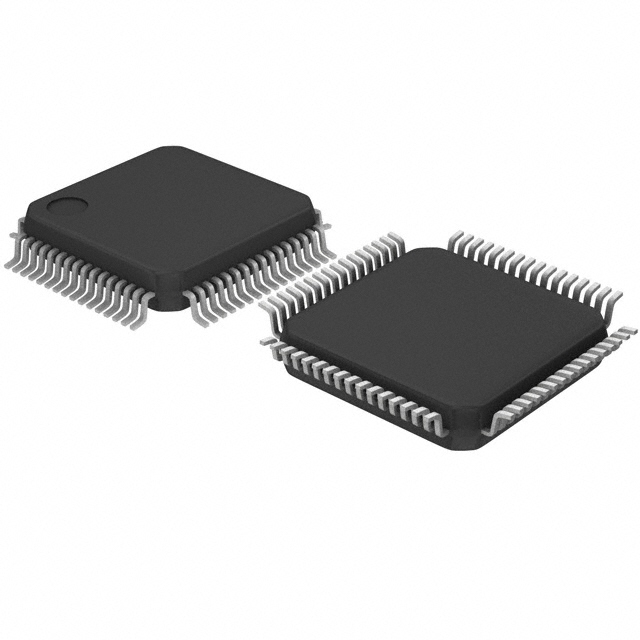
USB2504A-JT
Active4-PORT USB 2.0 HI-SPEED HUB CONTROLLER
Deep-Dive with AI
Search across all available documentation for this part.
USB2504A-JT
Active4-PORT USB 2.0 HI-SPEED HUB CONTROLLER
Deep-Dive with AI
Technical Specifications
Parameters and characteristics for this part
| Specification | USB2504A-JT |
|---|---|
| Current - Supply | 100 mA |
| Function | Hub Controller |
| Interface | USB |
| Operating Temperature [Max] | 70 °C |
| Operating Temperature [Min] | 0 °C |
| Package / Case | 64-LQFP |
| Protocol | USB |
| Standards | USB 2.0 |
| Supplier Device Package | 64-TQFP (10x10) |
| Voltage - Supply [Max] | 3.6 V |
| Voltage - Supply [Min] | 3 V |
Pricing
Prices provided here are for design reference only. For realtime values and availability, please visit the distributors directly
| Distributor | Package | Quantity | $ | |
|---|---|---|---|---|
| Digikey | Tray | 1 | $ 5.09 | |
| 25 | $ 4.25 | |||
| 100 | $ 3.86 | |||
| Microchip Direct | TRAY | 1 | $ 5.09 | |
| 25 | $ 4.25 | |||
| 100 | $ 3.86 | |||
| 1000 | $ 3.74 | |||
| 5000 | $ 3.70 | |||
Description
General part information
USB2504A Series
The USB2504 4-port hub controller is fully compliant with the USB 2.0 Specification and does not require firmware development. When connected to a USB high-speed host, the four downstream ports can operate at low-speed (1.5Mb/s), full-speed (12Mb/s), or high-speed (480Mb/s). As required by the USB 2.0 Specification, the USB2504 is fully backward compatible with legacy USB full-speed hosts.
A default configuration is available in the USB2504 following a reset. This configuration may be sufficient for some applications when it is desired to save the expense of an EEPROM. The controller may be configured from a microcontroller or an external EEPROM. When using the microcontroller interface, the USB2504 appears as a SMBus slave device. The EEPROM interface supports a 2-wire I²C device.
All required resistors on the USB ports are integrated into the USB2504. This includes all series termination resistors on D+ and D- pins and all required pull-down and pull-up resistors on D+ and D- pins. The over-current sense inputs for the downstream ports have internal pull-up resistors.
Documents
Technical documentation and resources