


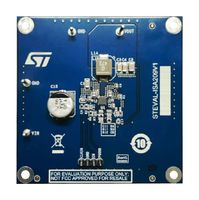
STEVAL-ISA209V1
ActivePOWER MANAGEMENT IC DEVELOPMENT TOOLS 38 V, 3 A SYNCHRONOUS STEP-DOWN SWITCHING REGULATOR EVALUATION BOARD BASED ON THE L6983NQTR
Deep-Dive with AI
Search across all available documentation for this part.
STEVAL-ISA209V1
ActivePOWER MANAGEMENT IC DEVELOPMENT TOOLS 38 V, 3 A SYNCHRONOUS STEP-DOWN SWITCHING REGULATOR EVALUATION BOARD BASED ON THE L6983NQTR
Deep-Dive with AI
Technical Specifications
Parameters and characteristics for this part
| Specification | STEVAL-ISA209V1 |
|---|---|
| Contents | Board(s) |
| Current - Output | 3 A |
| Main Purpose | DC/DC, Step Down |
| Outputs and Type | 1 Non-Isolated Output |
| Regulator Topology | Buck |
| Utilized IC / Part | L6983 |
| Voltage - Input [Max] | 38 V |
| Voltage - Input [Min] | 3.5 V |
Pricing
Prices provided here are for design reference only. For realtime values and availability, please visit the distributors directly
Description
General part information
STEVAL-ISA209V1 Series
The L6983 is an easy to use synchronous monolithic step-down regulator capable of delivering up to 3 A DC to the load, and the wide input voltage range makes the device suitable for a broad range of applications. The L6983NQTR used in this evaluation board is based on peak current mode architecture and is packaged in a QFN16 3x3 with internal compensation, thus minimizing design complexity and size.
The L6983 is available in low consumption mode (LCM) and low noise mode (LNM) versions. LCM maximizes the efficiency at light-load with controlled output voltage ripple, which is ideal for battery-powered applications. LNM sets the switching frequency and minimizes the output voltage ripple overload current range, meeting the specification for low noise sensitive applications.
The L6983 allows a 200 Hz - 2.2 MHz switching frequency range with optional spread spectrum for improved EMC. The EN pin provides an enable/disable function, and the typical shutdown current is 2 μA when disabled. As soon as the EN pin is pulled up, the device is enabled and an internal 1.3 ms soft-start sequence is triggered.
Documents
Technical documentation and resources