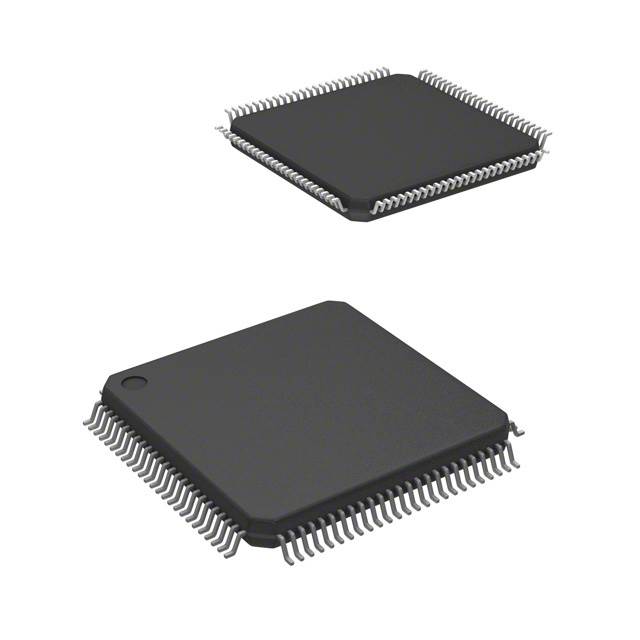
ATSAMG53N19A-AU
ActiveTQFP, IND TEMP 100 LQFP 14X14X1.4MM TRAY ROHS COMPLIANT: YES
Deep-Dive with AI
Search across all available documentation for this part.
ATSAMG53N19A-AU
ActiveTQFP, IND TEMP 100 LQFP 14X14X1.4MM TRAY ROHS COMPLIANT: YES
Deep-Dive with AI
Technical Specifications
Parameters and characteristics for this part
| Specification | ATSAMG53N19A-AU |
|---|---|
| Connectivity | I2C, SPI, UART/USART |
| Core Processor | ARM® Cortex®-M4 |
| Core Size | 32-Bit Single-Core |
| Data Converters [custom] | 12 b |
| Data Converters [custom] | 8 |
| Mounting Type | Surface Mount |
| Operating Temperature [Max] | 85 °C |
| Operating Temperature [Min] | -40 °C |
| Oscillator Type | Internal |
| Package / Case | 100-LQFP |
| Peripherals | I2S, WDT, POR, DMA, PWM |
| Program Memory Size | 512 KB |
| Program Memory Type | FLASH |
| RAM Size | 96 K |
| Speed | 48 MHz |
| Supplier Device Package | 100-LQFP (14x14) |
| Voltage - Supply (Vcc/Vdd) [Max] | 3.6 V |
| Voltage - Supply (Vcc/Vdd) [Min] | 1.62 V |
Pricing
Prices provided here are for design reference only. For realtime values and availability, please visit the distributors directly
| Distributor | Package | Quantity | $ | |
|---|---|---|---|---|
| Digikey | Tray | 180 | $ 3.85 | |
| Microchip Direct | TRAY | 1 | $ 4.68 | |
| 25 | $ 4.27 | |||
| 100 | $ 3.85 | |||
| 1000 | $ 3.54 | |||
| 5000 | $ 3.37 | |||
| Newark | Each | 100 | $ 3.97 | |
Description
General part information
ATSAMG53 Series
The Microchip's SAM G53 has an ARM® Cortex®-M4 core with an FPU (floating point unit) to maximize data throughput. This allows you to minimize the active-mode power consumption and get the core into sleep mode faster, which will reduce the overall power consumption.
The device has 16 DMA channels, which contribute to the extremely high throughput.
The combination of ultra-low power consumption, fast wake-up time, and high throughput is what gives the SAM G53 the edge in space- and power-constrained consumer applications such as sensor hubs. It wakes up quickly, has the throughput needed to reduce the amount of time spent in active mode, and then goes back to sleep with SRAM retention to conserve energy.
Documents
Technical documentation and resources