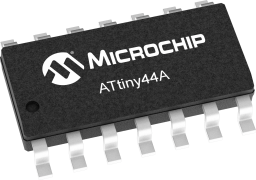
ATTINY44A-SSNR
ActiveMCU 8-BIT ATTINY AVR RISC 4KB FLASH 2.5V/3.3V/5V 14-PIN SOIC W T/R
Deep-Dive with AI
Search across all available documentation for this part.
ATTINY44A-SSNR
ActiveMCU 8-BIT ATTINY AVR RISC 4KB FLASH 2.5V/3.3V/5V 14-PIN SOIC W T/R
Technical Specifications
Parameters and characteristics for this part
| Specification | ATTINY44A-SSNR |
|---|---|
| Connectivity | USI |
| Core Processor | AVR |
| Core Size | 8-Bit |
| Data Converters [custom] | 8 |
| Data Converters [custom] | 10 |
| EEPROM Size | 256 x 8 |
| Mounting Type | Surface Mount |
| Number of I/O | 12 |
| Operating Temperature [Max] | 105 °C |
| Operating Temperature [Min] | -40 °C |
| Oscillator Type | Internal |
| Package / Case | 14-SOIC |
| Package / Case [x] | 0.154 in |
| Package / Case [y] | 3.9 mm |
| Peripherals | PWM, WDT, Brown-out Detect/Reset, POR, Temp Sensor |
| Program Memory Size | 4 KB |
| Program Memory Type | FLASH |
| RAM Size | 256 x 8 |
| Speed | 20 MHz |
| Voltage - Supply (Vcc/Vdd) [Max] | 5.5 V |
| Voltage - Supply (Vcc/Vdd) [Min] | 1.8 V |
Pricing
Prices provided here are for design reference only. For realtime values and availability, please visit the distributors directly
| Distributor | Package | Quantity | $ | |
|---|---|---|---|---|
| Digikey | Cut Tape (CT) | 1 | $ 1.03 | |
| 25 | $ 0.93 | |||
| 100 | $ 0.85 | |||
| Digi-Reel® | 1 | $ 1.03 | ||
| 25 | $ 0.93 | |||
| 100 | $ 0.85 | |||
| Tape & Reel (TR) | 3000 | $ 0.85 | ||
| Microchip Direct | T/R | 1 | $ 1.03 | |
| 25 | $ 0.93 | |||
| 100 | $ 0.85 | |||
| 1000 | $ 0.77 | |||
| 5000 | $ 0.74 | |||
Description
General part information
ATtiny44A Series
The high-performance Microchip picoPower® 8-bit AVR® RISC-based microcontroller combines 4 KB ISP Flash memory, 256B EEPROM, 256B SRAM, 12 general purpose I/O lines, 32 general purpose working registers, an 8-bit timer/counter with two PWM channels, a 16-bit timer/counter with two PWM channels, internal and external interrupts, an 8-channel 10-bit A/D converter, programmable gain stage (1x, 20x) for 12 differential ADC channel pairs, programmable watchdog timer with internal oscillator, internally calibrated oscillator, and four software selectable power saving modes. The device operates between 1.8-5.5 volts.
By executing powerful instructions in a single clock cycle, the device achieves throughputs approaching one MIPS per MHz, balancing power consumption and processing speed.
Documents
Technical documentation and resources