Deep-Dive with AI
Search across all available documentation for this part.
Deep-Dive with AI
Technical Specifications
Parameters and characteristics for this part
| Specification | HMC618ALP3ETR |
|---|---|
| Current - Supply | 89 mA |
| Frequency [Max] | 2.2 GHz |
| Frequency [Min] | 1.2 GHz |
| Gain | 23 dBi |
| Mounting Type | Surface Mount |
| Noise Figure | 0.75 dB |
| P1dB | 20 dBm |
| Package / Case | 16-VFQFN Exposed Pad |
| RF Type | WiMax, LTE |
| Supplier Device Package | 16-QFN (3x3) |
| Test Frequency [Max] | 2 GHz |
| Test Frequency [Min] | 1.7 GHz |
| Voltage - Supply [Max] | 5 V |
| Voltage - Supply [Min] | 3 V |
Pricing
Prices provided here are for design reference only. For realtime values and availability, please visit the distributors directly
| Distributor | Package | Quantity | $ | |
|---|---|---|---|---|
| Digikey | Bulk | 34 | $ 8.92 | |
| Cut Tape (CT) | 1 | $ 16.15 | ||
| 10 | $ 12.59 | |||
| 25 | $ 11.54 | |||
| 100 | $ 10.27 | |||
| 250 | $ 9.60 | |||
| Digi-Reel® | 1 | $ 16.15 | ||
| 10 | $ 12.59 | |||
| 25 | $ 11.54 | |||
| 100 | $ 10.27 | |||
| 250 | $ 9.60 | |||
| Tape & Reel (TR) | 500 | $ 7.72 | ||
Description
General part information
HMC618A Series
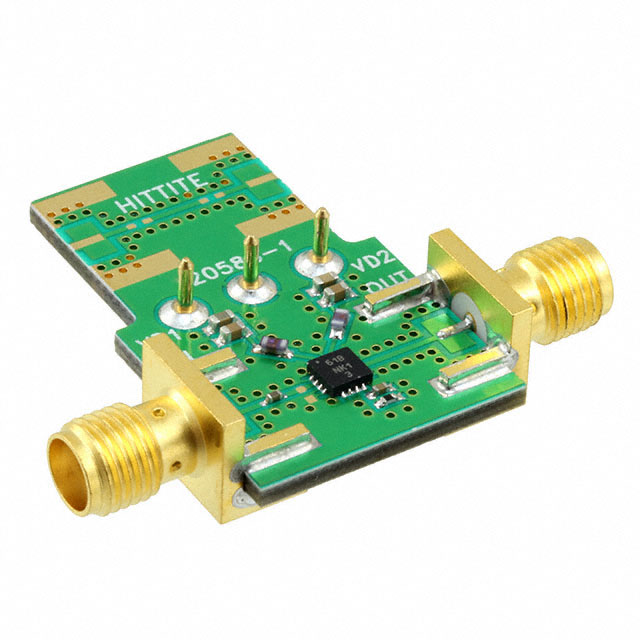
The HMC618ALP3E is a GaAs pHEMT MMIC Low Noise Amplifier that is ideal for Cellular/3G and LTE/WiMAX/4G basestation front-end receivers operating between 1.2 - 2.2 GHz. The amplifier has been optimized to provide 0.75 dB noise figure, 19 dB gain and +36 dBm output IP3 from a single supply of +5V. Input and output return losses are excellent and the LNA requires minimal external matching and bias decoupling components. The HMC618ALP3E shares the same package and pinout with the HMC617LP3E 0.55 - 1.2 GHz LNA. The HMC618ALP3E can be biased with +3V to +5V and features an externally adjustable supply current which allows the designer to tailor the linearity performance of the LNA for each application. The HMC618ALP3E offers improved noise figure versus the previously released HMC375LP3(E) and the HMC382LP3(E).ApplicationsCellular/3G and LTE/WiMAX/4GBTS & InfrastructureRepeaters and Femto CellsPublic Safety Radio
Documents
Technical documentation and resources