


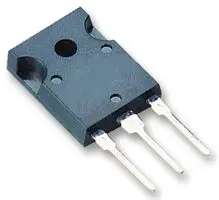
STPSC20H065CWY
ActiveSILICON CARBIDE SCHOTTKY DIODE, SIC, 650V SERIES, DUAL COMMON CATHODE, 650 V, 20 A, 28.5 NC, TO-247
STPSC20H065CWY
ActiveSILICON CARBIDE SCHOTTKY DIODE, SIC, 650V SERIES, DUAL COMMON CATHODE, 650 V, 20 A, 28.5 NC, TO-247
Technical Specifications
Parameters and characteristics for this part
| Specification | STPSC20H065CWY |
|---|---|
| Current - Average Rectified (Io) (per Diode) | 10 A |
| Current - Reverse Leakage @ Vr | 100 µA |
| Diode Configuration | 1 Pair Common Cathode |
| Grade | Automotive |
| Mounting Type | Through Hole |
| Operating Temperature - Junction [Max] | 175 ░C |
| Operating Temperature - Junction [Min] | -40 °C |
| Package / Case | TO-247-3 |
| Qualification | AEC-Q101 |
| Speed | 500 ns, 200 mA |
| Supplier Device Package | TO-247-3 |
| Technology | SiC (Silicon Carbide) Schottky |
| Voltage - DC Reverse (Vr) (Max) [Max] | 650 V |
| Voltage - Forward (Vf) (Max) @ If [Max] | 1.75 V |
Pricing
Prices provided here are for design reference only. For realtime values and availability, please visit the distributors directly
Description
General part information
STPSC20H065C-Y Series
The SiC diode is an ultrahigh performance power Schottky diode. It is manufactured using a silicon carbide substrate. The wide band gap material allows the design of a Schottky diode structure with a 650 V rating. Due to the Schottky construction, no recovery is shown at turn-off and ringing patterns are negligible. The minimal capacitive turn-off behavior is independent of temperature and are ideal for automotive applications.
Especially suited for use in PFC applications, this ST SiC diode will boost the performance in hard switching conditions. Its high forward surge capability ensures a good robustness during transient phases.