| Evaluation Boards | 1 | Obsolete | |
| DC/DC & AC/DC (Off-Line) SMPS Evaluation Boards | 1 | Obsolete | |
| Drivers, Receivers, Transceivers | 1 | Active | |
| Integrated Circuits (ICs) | 1 | Active | The HVD251 is intended for use in applications employing the Controller Area Network (CAN) serial communication physical layer in accordance with the ISO 11898 Standard. The HVD251 provides differential transmit capability to the bus and differential receive capability to a CAN controller at speeds up to 1 megabits per second (Mbps).
Designed for operation in harsh environments, the device features cross-wire, overvoltage and loss of ground protection to ±36 V. Also featured are overtemperature protection as well as –7-V to 12-V common-mode range, and tolerance to transients of ±200 V. The transceiver interfaces the single-ended CAN controller with the differential CAN bus found in industrial, building automation, and automotive applications.
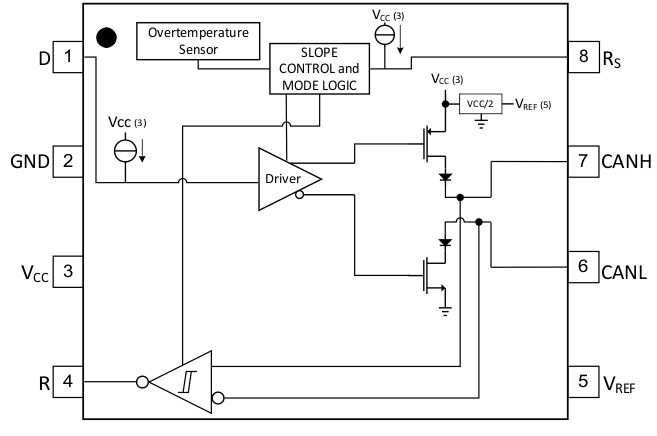
Rs, pin 8, selects one of three different modes of operation: high-speed, slope control, or low-power mode. The high-speed mode of operation is selected by connecting pin 8 to ground, allowing the transmitter output transistors to switch as fast as possible with no limitation on the rise and fall slope. The rise and fall slope can be adjusted by connecting a resistor to ground at pin 8; the slope is proportional to the pin’s output current. Slope control with an external resistor value of 10 kΩ gives about 15-V / µs slew rate; 100 kΩ gives about 2-V/µs slew rate.
If a high logic level is applied to the Rs pin 8, the device enters a low-current standby mode where the driver is switched off and the receiver remains active. The local protocol controller returns the device to the normal mode when it transmits to the bus.
The HVD251 is intended for use in applications employing the Controller Area Network (CAN) serial communication physical layer in accordance with the ISO 11898 Standard. The HVD251 provides differential transmit capability to the bus and differential receive capability to a CAN controller at speeds up to 1 megabits per second (Mbps).
Designed for operation in harsh environments, the device features cross-wire, overvoltage and loss of ground protection to ±36 V. Also featured are overtemperature protection as well as –7-V to 12-V common-mode range, and tolerance to transients of ±200 V. The transceiver interfaces the single-ended CAN controller with the differential CAN bus found in industrial, building automation, and automotive applications.
Rs, pin 8, selects one of three different modes of operation: high-speed, slope control, or low-power mode. The high-speed mode of operation is selected by connecting pin 8 to ground, allowing the transmitter output transistors to switch as fast as possible with no limitation on the rise and fall slope. The rise and fall slope can be adjusted by connecting a resistor to ground at pin 8; the slope is proportional to the pin’s output current. Slope control with an external resistor value of 10 kΩ gives about 15-V / µs slew rate; 100 kΩ gives about 2-V/µs slew rate.
If a high logic level is applied to the Rs pin 8, the device enters a low-current standby mode where the driver is switched off and the receiver remains active. The local protocol controller returns the device to the normal mode when it transmits to the bus. |
| Interface | 2 | Obsolete | |
55LBC180Extended Temp Range RS-485 Transceiver | Interface | 2 | Active | The SN55LBC180, SN65LBC180 and SN75LBC180 combine a differential line driver and receiver with 3-state outputs and operate from a single 5-V supply. The driver and receiver have active-high and active-low enables, respectively, which can be externally connected to function as a direction control. The driver differential outputs and the receiver differential inputs are connected to separate terminals for full-duplex operation and are designed to present minimum loading to the bus whether disabled or powered off (VCC= 0). These parts feature a wide common-mode voltage range making them suitable for point-to-point or multipoint data-bus applications.
The devices also provide positive and negative output-current limiting and thermal shutdown for protection from line fault conditions. The line driver shuts down at a junction temperature of approximately 172°C.
The SN75LBC180 is characterized for operation over the commercial temperature range of 0°C to 70°C. The SN65LBC180 is characterized over the industrial temperature range of –40°C to 85°C.
The SN55LBC180 is characterized for operation over the military temperature range of –55°C to 125°C.
The SN55LBC180, SN65LBC180 and SN75LBC180 combine a differential line driver and receiver with 3-state outputs and operate from a single 5-V supply. The driver and receiver have active-high and active-low enables, respectively, which can be externally connected to function as a direction control. The driver differential outputs and the receiver differential inputs are connected to separate terminals for full-duplex operation and are designed to present minimum loading to the bus whether disabled or powered off (VCC= 0). These parts feature a wide common-mode voltage range making them suitable for point-to-point or multipoint data-bus applications.
The devices also provide positive and negative output-current limiting and thermal shutdown for protection from line fault conditions. The line driver shuts down at a junction temperature of approximately 172°C.
The SN75LBC180 is characterized for operation over the commercial temperature range of 0°C to 70°C. The SN65LBC180 is characterized over the industrial temperature range of –40°C to 85°C.
The SN55LBC180 is characterized for operation over the military temperature range of –55°C to 125°C. |
| Logic | 1 | Active | |
| Counters, Dividers | 1 | Active | |
| Latches | 1 | Active | |
| Power Management (PMIC) | 1 | Active | |