STTH8T06600 V tandem Extrafast Boost Diode | Single Diodes | 1 | Obsolete | This device is part of ST's second generation of 600 V tandem diodes. It has ultralow switching-losses with a minimized QRR(6 nC) that makes it perfect for use in circuits working in hard-switching mode. In particular the VF/QRRtrade-off positions this device between standard ultrafast diodes and silicon-carbide Schottky rectifiers in terms of price/performance ratio.
The device offers a new positioning giving more flexibility to power-circuit designers looking for good performance while still respecting cost constraints.
Featuring ST's Turbo 2 600 V technology, the device is particularly suited as a boost diode in continuous conduction mode power factor correction circuits. |
| Discrete Semiconductor Products | 2 | Active | |
| Thermal Management | 1 | Obsolete | |
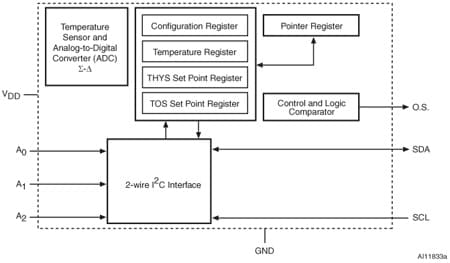
STTS20042.2 V memory module temperature sensor with a 4 Kb SPD EEPROM | Thermal Management | 1 | LTB | The STTS2004 is targeted for DDR4 DIMM modules in servers, desktops, and mobile personal computing platforms (laptops and other industrial applications). The thermal sensor (TS) in the STTS2004 is compliant with the JEDEC specification TSE2004a2, which defines memory module thermal sensor requirements for use in DRAM DIMMs (Dual Inline Memory Modules) with Serial Presence Detect (SPD), in which all the information concerning the DRAM module configuration (such as access speed, size, and organization) can be kept write-protected in one or more of the blocks of memory. The 4-Kbit serial EEPROM (SPD) in the STTS2004 is organized as two pages of 256 bytes each, or 512 bytes of total memory. Each page is comprised of two 128-byte blocks. The SPD is able to selectively lock the data in any or all of the four 128-byte blocks. The STTS2004 can interface to buses which have multiple devices on a shared bus, and each device has its own unique address on this bus. The device can achieve substantial power savings by using the software-programmed shutdown mode.
The TS-SPD EEPROM combination provides space as well as cost savings for mobile and server platform dual inline memory modules (DIMM) manufacturers, as it is packaged in the compact 2 mm x 3 mm 8-lead TDFN package with a thinner maximum height of 0.80 mm. The DN package is compliant to JEDEC MO-229, variation W2030D.
The digital temperature sensor has a programmable 9-12 bit analog-to-digital converter (ADC) which monitors and digitizes the temperature to a resolution of up to 0.0625 °C. The default resolution is 0.25 °C/LSB (10-bit). The typical accuracies over these temperature ranges are: ±2 °C over the full temperature measurement range of –20 °C to 125 °C, ±1 °C in the +40 °C to +125 °C active temperature range, and ±0.5 °C in the +75 °C to +95 °C monitor temperature range.
The temperature sensor in the STTS2004 is specified for operating at supply voltages from 2.2 V to 3.6 V. Operating at 3.3 V, the typical supply current is 160 μA (includes I2C communication current).
The on-board sigma-delta ADC converts the measured temperature to a digital value that is calibrated in °C. For Fahrenheit applications, a lookup table or conversion routine is required. The STTS2004 is factory-calibrated and requires no external components to measure temperature.
The digital temperature sensor component has user-programmable registers that provide the capabilities for DIMM temperature-sensing applications. The open drain event output pin is active when the monitoring temperature exceeds a programmable limit, or it falls above or below an alarm window. The user has the option to set the event output as a critical temperature output. This pin can be configured to operate in either a comparator mode for thermostat operation or in interrupt mode.
The STTS2004 is protocol-compatible with the 2 Kbit SPD in the STTS2002 and uses a page selection method which is applied to the lower or upper pages of the 4 Kbit SPD. Unlike the STTS2002, the STTS2004 does not support the Permanently Set Write Protect (PSWP) feature.
Locking a 128-byte block of the EEPROM is accomplished by using a software write protection mechanism in conjunction with a high input voltage VHVon the A0 input pin. A specific I2C sequence is used to protect each block from writes until write protection is electrically reversed using a separate I2C sequence which also requires VHVon input A0 pin of the device.
Write protection for all four blocks is cleared simultaneously, and write protection may be re-asserted after being cleared. |
| Expansion Boards, Daughter Cards | 1 | Active | |
STTS22HLow-voltage, ultralow-power, 0.5°C accuracy I²C/SMBus 3.0 temperature sensor | Sensors, Transducers | 1 | Active | The STTS22H is an ultralow-power, high-accuracy, digital temperature sensor offering high performance over the entire operating temperature range.
The STTS22H is a bandgap temperature sensor coupled with an A/D converter, signal processing logic, and an I²C/SMBus 3.0 interface all in a single ASIC.
This sensor is housed in a small 2 x 2 x 0.50 mm 6-lead UDFN package with exposed pad down for a better temperature match with the surrounding environment.
The STTS22H is factory calibrated and requires no additional calibration efforts on the customer side.
The STTS22H units are 100% tested on a production setup that is NIST traceable and verified with equipment that is calibrated in accordance with the IATF 16949:2016 standard. |
| Thermal Management | 2 | Obsolete | |
STTS75Temperature probe kit based on STTS75 | Development Boards, Kits, Programmers | 4 | Active | The STEVAL-MKI201V1K evaluation kit consists of a probe with the STTS75 temperature sensor connected via flat cable to the STEVAL-MKIGIBV1 adapter board, so it can interface with the STEVAL-MKI109V3 motherboard.
The device small package dimensions allow it to be mounted on top of a very thin probe, so it can take temperature readings not influenced by heat from other electronic components or boards.
The STEVAL-MKIGIBV1 can be plugged into a standard DIL24 socket.
The kit provides the complete STTS75 pinout and comes ready-to-use with the required decoupling capacitors on the VDD power supply line.
The STEVAL-MKI109V3 motherboards feature a high performance 32-bit microcontroller functioning as a bridge between the sensor and a PC running the free Unico GUI graphical user interface or dedicated software routines for customized applications. |
STTS7512.25 V low-voltage local digital temperature sensor | Evaluation Boards | 4 | Active | The STTS751 is a digital temperature sensor which communicates over a 2-wire SMBus 2.0 compatible bus. The temperature is measured with a user-configurable resolution between 9 and 12 bits. At 9 bits, the smallest step size is 0.5 °C, and at 12 bits, it is 0.0625 °C. At the default resolution (10 bits, 0.25 °C/LSB), the conversion time is nominally 21 milliseconds.
The open-drainEVENToutput is used to indicate an alarm condition in which the measured temperature has exceeded the user-programmed high limit or fallen below the low limit. When theEVENTpin is asserted, the host can respond using the SMBus Alert Response Address (ARA) protocol to which the STTS751 will respond by sending its slave address.
The STTS751 is a 6-pin device that supports user-configurable slave addresses. Via the pull-up resistor on the Addr/Thermpin, one of four different slave addresses can be specified. Two order numbers (STTS751-0 and STTS751-1) provide two different sets of slave addresses bringing the total available to eight. Thus, up to eight devices can share the same 2-wire SMBus without ambiguity, thereby allowing monitoring of multiple temperature zones in an application.
The two-wire interface can support transfer rates up to 400 kHz. |
| Discrete Semiconductor Products | 1 | Obsolete | |