S
STMicroelectronics
| Series | Category | # Parts | Status | Description |
|---|---|---|---|---|
| Part | Spec A | Spec B | Spec C | Spec D | Description |
|---|---|---|---|---|---|



| Series | Category | # Parts | Status | Description |
|---|---|---|---|---|
| Part | Spec A | Spec B | Spec C | Spec D | Description |
|---|---|---|---|---|---|
| Part | Category | Description |
|---|---|---|
 STMicroelectronics STEVAL-ISA068V1Obsolete | Development Boards Kits Programmers | EVAL BOARD FOR ST1S32 |
 STMicroelectronics 74VCXHQ163245TTRObsolete | Integrated Circuits (ICs) | IC TRANSLATION TXRX 2.7V 48TSSOP |
 STMicroelectronics | Development Boards Kits Programmers | VNQ9050LAJ EVALUATION BOARD |
 STMicroelectronics LSM303DLHCTRObsolete | Sensors Transducers | IMU ACCEL/MAG 3-AXIS I2C 14LGA |
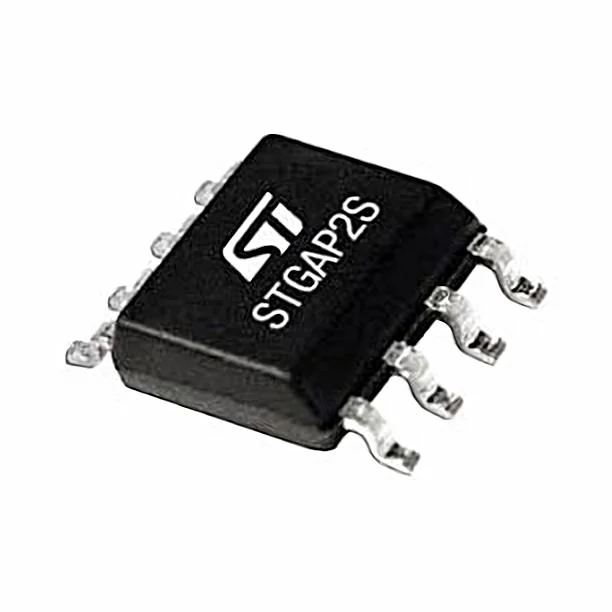 STMicroelectronics M93C56-WMN6TObsolete | Integrated Circuits (ICs) | EEPROM SERIAL-MICROWIRE 2K-BIT 256 X 8/128 X 16 3.3V/5V 8-PIN SO N T/R |
STMicroelectronics | Integrated Circuits (ICs) | STM32U |
 STMicroelectronics TS831-3IZObsolete | Integrated Circuits (ICs) | IC SUPERVISOR 1 CHANNEL TO92-3 |
 STMicroelectronics STMPE1208SQTRObsolete | Integrated Circuits (ICs) | IC I/O EXPANDER I2C 12B 40QFN |
 STMicroelectronics STM32L1-MAGNETObsolete | Development Boards Kits Programmers | IAR EXPERIMENT STM32 L1 EVAL BRD |
 STMicroelectronics VNB35N07Obsolete | Integrated Circuits (ICs) | IC PWR DRIVER N-CHAN 1:1 D2PAK |
| Series | Category | # Parts | Status | Description |
|---|---|---|---|---|
AEK-POW-LDOV01SAutomotive-grade LDO with configurable output voltage based on the L99VR01STR | Development Boards, Kits, Programmers | 1 | Active | The AEK-POW-LDOV01S is an evaluation board based on the L99VR01STR. It can be used in several electronic applications such as microcontroller supplies, automotive display drivers, sensors, and infotainment processors.
Thanks to its thermal performance up to 150°C, the device is suitable for electronic applications with high temperature environments and for applications requiring stable power supplies. |
| Linear Voltage Regulator Evaluation Boards | 1 | Active | ||
AEK-POW-SPSB081Automotive power management IC evaluation board with LIN and CAN-FD | Evaluation and Demonstration Boards and Kits | 1 | Active | The AEK-POW-SPSB081 is a power management IC evaluation board with enhanced power management functionalities, such as various standby modes to minimize power consumption with programmable local and remote wake-up capability.
The board is based on the SPSB081 power management system IC, which embeds one low-drop voltage regulator (V1) to supply the system microcontroller and another voltage regulator (V2) to be used as a voltage tracker of V1 or to supply external peripheral loads such as sensors.
V1 has a fixed rail of 5 V and features an overvoltage detection and protection solution, while V2 can work in two different ways: as a voltage tracker of V1, or as an independent voltage regulator programmable via SPI with 5 or 3.3 V.
Four high-side drivers allow supplying and driving LEDs and sensors. These high-side drivers are driven via SPI and can be configured in four different modes: OFF, ON, TIMED (with programmable time), and PWM (configurable via device registers).
Moreover, you can set the high-side driver output to be driven by the DIR pin. This functionality allows the user to generate custom PWM signals for the high-side outputs.
All outputs are short-circuit protected and detect open-load.
The communication protocol used to configure SPSB0815 registers is the SPI, implemented with four wires (MISO, MOSI, CSN, and CLK).
The AEK-POW-SPSB081 also exploits the LIN and CAN transceivers embedded in the IC, allowing the use of the board as a bridge between the microcontroller and the CAN or LIN communication lines.
An external microcontroller (for example, when using an AEK-MCU-C1MLIT1) has to refresh periodically a watchdog TRIG bit in the SPSB081 register via SPI, to maintain the device in active mode.
In case of watchdog failure, the device enters the V1_standby (for energy saving). To wake it up, send a pulse to the WU1_IN pin or just press the S1 button.
By placing a jumper on JP1, the device enters the debug mode where the watchdog is inactive.
Three demos are available in the AutoDevKit ecosystem, each of them based on a different SPC58 microcontroller evaluation board plus an AEK-POW-SPSB081.
The demos show how to use the outputs, configuring them in four different modes: OUT 1 for ON, OUT 2 for TIMED, OUT 3 for PWM and OUT 4 for DIR.
V2 is configured as a linear regulator and changes settings alternatively every 2.5 seconds between 3.3 and 5 V.
CAN connector and CAN_rx/CAN_tx pins are then connected to the microcontroller board.
The CAN test signals transmitted from the microcontroller every five seconds can be effectively decoded through CAN_H/CAN_L pins. |
AEK-SNS-2TOFM1Predefined gesture detection system based on FlightSense technology sensors | Evaluation Boards | 1 | Active | The AEK-SNS-2TOFM1 includes two Time-of-Flight distance-ranging sensors placed at a distance of 23 cm one from the other.
The on-board SPC582B60E1 microcontroller reads the sensor data and detects a predefined hand/foot gesture.
This solution is designed for power liftgate applications, to open/close the trunk with a predefined foot movement.
The AEK-SNS-2TOFM1 evaluation board firmware is preloaded. It is enabled for an external CAN bus driving.
The AutoDevKit software library (STSW-AUTODEVKIT) includes a CAN bus-driving example based on the SPC58EC Chorus 4M. |
AEK-USB-2TYPEC1USB Type-C™ and Power Delivery dual port interface board with automotivegrade STUSB1702Y USB Type-C controller | Evaluation and Demonstration Boards and Kits | 1 | Active | The AEK-USB-2TYPEC1 automotive grade USB Type-C and Power Delivery dual port expansion board is part of the ST AutoDevKit development initiative. It embeds two STUSB1702Y USB Type-C™ port controllers for a two-port Provider solution.
Each STUSB1702Y USB Type-C port controller includes a fully-featured USB type-C state machine for attach/detach and cable orientation detection, a USB PD PHY and BMC transceiver, high voltage (20 V) technology VBUSvoltage monitoring, 600 mA VCONN power switch, VBUS and VCONN discharge paths, 22 V CC line protection, VBUS switch gate drivers and data role configuration (not used in this case).
The two USB Type-C ports have USB 2.0 data lines that are accessible through on-board connectors J101 and J102. The same connectors may be used to redirect the data from one of the two USB 2.0 ports to the 4x20 pass-through connector.
The board also has a power status LED and three status LEDs to signal what each Type-C port is advertising: power role, VBUS negotiation status and CC line orientation (direct or flipped). Two alternate function connectors (not mounted) are available for extension or future developments.
The AEK-USB-2TYPEC1 board is designed to be connected to a SPC58 Chorus 4 MB flash discovery board (SPC58EC-DISP) equipped with a 32-bit Power Architecture®microcontroller for automotive ASIL-B applications. The AEKD-USBTYPEC1 kit consists of two boards and a USB-PD firmware package, so you can develop application based on the USB-PD Provider role.
The AEK-USB-2TYPEC1 embeds a connector for an external power board, which would allow the system to deliver output voltage profiles up to 20 V and satisfy various power requests according to the USB Power Delivery specification. |
AEKDLoads for Adaptive Front Lighting (AFL) system with LED lights, motors and cooling fan | Sensor Evaluation Boards | 5 | Active | The AEKD-AFL001 represents the complete logic and driving hardware for an adaptive front lighting system for prototyping, testing, and development purposes.
It consists of several AutoDevKit boards designed for motor vehicle application development featuring ST automotive-grade components.
The set includes two stepper motor control boards, a four-channel LED driver board, a control board with MCU, a connector board with a FAN switch board and another connector board for wiring configuration.
The adaptive front lighting system firmware runs on the control board automotive-grade SPC5 chorus MCU and allows independent control of all the function boards and their respective loads.
The package also includes sample applications to help users familiarize themselves with the code quickly.
The firmware is available in the STSW-AUTODEVKIT studio. Just import the related project named 'SPC58ECXX_RLA adaptive front lighting (AFL)'.
You can also order our fully compatible demo motor vehicle front lighting assembly (AEKD-AFLLIGHT1) with LED lights, stepper motors, and a fan to provide a complete adaptive front lighting tool for application and solution development purposes. |
AEKD-AICAR1Automotive AI on the edge for car state classification | Embedded MCU, DSP Evaluation Boards | 1 | Active | The AEKD-AICAR1 is a versatile system based on a long-short term memory (LSTM) recurrent neural network (RNN), which can provide a car state classification: car parked, car driving on normal road conditions, car driving on a bumpy road, car skidding or swerving.
The innovative idea in the AEKD-AICAR1 is to define an ECU detection node with an embedded artificial intelligence processing.
The AEKD-AICAR1 houses an SPC58EC chorus 4Mbytes microcontroller, which can acquire discrete acceleration variations on a three-axis reference system.
The AEKD-AICAR1 system represents a reference for the automotive AI on the edge processing.
It is possible to replace easily the sensor with another one that belongs to the ST MEMS family. It is also possible to modify the neural network and/or retrain the neural network. The new neural network is converted into a library executable by the MCU using SPC5-STUDIO-AI. |
AEKD-USBTYPEC1USB Type-C™ and USB Power Delivery evaluation kit based on the automotive grade SPC58 MCU and AutoDevKit development initiative | Development Boards, Kits, Programmers | 1 | Active | The AEKD-USBTYPEC1 evaluation kit is designed to let you test the USB Power Delivery protocol stack implemented on the ASIL-B automotive grade 32-bit Power Architecture®microcontroller SPC58 C (Chorus) line (from 1 to 10 MB flash, single or multi-core, including ISO CAN FD and Ethernet peripherals). |
AIS25Ultralow-noise, wide bandwidth, 3-axis accelerometer with TDM interface for automotive applications | Motion Sensors | 2 | Active | The STEVAL-MKI226KA evaluation kit is based on the AIS25BA 3-axis digital accelerometer. The kit is connected to a generic adapter board (STEVAL-MKIGI03B) through a flat cable, to make it compatible with the STEVAL-MKI109V3.
The sensing board can be directly attached to the system to be measured through the provided adhesive.
The AIS25BA is soldered exactly in the center of the board.
The STEVAL-MKIGI03B can be plugged into a standard DIL 24 socket. The kit provides the complete AIS25BA pinout and comes ready-to-use with the required decoupling capacitors on the VDD power supply line.
The STEVAL-MKI109V3 motherboard supports this adapter. The motherboard includes a high performance 32-bit microcontroller functioning as a bridge between the sensor and a PC.
It is possible to use the downloadable graphical user interface (Unico-GUI) or dedicated software routines for customized applications.
The adapter board can be also plugged into the X-NUCLEO-IKS01A2, X-NUCLEO-IKS01A3, and X-NUCLEO-IKS02A1 expansion boards. |
AIS2DW12MEMS digital output motion sensor: ultra-low-power 3-axis accelerometer for automotive applications | Sensors, Transducers | 1 | Active | The AIS2DW12 is an ultra-low-power three-axis linear accelerometer which leverages on the robust and mature manufacturing processes already used for the production of micromachined accelerometers and designed to address non-safety automotive applications.
The AIS2DW12 has four different ultra-low-power modes, two user-selectable full scales (±2g/±4g) and is capable of measuring accelerations with output data rates from 1.6 Hz to 100 Hz.
The AIS2DW12 has an integrated 32-level first-in, first-out (FIFO) buffer allowing the user to store data in order to limit intervention by the host processor.
The embedded self-test capability allows the user to check the functioning of the sensor in the final application.
The AIS2DW12 has a dedicated internal engine to process motion and acceleration detection including free-fall, motion and no-motion, wakeup, activity/inactivity and 6D/4D orientation.
The AIS2DW12 is available in a small thin plastic land grid array package (LGA) and it is guaranteed to operate over an extended temperature range from -40 °C to +85 °C. |