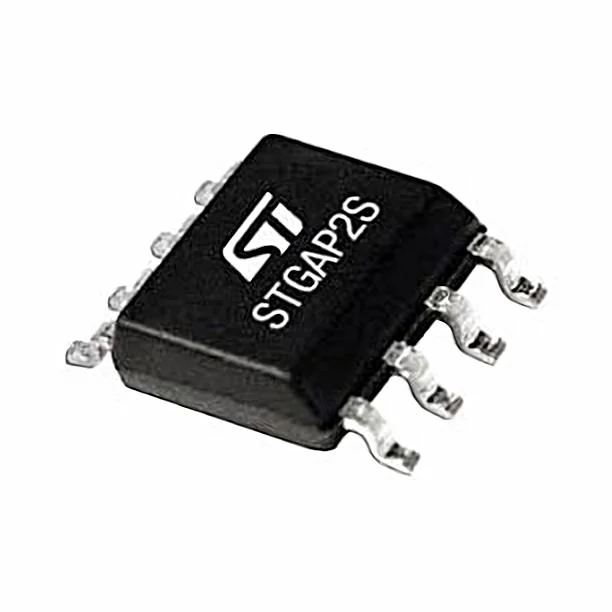
STEVAL-L6981NDR38 V, 1.5 A synchronous step-down switching regulator evaluation board based on the L6981NDR for industrial power systems | DC/DC & AC/DC (Off-Line) SMPS Evaluation Boards | 1 | Active | The STEVAL-L6981NDR is based on the L6981NDR synchronous monolithic step-down regulator delivering up to 1.5 A DC.
Its wide input voltage range makes the solution suitable for a broad range of applications.
The device implements peak current mode architecture in a SO 8L package with internal compensation to minimize design complexity and size.
The L6981 is available in low consumption mode (LCM) and low noise mode (LNM) versions.
LCM maximizes efficiency at light-load with controlled output voltage ripple, making the device extremely suitable for battery-powered applications.
LNM makes the switching frequency constant and minimizes the output voltage ripple overload current range, meeting the specification for noise sensitive applications.
The EN pin manages the enable/disable function. The typical shutdown current is 2 μA when disabled. When the EN pin is pulled up, the device is enabled and the internal 1.3 ms soft-start takes place.
Pulse-by-pulse current sensing on both power elements implements effective constant current protection while thermal shutdown prevents thermal run-away. |
STEVAL-L6982CDR38 V, 2 A synchronous step-down switching regulator evaluation board based on the L6982CDR | DC/DC & AC/DC (Off-Line) SMPS Evaluation Boards | 1 | Active | The STEVAL-L6982CDR evaluation board is based on the L6982CDR synchronous monolithic step-down regulator capable of delivering up to 2 A DC to the load.
Its wide input voltage range makes the device suitable for a broad range of applications.
The device implements peak current mode architecture in an SO 8L package with internal compensation to minimize design complexity and size.
The L6982 is available in low consumption mode version (LCM) as L6982CDR and low noise mode version (LNM) as L6982NDR.
LCM maximizes efficiency at light load with controlled output voltage ripple, making the device extremely suitable for battery-powered applications.
LNM makes the switching frequency constant and minimizes the output voltage ripple overload current range, meeting the specification for noise sensitive applications.
The EN pin manages the enable/disable function. The typical shutdown current is 2 μA when disabled. When the EN pin is pulled up, the device is enabled and the internal 1.3 ms soft-start takes place.
Pulse-by-pulse current sensing on both power elements implements effective constant current protection while thermal shutdown prevents thermal run-away. |
STEVAL-L6982NDR38 V, 2 A synchronous step-down switching regulator evaluation board based on the L6982NDR | Evaluation Boards | 1 | Active | The STEVAL-L6982NDR evaluation board is based on the L6982NDR synchronous monolithic step-down regulator capable of delivering up to 2 A DC to the load.
Its wide input voltage range makes the device suitable for a broad range of applications.
The device implements peak current mode architecture in a SO 8L package with internal compensation to minimize design complexity and size.
The L6982 is available both in low consumption mode (LCM) and low noise mode (LNM) versions.
LCM maximizes efficiency at light-load with controlled output voltage ripple, which is ideal for battery-powered applications.
LNM makes the switching frequency constant and minimizes the output voltage ripple overload current range, meeting the specification for noise sensitive applications.
The EN pin provides enable/disable function. The typical shutdown current is 2 μA when disabled.
When the EN pin is pulled up, the device is enabled and the internal 1.3 ms soft start takes place.
Pulse-by-pulse current sensing on both power elements implements effective constant current protection and thermal shutdown prevents thermal run-away. |
STEVAL-L6983IV138V, 10W synchronous iso-buck converter evaluation board based on L6983I | Evaluation Boards | 1 | Active | The STEVAL-L6983IV1 is an evaluation board based on ST L6983I, 38 V, 10 W synchronous iso-buck converter designed for isolated applications.
The primary output voltage can be accurately adjusted, whereas the isolated secondary output is derived by using a given transformer ratio. No optocoupler is required.
The primary sink capability up to -4.5 A (even during soft-start) allows a proper energy transfer to the secondary side as well as enables a tracked soft-start of the secondary output.
The control loop is based on a peak current mode architecture and the device operates in forced PWM. The 390 ns blanking time filters oscillations, generated by the transformer leakage inductance, making the solution more robust.
The compact QFN-16 3x3 mm package and the internal compensation of the L6983I help minimizing design complexity and size.
The switching frequency can be programmed in the 200 kHz - 1 MHz range with optional spread spectrum for improved EMC.
The EN pin provides enable/disable functionality. The typical shutdown current is 2 uA when disabled. As soon as the EN pin is pulled-up the device is enabled, and the internal 1.3 ms soft start takes place.
The L6983I features power good open collector that monitors the FB voltage. Pulse by pulse current sensing on both power elements implements an effective constant current protection and thermal shutdown prevents thermal run-away. Due to the primary reverse current limit, the secondary output is protected against short-circuit events.
The evaluation board generates an isolated unregulated voltage and provides the possibility to use a post-regulation to generate a dual voltage (layout available on the bottom of the PCB, components not mounted). |
STEVAL-L6986IV138 V, 5 W synchronous iso-buck converter evaluation board with dual isolated output based on the L6986I | Development Boards, Kits, Programmers | 1 | Active | The STEVAL-L6986IV1 evaluation board is based on L6986I 38 V, 5 W synchronous step-down switching regulator designed for isolated buck topology.
The primary output voltage can be accurately adjusted, whereas the isolated secondary output is generated by using a transformer. No optocoupler is required.
The primary sink capability (typ. 1.9 A) allows proper energy transfer to the secondary side as well as a tracked soft-start of the secondary output. The control loop is based on a peak current mode architecture and the device operates in forced PWM.
The 300 ns blanking time filters oscillations generated by the transformer leakage inductance, making the solution more robust. Pulse by pulse current sensing on both power elements implements an effective constant current protection on the primary side. Thanks to the primary reverse current limit, the secondary output is protected against short-circuit.
The secondary voltage is stabilized over current by using a power transistor and a shunt voltage reference (TL431AIL3T).
The STEVAL-L6986IV1 evaluation board generates two isolated voltages (positive around 18 V and negative between 4 and 5 V), particularly suitable for supplying the IGBT/SiC MOSFET gate driver for multiple applications. A simple by-pass enables the supply of a single isolated voltage. |
STEVAL-L7983ADJ12 V/0.3 A step down DC/DC converter (VIN = 12 to 60 V) based on the L7983PUR regulator | Evaluation Boards | 1 | Active | The STEVAL-L7983ADJ step-down switching power supply evaluation board is based on the L7983PUR regulator in an DFN10 3x3 mm package with 12 V set output voltage. The selected switching frequency is 1 MHz and it can be adjusted by applying an external clock on the LNM/LCM pin or by changing the frequency programming resistor.
The step-down monolithic switching regulator can deliver up to 300 mA DC based on peak current mode architecture. The wide input voltage range and adjustable UVLO threshold meet the specification for 12 V, 24 V and 48 V industrial bus standards.
L7983 supports dynamic Low Consumption Mode (LCM) to Low Noise Mode (LNM) transition. LCM is designed for applications with active idle mode to maximize the efficiency at light load with controlled output voltage ripple, while LNM keeps the switching frequency constant over the load current range for low noise applications.
The soft start time is internally fixed and the output voltage supervisor manages the reset phase for any digital load (MCU, FPGA, etc.).
The internal compensation network features high noise immunity, simple design and component cost savings. The RST open collector output can also implement output voltage sequencing during the power-up phase.
The synchronous rectification, designed for high efficiency at medium to heavy loads, and the high switching frequency capability contribute to size reduction in final application designs. Pulse-by-pulse current sensing on both power elements implements effective constant current protection. |
STEVAL-L7983V333.3 V/0.3 A step down DC/DC converter (VIN = 3.5 V to 60 V) based on the L7983PU33R | DC/DC & AC/DC (Off-Line) SMPS Evaluation Boards | 1 | Active | The STEVAL-L7983V33 product evaluation board is a step-down switching power supply based on the L7983PU33R regulator in a DFN10 3x3 mm package with fixed 3.3 V output voltage. The programmed switching frequency is 1 MHz and it can be adjusted by applying an external clock on LNM/LCM pin or by changing the frequency programming resistor.
The L7983 device is a step-down monolithic switching regulator able to deliver up to 300 mA DC based on peak current mode architecture. The wide input voltage range and adjustable UVLO threshold meet the specification for the 12 V, 24 V and 48 V industrial bus standards.
L7983 supports dynamic Low Consumption Mode (LCM) to Low Noise Mode (LNM) transition.
LCM is designed for applications which remain active in idle mode to maximize the efficiency under light load condition with controlled output voltage ripple. LNM makes the switching frequency constant over load current range, meeting the low noise application specification.
The soft start time is internally fixed and the output voltage supervisor manages the reset phase for any digital load (µC, FPGA, etc.).
The internal compensation network features high noise immunity, simple design and component cost reduction. The RST open collector output can also implement output voltage sequencing during the power-up phase.
Synchronous rectification, designed for high efficiency under medium to heavy load, and the high switching frequency capability reduce the application size. Pulse by pulse current sensing on both power elements implements an effective constant current protection. |
STEVAL-L7983V505.0 V / 0.3 A step down DC/DC converter (VIN = 5 to 60 V) based on the L7983PU50R regulator | Evaluation Boards | 1 | Active | The STEVAL-L7983V50 step-down switching power supply evaluation board is based on the L7983PU50R regulator in an DFN10 3x3 mm package with 5 V set output voltage. The selected switching frequency is 1 MHz and it can be adjusted by applying an external clock on the LNM/LCM pin or by changing the frequency programming resistor.
The step-down monolithic switching regulator can deliver up to 300 mA DC based on peak current mode architecture. The wide input voltage range and adjustable UVLO threshold meet the specification for 12 V, 24 V and 48 V industrial bus standards.
L7983 supports dynamic Low Consumption Mode (LCM) to Low Noise Mode (LNM) transition. LCM is designed for applications with active idle mode to maximize the efficiency at light load with controlled output voltage ripple, while LNM keeps the switching frequency constant over the load current range for low noise applications.
The soft start time is internally fixed and the output voltage supervisor manages the reset phase for any digital load (MCU, FPGA, etc.).
The internal compensation network features high noise immunity, simple design and component cost savings. The RST open collector output can also implement output voltage sequencing during the power-up phase.
The synchronous rectification, designed for high efficiency at medium to heavy loads, and the high switching frequency capability contribute to size reduction in final application designs. Pulse-by-pulse current sensing on both power elements implements effective constant current protection. |
STEVAL-L99615CUp to 5 cells BMS for industrial applications based on L9961 | Evaluation and Demonstration Boards and Kits | 1 | Active | The STEVAL-L99615C is an evaluation kit composed of an expansion board containing the L9961 IC device for battery pack monitoring solution, and the NUCLEO-G071RB STM32 Nucleo-64 development board.
The evaluation kit demonstrates the performance and the ease of integration of ST technology for BMS applications.
The STEVAL-L99615C exploits the characteristics of the L9961 able to monitor up to five Li-ion battery cells in series configuration, communicating with the STM32G071RB microcontroller, through an I²C interface.
The expansion board has been specifically developed to be stacked on the NUCLEO-G071RB development board through the morpho connectors. It embeds a power connector for the connection to a 5-cell battery pack or, alternatively to an external power supply to emulate the battery pack.
A dedicated software package containing firmware program for the STM32G071RB microcontroller and a GUI for the PC (STSW-L99615C), has been released to permit the users to take benefit from the demonstration.
Major characteristics described by STSW-L99615C are: cell voltage and stack voltage monitoring, stack current monitoring, temperature conversion via external NTC, OV, and UV thresholds management. |
STEVAL-LLL004V175 W digitally controlled constant current LED driver reference design | Development Boards, Kits, Programmers | 1 | Active | The STEVAL-LLL004V1 digitally controlled constant current LED driver reference design features a PFC stage and two DC-DC converters designed to work in transition mode (TM) for optimal efficiency.
The LED driver can deliver 75 W output power and implements both analog and digital techniques for flicker free dimming down to 0.5% of the maximum brightness level. The board features high efficiency, a very high power factor above 0.97, and a low THD across wide input voltage and load conditions, thanks to the high performance ST power products and the advanced algorithms running on the 32-bit STM32F0 microcontroller. |