ST232ABVERY HIGH SPEED, ULTRA LOW POWER CONSUMPTION 5V POWERED RS-232 DRIVERS AND RECEIVERS, [-40oC, 85oC] TEMPERATURE RANGE | Interface | 1 | Active | The ST232AB/AC is a 2 driver, 2 receiver device following EIA/TIA-232 and V.28 communication standard. It is particularly suitable for applications where ±12 V is not available. The ST232AB/AC uses a single 5 V power supply and only four external capacitors (0.1 µF). Typical applications are in: portable computers, low power modems, interfaces translation, battery powered RS-232 networks. |
ST232ACVERY HIGH SPEED, ULTRA LOW POWER CONSUMPTION 5V POWERED RS-232 DRIVERS AND RECEIVERS, [0oC, 70oC] TEMPERATURE RANGE | Drivers, Receivers, Transceivers | 1 | Active | The ST232AB/AC is a 2 driver, 2 receiver device following EIA/TIA-232 and V.28 communication standard. It is particularly suitable for applications where ±12 V is not available. The ST232AB/AC uses a single 5 V power supply and only four external capacitors (0.1 µF). Typical applications are in: portable computers, low power modems, interfaces translation, battery powered RS-232 networks. |
ST232B5V POWERED MULTI-CHANNEL RS-232 DRIVERS AND RECEIVERS, [-40oC, 85oC] TEMPERATURE RANGE | Integrated Circuits (ICs) | 1 | Active | The ST232 is a 2 driver, 2 receiver device following EIA/TIA-232 and V.28 communication standard. It is particularly suitable for applications where ±12V is not available. The ST232 uses a single 5V power supply and only four external capacitors (0.1μF). Typical applications are in: portable computers, low power modems, interfaces translation, battery powered RS-232 system, multi-drop RS-232 networks. |
ST232EB15kV ESD-protected 5 V RS-232 transceiver | Drivers, Receivers, Transceivers | 1 | Active | The ST202EB, ST202EC, ST232EB, and ST232EC are two-driver, two-receiver devices designed for RS-232 and V.28 communications in harsh environments. Each transmitter output and receiver input is protected against ± 15 kV electrostatic discharge (ESD) shocks. The drivers meet all EIA/TIA-232E and CCITT V.28 specifications at data rates up to 230 kbps, when loaded in accordance with the EIA/TIA-232E specification. The ST202EB, ST202EC, ST232EB, and ST232EC use a single 5 V supply voltage.
The ST232EB and ST232EC operate with four 1 µF capacitors, while the ST202EB and ST202EC operate with four 0.1 µF capacitors, further reducing cost and board space. |
ST232EC15KV ESD PROTECTED 5V RS-232 TRANSCEIVER, [0oC, 70oC] TEMPERATURE RANGE | Interface | 1 | Active | The ST202EB, ST202EC, ST232EB, and ST232EC are two-driver, two-receiver devices designed for RS-232 and V.28 communications in harsh environments. Each transmitter output and receiver input is protected against ± 15 kV electrostatic discharge (ESD) shocks. The drivers meet all EIA/TIA-232E and CCITT V.28 specifications at data rates up to 230 kbps, when loaded in accordance with the EIA/TIA-232E specification. The ST202EB, ST202EC, ST232EB, and ST232EC use a single 5 V supply voltage.
The ST232EB and ST232EC operate with four 1 µF capacitors, while the ST202EB and ST202EC operate with four 0.1 µF capacitors, further reducing cost and board space. |
| Integrated Circuits (ICs) | 2 | Obsolete | |
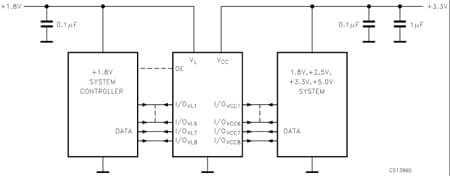
ST2378E8-bit Dual supply 1.71 V to 5.5 V level translator with I/O VCC +/-15 kV ESD protection | Integrated Circuits (ICs) | 1 | Active | The ST2378E device is an 8-bit, dual supply,bidirectional level translator with ±15 kV ESD protection on I/Os at VCCside. It is designed to interface data transfer between low voltage ASICs/PLDs and higher voltage systems. Externally applied voltage, VCCand VL, set logic levels at both sides with the range specified as 1.71 V ≤ VL≤ 5.5 V and VL≤ VCC≤ 5.5 V. For proper operation, VCCshould be set higher than VL.
Utilizing a transmission-gate-based design, this device allows bidirectional asynchronous data transfer, which means each channel is allowed to have either VCCto VLor VLto VCCdata transfer direction independently and no direction pin is required. The ST2378E device operates at a guaranteed data rate of 13 Mbps over the entire specified operating voltage range.
Among the other features, the OE pin allows disable mode operation whereby current consumption is reduced to less than 1 μA. |
| Transistors | 1 | Obsolete | |
ST2513.56 MHz short-range contactless memory chip with 512-bit EEPROM and anticollision fucntions | Evaluation Boards | 69 | Active | The ST25TB04K is a contactless memory, powered by an externally transmitted radio wave. It contains a 4096-bit user EEPROM. The memory is organized as 16 blocks of 32 bits. The ST25TB04K is accessed via the 13.56 MHz carrier. Incoming data are demodulated and decoded from the received amplitude shift keying (ASK) modulation signal and outgoing data are generated by load variation using bit phase shift keying (BPSK) coding of a 847 kHz sub-carrier. The received ASK wave is 10% modulated. The data transfer rate between the ST25TB04K and the reader is 106 kbit/s in both reception and emission modes.
The ST25TB04K follows the ISO 14443 - 2 Type B recommendation for the radio-frequency power and signal interface.
The ST25TB04K is specifically designed for short range applications that need re-usable products. The ST25TB04K includes an anticollision mechanism that allows it to detect and select tags present at the same time within range of the reader. The anticollision is based on a probabilistic scanning method using slot markers.
The ST25TB04K contact-less EEPROM can be randomly read and written in block mode (each block containing 32 bits). The instruction set includes the following nine commands:
The ST25TB04K memory is organized in three areas, as described in Table 1. The first area is a resettable OTP (one time programmable) area in which bits can only be switched from 1 to 0. Using a special command, it is possible to erase all bits of this area to 1. The second area provides two 32-bit binary counters which can only be decremented. The last area is the EEPROM memory. It is accessible by block of 32 bits and includes an auto-erase cycle during each Write_block command.
Die floor plan and physical options related to the die assembly are described in Figure 2.
For the option 1 of the die assembly, the CTUN (referenced in Table 2) can increase from 0.5pF to 1pF. The option 2 of the die assembly is showing a tripod which can be used for physical stability, having no impact on CTUN parameter. |
| RF, RFID, Wireless Evaluation Boards | 1 | Active | The ST25-TAG-BAG-AB is a ready-to-use tag set, containing tags based on NFC Forum Type 5 tag ICs (ST25TV512C and ST25TV02KC). These ICs are combined with antennas of different size and material, with advanced designs (like tamper detect), to address different applications.
The set is intended for evaluation of the ST25TV series NFC tags, belonging to the ST25T product family, offering long range (ISO/IEC 15693) NFC/RFID tags with advanced features and 512- and 2 K-bit memory sizes.
More info on devices of the ST25TV series can be found on the ST25TV webpage. |