S
STMicroelectronics
| Series | Category | # Parts | Status | Description |
|---|---|---|---|---|
| Part | Spec A | Spec B | Spec C | Spec D | Description |
|---|---|---|---|---|---|



| Series | Category | # Parts | Status | Description |
|---|---|---|---|---|
| Part | Spec A | Spec B | Spec C | Spec D | Description |
|---|---|---|---|---|---|
| Part | Category | Description |
|---|---|---|
 STMicroelectronics STEVAL-ISA068V1Obsolete | Development Boards Kits Programmers | EVAL BOARD FOR ST1S32 |
 STMicroelectronics 74VCXHQ163245TTRObsolete | Integrated Circuits (ICs) | IC TRANSLATION TXRX 2.7V 48TSSOP |
 STMicroelectronics | Development Boards Kits Programmers | VNQ9050LAJ EVALUATION BOARD |
 STMicroelectronics LSM303DLHCTRObsolete | Sensors Transducers | IMU ACCEL/MAG 3-AXIS I2C 14LGA |
 STMicroelectronics M93C56-WMN6TObsolete | Integrated Circuits (ICs) | EEPROM SERIAL-MICROWIRE 2K-BIT 256 X 8/128 X 16 3.3V/5V 8-PIN SO N T/R |
STMicroelectronics | Integrated Circuits (ICs) | STM32U |
 STMicroelectronics TS831-3IZObsolete | Integrated Circuits (ICs) | IC SUPERVISOR 1 CHANNEL TO92-3 |
 STMicroelectronics STMPE1208SQTRObsolete | Integrated Circuits (ICs) | IC I/O EXPANDER I2C 12B 40QFN |
 STMicroelectronics STM32L1-MAGNETObsolete | Development Boards Kits Programmers | IAR EXPERIMENT STM32 L1 EVAL BRD |
 STMicroelectronics VNB35N07Obsolete | Integrated Circuits (ICs) | IC PWR DRIVER N-CHAN 1:1 D2PAK |
| Series | Category | # Parts | Status | Description |
|---|---|---|---|---|
M48T201V5.0 or 3.3 V TIMEKEEPER® supervisor | Integrated Circuits (ICs) | 1 | Active | The M48T201Y/V are self-contained devices that include a real time clock (RTC), programmable alarms, a watchdog timer, and a square wave output which provides control of up to 512 K x 8 of external low-power static RAM. Access to all RTC functions and the external RAM is the same as conventional bytewide SRAM. The 16 TIMEKEEPER®registers offer year, month, date, day, hour, minute, second, calibration, alarm, century, watchdog, and square wave output data. Externally attached static RAMs are controlled by the M48T201Y/V via theGCONandECONsignals.
The 44-pin, 330 mil SOIC provides sockets with gold plated contacts at both ends for direct connection to a separate SNAPHAT®housing containing the battery and crystal. The unique design allows the SNAPHAT battery package to be mounted on top of the SOIC package after the completion of the surface mount process.
Insertion of the SNAPHAT housing after reflow prevents potential battery damage due to the high temperatures required for device surface-mounting. The SNAPHAT housing is keyed to prevent reverse insertion. The SOIC and battery packages are shipped separately in plastic anti-static tubes or in tape & reel form. For the 44-lead SOIC, the battery/crystal package (e.g. SNAPHAT) part number is M4Txx-BR12SH (see Table 19 on page 33). |
M48T201Y5.0 or 3.3 V TIMEKEEPER® supervisor | Clock/Timing | 1 | Active | The M48T201Y/V are self-contained devices that include a real time clock (RTC), programmable alarms, a watchdog timer, and a square wave output which provides control of up to 512 K x 8 of external low-power static RAM. Access to all RTC functions and the external RAM is the same as conventional bytewide SRAM. The 16 TIMEKEEPER®registers offer year, month, date, day, hour, minute, second, calibration, alarm, century, watchdog, and square wave output data. Externally attached static RAMs are controlled by the M48T201Y/V via theGCONandECONsignals.
The 44-pin, 330 mil SOIC provides sockets with gold plated contacts at both ends for direct connection to a separate SNAPHAT®housing containing the battery and crystal. The unique design allows the SNAPHAT battery package to be mounted on top of the SOIC package after the completion of the surface mount process.
Insertion of the SNAPHAT housing after reflow prevents potential battery damage due to the high temperatures required for device surface-mounting. The SNAPHAT housing is keyed to prevent reverse insertion. The SOIC and battery packages are shipped separately in plastic anti-static tubes or in tape & reel form. For the 44-lead SOIC, the battery/crystal package (e.g. SNAPHAT) part number is M4Txx-BR12SH (see Table 19 on page 33). |
| Integrated Circuits (ICs) | 1 | Obsolete | ||
| Clock/Timing | 1 | Obsolete | ||
M48T353.3 V, 256 Kbit (32 Kbit x 8) TIMEKEEPER® SRAM | Integrated Circuits (ICs) | 3 | Active | The M48T35AV TIMEKEEPER®RAM is a 32 Kbit x 8 non-volatile static RAM and real-time clock. The monolithic chip is available in two special packages to provide a highly integrated battery-backed memory and real-time clock solution.
The M48T35AV is a non-volatile pin and function equivalent to any JEDEC standard 32 Kb x 8 SRAM. It also easily fits into many ROM, EPROM, and EEPROM sockets, providing the non-volatility of PROMs without any requirement for special WRITE timing or limitations on the number of WRITEs that can be performed.
The 28-pin, 600 mil DIP CAPHAT™houses the M48T35AV silicon with a quartz crystal and a long-life lithium button cell in a single package.
The 28-pin, 330 mil SOIC provides sockets with gold plated contacts at both ends for direct connection to a separate SNAPHAT®housing containing the battery and crystal. The unique design allows the SNAPHAT battery package to be mounted on top of the SOIC package after the completion of the surface mount process. Insertion of the SNAPHAT housing after reflow prevents potential battery and crystal damage due to the high temperatures required for device surface-mounting. The SNAPHAT housing is keyed to prevent reverse insertion.
The SOIC and battery/crystal packages are shipped separately in plastic anti-static tubes or in tape & reel form.
For the 28-lead SOIC, the battery/crystal package part numbers are M4T28-BR12SH1 (48 mAh lithium battery SNAPHAT), M4T32-BR12SH1 (120 mAh lithium battery SNAPHAT), and M4T32-BR12SH6 (120 mAh lithium battery SNAPHAT, –40 to +85 °C crystal). |
M48T35AV3.3 V, 256 Kbit (32 Kbit x 8) TIMEKEEPER® SRAM | Clock/Timing | 1 | Active | The M48T35AV TIMEKEEPER®RAM is a 32 Kbit x 8 non-volatile static RAM and real-time clock. The monolithic chip is available in two special packages to provide a highly integrated battery-backed memory and real-time clock solution.
The M48T35AV is a non-volatile pin and function equivalent to any JEDEC standard 32 Kb x 8 SRAM. It also easily fits into many ROM, EPROM, and EEPROM sockets, providing the non-volatility of PROMs without any requirement for special WRITE timing or limitations on the number of WRITEs that can be performed.
The 28-pin, 600 mil DIP CAPHAT™houses the M48T35AV silicon with a quartz crystal and a long-life lithium button cell in a single package.
The 28-pin, 330 mil SOIC provides sockets with gold plated contacts at both ends for direct connection to a separate SNAPHAT®housing containing the battery and crystal. The unique design allows the SNAPHAT battery package to be mounted on top of the SOIC package after the completion of the surface mount process. Insertion of the SNAPHAT housing after reflow prevents potential battery and crystal damage due to the high temperatures required for device surface-mounting. The SNAPHAT housing is keyed to prevent reverse insertion.
The SOIC and battery/crystal packages are shipped separately in plastic anti-static tubes or in tape & reel form.
For the 28-lead SOIC, the battery/crystal package part numbers are M4T28-BR12SH1 (48 mAh lithium battery SNAPHAT), M4T32-BR12SH1 (120 mAh lithium battery SNAPHAT), and M4T32-BR12SH6 (120 mAh lithium battery SNAPHAT, –40 to +85 °C crystal). |
M48T35Y5 V, 256 Kbit (32 Kb x 8) TIMEKEEPER® SRAM | Real Time Clocks | 2 | Active | The M48T35/Y TIMEKEEPER®RAM is a 32 Kb x 8 non-volatile static RAM and real-time clock. The monolithic chip is available in two special packages to provide a highly integrated battery-backed memory and real-time clock solution.
The M48T35/Y is a non-volatile pin and function equivalent to any JEDEC standard 32 Kb x 8 SRAM. It also easily fits into many ROM, EPROM, and EEPROM sockets, providing the non-volatility of PROMs without any requirement for special WRITE timing or limitations on the number of WRITEs that can be performed.
The 28-pin, 600 mil DIP CAPHAT™houses the M48T35/Y silicon with a quartz crystal and a long life lithium button cell in a single package.
The 28-pin, 330 mil SOIC provides sockets with gold plated contacts at both ends for direct connection to a separate SNAPHAT®housing containing the battery and crystal. The unique design allows the SNAPHAT battery package to be mounted on top of the SOIC package after the completion of the surface mount process. Insertion of the SNAPHAT housing after reflow prevents potential battery and crystal damage due to the high temperatures required for device surface-mounting. The SNAPHAT housing is keyed to prevent reverse insertion. The SOIC and battery/crystal packages are shipped separately in plastic anti-static tubes or in tape & reel form.
For the 28-lead SOIC, the battery/crystal package (e.g., SNAPHAT) part number is "M4T28-BR12SH". |
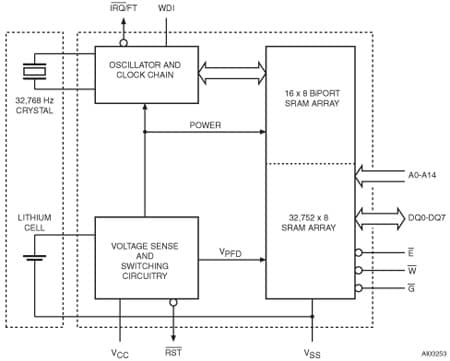
M48T375.0 or 3.3 V, 256 Kbit (32 Kbit x 8) TIMEKEEPER® SRAM | Integrated Circuits (ICs) | 5 | Active | The M48T37Y/V TIMEKEEPER®RAM is a 32 Kb x 8 non-volatile static RAM and real-time clock. The monolithic chip is available in a special package which provides a highly integrated battery-backed memory and real-time clock solution.
The 44-lead, 330 mil SOIC package provides sockets with gold-plated contacts at both ends for direct connection to a separate SNAPHAT housing containing the battery and crystal. The unique design allows the SNAPHAT®battery/crystal package to be mounted on top of the SOIC package after the completion of the surface mount process.
Insertion of the SNAPHAT housing after reflow prevents potential battery and crystal damage due to the high temperatures required for device surface-mounting. The SNAPHAT housing is keyed to prevent reverse insertion.
The SOIC and battery packages are shipped separately in plastic anti-static tubes or in tape & reel form. For the 44-lead SOIC, the battery/crystal package (e.g., SNAPHAT) part number is "M4T28-BR12SH" or "M4T32-BR12SH". |
M48T37Y5.0 or 3.3 V, 256 Kbit (32 Kbit x 8) TIMEKEEPER® SRAM | Real Time Clocks | 1 | Active | The M48T37Y/V TIMEKEEPER®RAM is a 32 Kb x 8 non-volatile static RAM and real-time clock. The monolithic chip is available in a special package which provides a highly integrated battery-backed memory and real-time clock solution.
The 44-lead, 330 mil SOIC package provides sockets with gold-plated contacts at both ends for direct connection to a separate SNAPHAT housing containing the battery and crystal. The unique design allows the SNAPHAT®battery/crystal package to be mounted on top of the SOIC package after the completion of the surface mount process.
Insertion of the SNAPHAT housing after reflow prevents potential battery and crystal damage due to the high temperatures required for device surface-mounting. The SNAPHAT housing is keyed to prevent reverse insertion.
The SOIC and battery packages are shipped separately in plastic anti-static tubes or in tape & reel form. For the 44-lead SOIC, the battery/crystal package (e.g., SNAPHAT) part number is "M4T28-BR12SH" or "M4T32-BR12SH". |
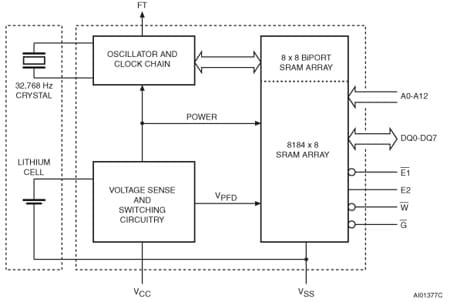
M48T585.0 V, 64 Kbit (8 Kb x 8) TIMEKEEPER® SRAM | Clock/Timing | 2 | Active | The M48T58/Y TIMEKEEPER®RAM is a 8 Kb x 8 non-volatile static RAM and real-time clock. The monolithic chip is available in two special packages to provide a highly integrated battery-backed memory and real-time clock solution.
The M48T58/Y is a non-volatile pin and function equivalent to any JEDEC standard 8b Kb x 8 SRAM. It also easily fits into many ROM, EPROM, and EEPROM sockets, providing the non-volatility of PROMs without any requirement for special WRITE timing or limitations on the number of WRITEs that can be performed.
The 28-pin, 600 mil DIP CAPHAT™houses the M48T58/Y silicon with a quartz crystal and a long life lithium button cell in a single package.
The 28-pin, 330 mil SOIC provides sockets with gold plated contacts at both ends for direct connection to a separate SNAPHAT®housing containing the battery and crystal. The unique design allows the SNAPHAT battery package to be mounted on top of the SOIC package after the completion of the surface mount process. Insertion of the SNAPHAT housing after reflow prevents potential battery and crystal damage due to the high temperatures required for device surface-mounting. The SNAPHAT housing is keyed to prevent reverse insertion. The SOIC and battery/crystal packages are shipped separately in plastic anti-static tubes or in tape & reel form.
For the 28-lead SOIC, the battery/crystal package (e.g., SNAPHAT) part number is "M4T28-BR12SH". |