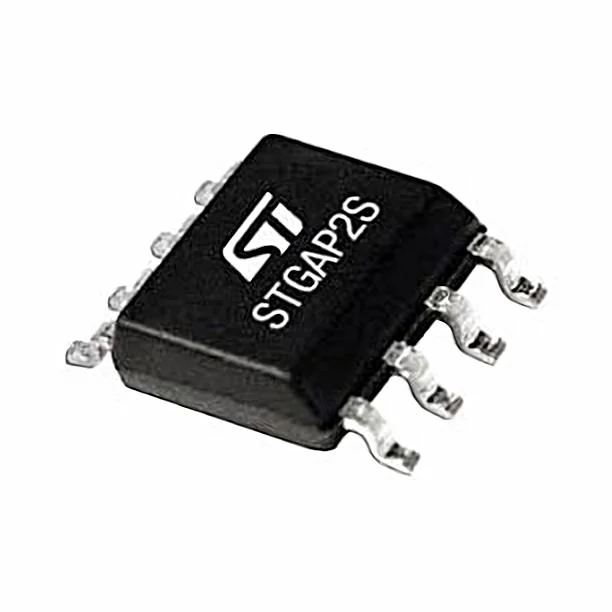
L9662Octal squib driver and quad Manchester/PSI5 encoded sensor interface ASIC for safety application | Integrated Circuits (ICs) | 1 | Active | The device is intended to deploy up to 8 squibs and to interface up to 4 satellites. 2 satellite interfaces can be used to interface Hall sensors. Squib drivers are sized to deploy 1.2 A minimum for 2 ms, 1.75 A minimum for 1 ms and 1.75 A minimum for 0.65 ms during load dump along with 1.5 A minimum for 2 ms for VRES voltages less than 25 V.
Full diagnostic capabilities of the squib interface are provided. Satellite interfaces support Manchester 1, 2 and PSI5 decoding with variable bit rate. |
| Integrated Circuits (ICs) | 4 | Active | |
| Integrated Circuits (ICs) | 1 | Active | |
| Interface | 2 | Active | |
L9678P-SLow end System Basis Chip for Airbag including PSI5 remote sensor interface | Integrated Circuits (ICs) | 1 | Active | The L9678P IC is a system chip solution targeted for emerging market applications. Base system designs can be completed with the L9678P, SPC560Px microcontroller and an on-board acceleration sensor or PSI5 sensor.
Energy reserve voltage is derived through a cost effective high frequency boost regulator. High frequency operation allows the user to pick up low value and cheap inductance. The voltage is programmable to 23 V or 33 V nominal.
Battery voltage is sensed through the VBATMON pin providing start-up and shutdown control for the system. Once battery voltage drops below the minimum operating voltage, the device enables the integrated crossover switch to permit orderly shutdown.
L9678P offers two linear regulators (5 V with external pass transistor and fully integrated 3.3 V). User can use one of these regulators to supply µC. Input/output pins are compatible with both ranges by dedicated supply pin VDDQ. External pass transistor gives the flexibility to easily address different current loads in case of different micro-controllers.
One optional 7.2 V linear regulator with external pass transistor can be used to supply remote sensor interface.
External acceleration data is received through the PSI-5 remote sensor interface. Both channels have independent decoders. Sensor data and diagnostics are available via SPI.
The safing logic monitors inertial sensors (remote sensors via PSI-5 or on-board sensors via SPI) to determine if a crash event is in progress, thereby enabling deployment to occur. Parameters for sensor configuration and thresholds are user programmable.
Squib/pyroswitch/pyroswitch deployment uses four independent high and low side drivers, capable of deploying at 25 V max. Diagnostic data control is provided through the SPI interface.
The Hall-effect, resistive or switch sensor interface can be used to determine the state of external switch devices, such as buckle switches, seat track position sensors, weight sensors, deactivation switches.
The integrated clock module provides a fixed clock signal for the microcontroller. The clock module provides the user the option of deleting the commonly used resonator or crystal. |
| Interface | 1 | Obsolete | |
L9679EAutomotive Extension Airbag IC | Integrated Circuits (ICs) | 1 | Active | The L9679E is an extension chip in airbag systems or a pyroswitch manager. This device is family-compatible with the L9679 and L9680 devices. The device includes an octal driver for squib/pyroswitch deployments and a quad channel interface for PSI-5 sensors. Deployment profiles can be set according to user specifications via SPI configuration, as well as the protocol to be used to communicate with the satellite sensors. Independent configurable arming inputs are provided for a programmable mapping of the loops to be deployed. |
L9679PAutomotive advanced airbag IC for mid/high end applications | Specialized | 2 | Active | The L9679P is a chip that can be used in advanced airbag systems for mature airbag markets or in cut-off battery systems for integrated safety markets. This device is family compatible with the L9678 and L9680 devices. Safety system integration is enabled through higher power supply currents and integrated PSI-5 satellite interface.
High frequency power supply design allows further cost reduction by using smaller and less expensive external components. All switching regulators operate at 1.882 MHz while buck converters have integrated synchronous rectifiers.
Additional attention is given to system integrity and diagnostics. The reserve capacitor is electrically isolated from the boost regulator by a 50 mA nominal fixed current source, controlling in-rush an additional capacitor discharge fixed current source is integrated to diagnose the reserve capacitor value and ESR. The same current sources can be used to discharge the capacitor at shutdown.
Thanks to low quiescent current, the device can be directly connected to battery. In this way, the device start-up and shutdown are controlled through the wake-up input function. The power supply and crossover function are controlled automatically through the internal state machine.
The user can select both ECU logic voltage (VCCat 3.3 V or 5.0 V) and energy reserve output voltage (at either 23 V or 33 V). Deployment voltage is set to a maximum of 25 V for all profiles and can be controlled through external safing switch circuit using the high side safing switch reference enabled through the system SPI interface or the arming logic. |
L9680Automotive advanced airbag IC for mid/high end applications | Interface | 2 | Active | The L9680 is a chip that can be used in advanced airbag systems for mature airbag markets or in cut-off battery systems for integrated safety markets. This device is family compatible with the L9678 and L9679 devices. Safety system integration is enabled through higher power supply currents and integrated active wheel speed sensor interface. The active wheel speed interface is shared with the PSI-5 satellite interface to create a generic remote safety sensor interface compliant to both systems.
High frequency power supply design allows further cost reduction by using smaller and less expensive external components. All switching regulators operate at 1.882 MHz while buck converters have integrated synchronous rectifiers.
Additional attention is given to system integrity and diagnostics. The ER capacitor is electrically isolated from the boost regulator by a fixed charge current circuit to control in-rush current. An additional discharge current circuit is integrated in the IC to measure the capacitance and the ESR of ER capacitor. The same current sources can be used to discharge the capacitor at shutdown.
Thanks to low quiescent current, the device can be directly connected to battery. In this way, the device start-up and shutdown are controlled through the wake-up input function. The power supply and crossover function are controlled automatically through the internal state machine.
The user can select both ECU logic voltage (VCCat 3.3 V or 5.0 V) and energy reserve output voltage (at either 23 V or 33 V). Deployment voltage is set to a maximum of 25 V for all profiles and can be controlled through external safing switch circuit using the high-side safing switch reference enabled through the system SPI interface or the arming logic. |
L9690Automotive 12 channels chip for advanced airbag applications | Integrated Circuits (ICs) | 1 | Active | The L9690 is an advanced airbag system chip solution targeted for the global airbag market.
High frequency power supply design optimizes system cost by using smaller and less expensive external components. All switching regulators operate at 2 MHz and all buck converters have integrated synchronous rectifiers.
The reserve capacitor is electrically isolated from the boost regulator by integrated switches and external resistors, controlling in-rush current. A capacitor discharge switch is integrated to discharge the capacitor at shutdown.
Low quiescent current permits the device to be directly connected to battery. In this mode, device start-up and shutdown are controlled through the wake-up input pin (actually, shutdown needs also dedicated SPI command too). The power supply and crossover function are controlled automatically through the internal state machine.
For systems with high feature content, two L9690 devices can be used in a master/slave configuration.
The L9690 provides two fully isolated deployment voltage regulators, using the external safing FETs as power elements in the regulator loop. Deployment voltage is set to a nominal 18V value to further optimize system cost.
Integrated safing logic uses a rolling average algorithm and decodes all sensor information within the system remote sensor SPI bus. Number of samples and thresholds are user-programmable. An alternative safing function permits arming from an external source through the Global SPI bus (E2E communication).
Dual SPI interfaces separate device global functions and remote sensors. LIN interface is available, providing OCS message decoding for passenger loop inhibition. |