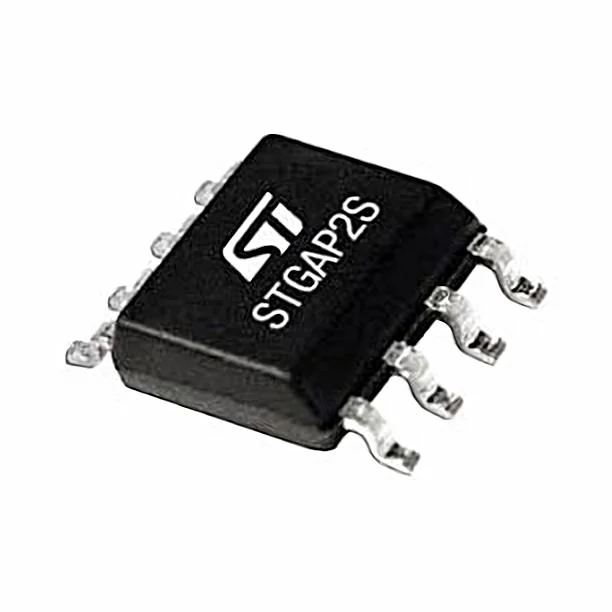
IPS161HFSingle channel high-side switches | Power Distribution Switches, Load Drivers | 2 | Active | The IPS160HF (Iout < 2.5 A) and IPS161HF (Iout < 0.7 A) are monolithic devices which can drive capacitive, resistive or inductive loads with one side connected to ground.
The 60 V operating range and Ron = 60 mΩ, combined with the extended diagnostic (Open Load, Over Load, Overtemperature) and the < 60 us propagation delay time at startup (enabling Class 3 for interface types C and D), make the IC suitable for applications implementing the proper architectures to address higher SIL levels.
The built-in overload and thermal shutdown protections guarantee the ICs, the application and the load against electrical and thermal overstress. Furthermore, in order to minimize the power dissipation when the output is shorted, a low-dissipative short-circuit protection (cut-off) is implemented to limit the output average current value and consequent device overheating. Cut-off delay time can be set by soldering an external capacitor or disabled by a resistor on pin 4 (CoD).
The DIAG common diagnostic open drain pin reports the open load in off-state, cut-off (overload) and thermal shutdown. |
IPS2050Industrial digital output expansion board based on IPS2050H-32 for STM32 Nucleo | Development Boards, Kits, Programmers | 4 | Active | The STEVAL-IFP044V1 is an industrial digital output expansion board. It provides a powerful and flexible environment for the evaluation of the driving and diagnostic capabilities of the IPS2050H-32 (dual high-side smart power solid state relay) in a digital output module connected to 5.7 A (max.) industrial loads.
The STEVAL-IFP044V1 can interface with the microcontroller on the STM32 Nucleo via 5 kV optocouplers driven by GPIO pins, Arduino UNO R3 (default configuration) and ST morpho (optional, not mounted) connectors.
The expansion board can be connected to either a NUCLEO-F401RE or NUCLEO-G431RB development board.
It is also possible to evaluate a system composed by up to four stacked STEVAL-IFP044V1 expansion boards.
As an example, a system with four STEVAL-IFP044V1 expansion boards allows you to evaluate an eight-channel digital output module with 5.7 A (max.) capability each. |
IPS2050HHigh efficiency, high-side switch with extended diagnostics and smart driving for capacitive loads | Power Management (PMIC) | 3 | Active | The IPS2050H/HQ and IPS2050H-32/HQ-32 are dual high-side switch ICs able to drive capacitive, resistive or inductive loads with one side connected to ground.
The very low RDS-ON(≤ 50 mΩ up to TJ= 125 °C) makes the IC suitable for applications with up to 2.4 A (IPS2050H/HQ) or 5.6 A (IPS2050H-32/HQ-32) steady state operating current.
Each output channel is independently protected against junction over-temperature events by a junction temperature sensor, and a further temperature sensor is included to monitor case temperature, so an overheated output channel can only be turned back ON when the case temperature returns below the reset temperature.
The embedded per-channel overload protection circuit monitors the output current and, on triggering of the activation threshold (IPK-X), starts modulating the impedance of the output switch to limit the output current to ILIM-X, for both IC and load protection.
The IC offers two different sets of activation threshold and limitation levels (IPKH-X, ILIMH-Xand IPKL-X, ILIML-X) for smart driving of capacitive loads (such as bulb lamps) and loads with initial peak current requirements.
The IC diagnostics is based on two FAULT pins (current source), one for each channel. Each FAULT pin is activated by an overload or an over-temperature event on the related channel. |
IPS2050H-32High efficiency, high-side switch with extended diagnostics and smart driving for capacitive loads | Power Distribution Switches, Load Drivers | 3 | Active | The IPS2050H/HQ and IPS2050H-32/HQ-32 are dual high-side switch ICs able to drive capacitive, resistive or inductive loads with one side connected to ground.
The very low RDS-ON(≤ 50 mΩ up to TJ= 125 °C) makes the IC suitable for applications with up to 2.4 A (IPS2050H/HQ) or 5.6 A (IPS2050H-32/HQ-32) steady state operating current.
Each output channel is independently protected against junction over-temperature events by a junction temperature sensor, and a further temperature sensor is included to monitor case temperature, so an overheated output channel can only be turned back ON when the case temperature returns below the reset temperature.
The embedded per-channel overload protection circuit monitors the output current and, on triggering of the activation threshold (IPK-X), starts modulating the impedance of the output switch to limit the output current to ILIM-X, for both IC and load protection.
The IC offers two different sets of activation threshold and limitation levels (IPKH-X, ILIMH-Xand IPKL-X, ILIML-X) for smart driving of capacitive loads (such as bulb lamps) and loads with initial peak current requirements.
The IC diagnostics is based on two FAULT pins (current source), one for each channel. Each FAULT pin is activated by an overload or an over-temperature event on the related channel. |
IPS4260Quad low-side intelligent power switch | Power Management (PMIC) | 2 | Active | The IPS4260L is a monolithic high speed (fSW up to 250 kHz) device, which can drive four independent capacitive, resistive or inductive loads with one side connected to supply voltage. The channels can be parallelized to reduce power dissipation. When connected to Vcc rail, four integrated catch diodes clamp the turn-off transients generated by inductive loads even with huge inductance; combined with proper external TVS connected to VCC or to GND the IC allows fast decay, too. Each channel is protected against overload or short circuit event: the intervention level can be set by an external resistor on ILIM pin . Built-in thermal shutdown protects the chip against overtemperature even in case of short-circuit. If enabled, the integrated cut-off protection features a non-dissipative protection in case of overload; it limits both the output average current value and, consequently, the device overheating. Cut-off delay/restart can be programmed by external resistors on CoD pin; it can be disabled by shorting CoD to GND. Two common diagnostic open drains pins (OL, for open load and FLT for cut-off and thermal shutdown) together with the four open drain on each INx pin (cut-off and thermal shutdown) feature an extensive diagnostic of the chip. |
IPS4260LQuad low-side intelligent power switch | Power Management (PMIC) | 1 | Active | The IPS4260L is a monolithic high speed (fSW up to 250 kHz) device, which can drive four independent capacitive, resistive or inductive loads with one side connected to supply voltage. The channels can be parallelized to reduce power dissipation. When connected to Vcc rail, four integrated catch diodes clamp the turn-off transients generated by inductive loads even with huge inductance; combined with proper external TVS connected to VCC or to GND the IC allows fast decay, too. Each channel is protected against overload or short circuit event: the intervention level can be set by an external resistor on ILIM pin . Built-in thermal shutdown protects the chip against overtemperature even in case of short-circuit. If enabled, the integrated cut-off protection features a non-dissipative protection in case of overload; it limits both the output average current value and, consequently, the device overheating. Cut-off delay/restart can be programmed by external resistors on CoD pin; it can be disabled by shorting CoD to GND. Two common diagnostic open drains pins (OL, for open load and FLT for cut-off and thermal shutdown) together with the four open drain on each INx pin (cut-off and thermal shutdown) feature an extensive diagnostic of the chip. |
IPS4260LMQuad low-side intelligent power switch | Integrated Circuits (ICs) | 2 | Active | The IPS4260LM is a monolithic high speed (fSW up to 250 kHz) device, which can drive four independent capacitive, resistive or inductive loads with one side connected to supply voltage. The channels can be parallelized to reduce power dissipation. When connected to Vcc rail, four integrated catch diodes clamp the turn-off transients generated by inductive loads even with huge inductance; combined with proper external TVS connected to VCC or to GND the IC allows fast decay, too. Each channel is protected against overload or short circuit event: the intervention level can be set by an external resistor on ILIM pin . Built-in thermal shutdown protects the chip against overtemperature even in case of short-circuit. If enabled, the integrated cut-off protection features a non-dissipative protection in case of overload; it limits both the output average current value and, consequently, the device overheating. Cut-off delay/restart can be programmed by external resistors on CoD pin; it can be disabled by shorting CoD to GND. Two common diagnostic open drains pins (OL, for open load and FLT for cut-off and thermal shutdown) together with the four open drain on each INx pin (cut-off and thermal shutdown) feature an extensive diagnostic of the chip. |
IPS8160Industrial digital output expansion board based on IPS8160HQ-1 for STM32 Nucleo | Evaluation Boards | 2 | Active | The X-NUCLEO-OUT09A1 industrial digital output expansion board for STM32Nucleo provides a powerful and flexible environment for the evaluation of the driving and diagnostic capabilities of the IPS8160HQ octal high-side smart power solid state relay, in a digital output module connected to 0.7 A industrial loads.
The X-NUCLEO-OUT09A1 interfaces with the microcontroller on the STM32 Nucleo via 5 kV optocouplers driven by GPIO pins and Arduino R3 connectors.
The expansion board can be connected to either a NUCLEO-F401RE or a NUCLEO-G431RB development board.
It is also possible to evaluate a system composed of a X-NUCLEO-OUT09A1 stacked on other expansion boards. |
| Power Management (PMIC) | 1 | Active | The IPS8160HQ and IPS8160HQ-1 are monolithic devices designed with STMicroelectronics VIPower M0-3 technology, intended to drive any kind of load with one side connected to ground. They can be driven by using a 3.3 V logic supply.
They are suitable for applications with up to 0.7 A (IPS8160HQ) or 1 A (IPS8160HQ-1) steady-state operating current.
Active current limitation combined with thermal shutdown and automatic restart protect the devices against overload. In overload conditions, the channel turns OFF and ON again automatically to maintain the junction temperature between TJSDand TR. If this condition causes the case temperature to trigger TCSD, then overloaded channels are turned OFF and can be turned back ON only when the case temperature decreases down to TCR. Non-overloaded channels continue to operate normally.
The devices automatically turn OFF in case of ground pin disconnection.
Devices are especially suitable for industrial applications conforming to IEC 61131. |
| Integrated Circuits (ICs) | 1 | Active | The IPS8160HQ and IPS8160HQ-1 are monolithic devices designed with STMicroelectronics VIPower M0-3 technology, intended to drive any kind of load with one side connected to ground. They can be driven by using a 3.3 V logic supply.
They are suitable for applications with up to 0.7 A (IPS8160HQ) or 1 A (IPS8160HQ-1) steady-state operating current.
Active current limitation combined with thermal shutdown and automatic restart protect the devices against overload. In overload conditions, the channel turns OFF and ON again automatically to maintain the junction temperature between TJSDand TR. If this condition causes the case temperature to trigger TCSD, then overloaded channels are turned OFF and can be turned back ON only when the case temperature decreases down to TCR. Non-overloaded channels continue to operate normally.
The devices automatically turn OFF in case of ground pin disconnection.
Devices are especially suitable for industrial applications conforming to IEC 61131. |