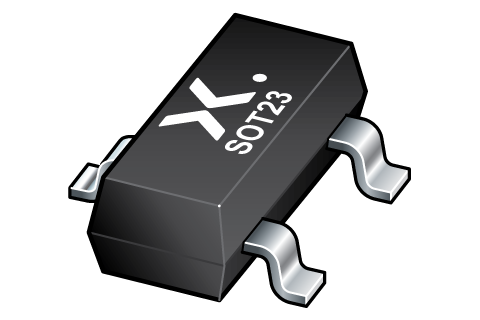
PBSS8110T100 V, 1 A NPN low VCEsat transistor | Discrete Semiconductor Products | 1 | Active | NPN low VCEsattransistor in a small SOT23 (TO-236AB) Surface-Mounted Device (SMD) plastic package. |
| Transistors | 1 | Active | NPN low VCEsattransistor in a small SOT23 (TO-236AB) Surface-Mounted Device (SMD) plastic package. |
PBSS8510PA100 V, 5.2 A NPN low V_CEsat (BISS) transistor | Single Bipolar Transistors | 1 | Active | NPN low VCEsatBreakthrough In Small Signal (BISS) transistor, encapsulated in an ultra thin SOT1061 leadless small Surface-Mounted Device (SMD) plastic package with medium power capability. |
PBSS9110100 V, 1 A PNP low VCEsat (BISS) transistor | Single | 5 | Active | PNP low VCEsatBreakthrough In Small Signal (BISS) transistor in a SOT223 (SC-73) small Surface-Mounted Device (SMD) plastic package. |
| Transistors | 1 | Active | PNP low VCEsattransistor in a SOT23 (TO-236AB) Surface-Mounted Device (SMD) plastic package. |
PCA9535PWLow-voltage 16-bit I²C and SMBus low-power I/O expander with interrupt output and configuration registers | I/O Expanders | 1 | Active | The PCA9535 provides 16 bits of General Purpose Input/Output (GPIO) expansion for I²C-bus/SMBus applications. It is designed for a wide voltage range of 2.3 V to 5.5 V with interrupt. Nexperia GPIO expanders provide an elegant solution when additional IOs are needed while keeping the interconnections to a minimum, for example, in ACPI power switches, sensors, push buttons, LEDs and fan control. The PCA9535 contains a set of 8 bit Input, Output, Configuration and Polarity inversion registers. At power up all IOs default to inputs. Each IO can be configured as either input or output by changing the corresponding bit in the configuration register. The data for each input or output is stored in the corresponding input or output register. The polarity inversion register can be programmed to invert the polarity of the input register. The PCA9535 has an open-drain interrupt output which is activated when any one of the GPIO changes from its corresponding input port register state. The power on reset sets the registers to default values and initializes the device state machine. The PCA9535 has three address pins A0, A1 and A2 which can be used to configure the I²C bus slave address of the device. It allows up-to eight devices to share the same I²C-bus/SMBus. |
PCA9539PWLow-voltage 16-bit I²C and SMBus low-power I/O expander with interrupt output, reset pin and configuration registers | Interface | 1 | Active | The PCA9539 provides 16 bits of General Purpose Input/Output (GPIO) expansion with interrupt and reset for I²C-bus/SMBus applications. It is designed for a wide voltage range of 2.3 V to 5.5 V. Nexperia GPIO expanders provide an elegant solution when additional IOs are needed while keeping the interconnections to a minimum, for example, in ACPI power switches, sensors, push buttons, LEDs and fan control. The PCA9539 contains a set of 8 bit Input, Output, Configuration and Polarity Inversion registers. At power up all IOs default to inputs. Each IO can be configured as either input or output by changing the corresponding bit in the configuration register. The data for each input or output is stored in the corresponding input or output register. The polarity inversion register can be programmed to invert the polarity of the read register. The PCA9539 has an open-drain interrupt output which is activated when any one of the GPIO changes from its corresponding input port register state.INTcan be connected to the interrupt input of a microcontroller. By sending an interrupt signal on this line, the remote I/O can inform the microcontroller if there is incoming data on its ports without having to communicate via the I²C-bus. Thus, PCA9539 can remain a simple slave. The power on reset sets the registers to default values and initializes the device state machine. TheRESETpin can be used to achieve same reset functionality without power down/up cycling by keeping active low. The state machine and the registers are in their default state until theRESETinput is once again HIGH. This input requires pull up to VCC. The PCA9539 has two address pins A0 and A1 which can be used to configure the I²C bus slave address of the device. It allows up-to four devices to share the same I²C-bus/SMBus. |
PCA9555PWLow-voltage 16-bit I²C-bus I/O port with interrupt and weak pull-up | I/O Expanders | 1 | Active | The PCA9555 provides 16 bits of General Purpose Input/Output (GPIO) expansion for I²C-bus/SMBus applications. It is designed for a wide voltage range of 2.3 V to 5.5 V with interrupt and default pull-up resistors on GPIOs. Nexperia GPIO expanders provide an elegant solution when additional IOs are needed while keeping the interconnections to a minimum, for example, in ACPI power switches, sensors, push buttons, LEDs and fan control. The PCA9555 contains a set of 8 bit Input, Output, Configuration and Polarity Inversion registers. At power up all IOs default to inputs. Each IO can be configured as either input or output by changing the corresponding bit in the configuration register. The data for each input or output is stored in the corresponding Input or Output register. The polarity inversion register can be programmed to invert the polarity of the input register. The PCA9555 has an open-drain interrupt output which is activated when any one of the GPIO changes from its corresponding input port register state. The power on reset sets the registers to default values and initializes the device state machine. The PCA9555 has three address pins A0, A1 and A2 which can be used to configure the I²C bus slave address of the device. It allows up-to eight devices to share the same I²C-bus/SMBus. |
PCMF1HDMI14SCommon-mode EMI filter for differential channels with integrated ESD protection | Common Mode Chokes | 1 | Active | Common-mode ElectroMagnetic Interference (EMI) filters with integrated ElectroStatic Discharge (ESD) protection for one, two and three differential channels. The devices are designed to provide low insertion loss for differential high-speed signals on each channel while unwanted common-mode signals are attenuated. |
PCMF1HDMI2Common-mode EMI filter for differential channels with integrated bidirectional ESD protection | Common Mode Chokes | 2 | Active | The devices are common-mode ElectroMagnetic Interference (EMI) filters with integrated ElectroStatic Discharge (ESD) protection for one, two or three differential channels. The devices are designed to provide low insertion loss for differential high-speed signals on each channel while unwanted common-mode signals are attenuated. |