| Evaluation Boards | 1 | Active | |
| Development Boards, Kits, Programmers | 1 | Active | |
| Evaluation Boards | 1 | Active | |
| Evaluation and Demonstration Boards and Kits | 1 | Active | |
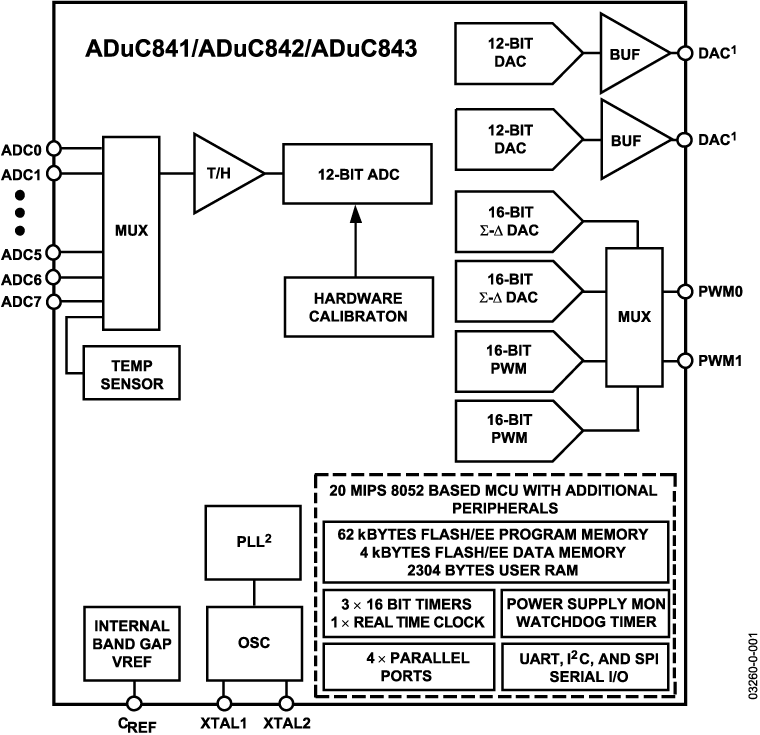
ADuC843Precision Analog Microcontroller: 16MIPS 8052 Flash MCU + 8-Ch 12-Bit ADC | Microcontrollers | 2 | Active | TheADuC841/ADuC842/ADuC843 are complete smart transducer front ends, that integrates a high performance self-calibrating multichannel ADC, a dual DAC, and an optimized single-cycle 20 MHz 8-bit MCU (8051 instruction set compatible) on a single chip.The ADuC841 and ADuC842 are identical with the exception of the clock oscillator circuit; the ADuC841 is clocked directly from an external crystal up to 20 MHz whereas the ADuC842 uses a 32 kHz crystal with an on-chip PLL generating a programmable core clock up to 16.78 MHz.The ADuC843 is identical to the ADuC842 except that the ADuC843 has no analog DAC outputs.The microcontroller is an optimized 8052 core offering up to 20 MIPS peak performance. Three different memory options are available offering up to 62 kBytes of nonvolatile Flash/EE program memory. Four kBytes of nonvolatile Flash/EE data memory, 256 bytes RAM, and 2 kBytes of extended RAM are also integrated on-chip.The parts also incorporate additional analog functionality with two 12-bit DACs, power supply monitor, and a band gap reference. On-chip digital peripherals include two 16-bit Σ-Δ. DACs, a dual output 16-bit PWM, a watchdog timer, a time interval counter, three timers/counters, and three serial I/O ports (SPI, I2C, and UART).On the ADuC812 and the ADuC832, the I2C and SPI interfaces share some of the same pins. For backwards compatibility, this is also the case for the ADuC841/ADuC842/ADuC843.However, there is also the option to allow SPI operate separately on P3.3, P3.4, and P3.5, while I2C uses the standard pins. The I2C interface has also been enhanced to offer repeated start, general call, and quad addressing.On-chip factory firmware supports in-circuit serial download and debug modes (via UART) as well as single-pin emulation mode via theEApin.ApplicationsOptical networking—laser power controlBase station systemsPrecision instrumentation, smart sensorsTransient capture systemsDAS and communications systems |
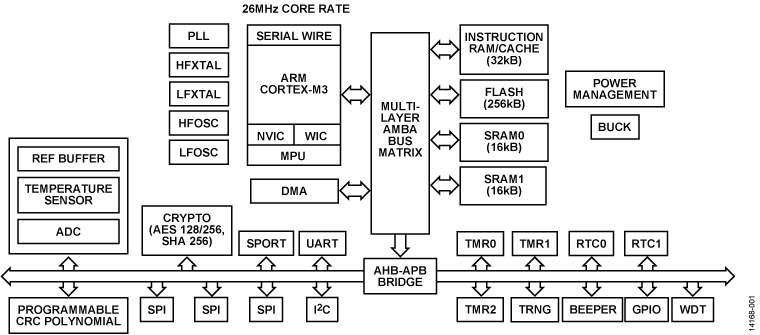
ADuCM3029Ultra Low Power ARM Cortex-M3 MCU with Integrated Power Management and 256 KB of Embedded Flash Memory | Embedded | 1 | Active | TheADuCM3027/ADuCM3029 microcontroller units (MCUs) are ultra low power microcontroller systems with integrated power management for processing, control, and connectivity. The MCU system is based on the ARM®Cortex®-M3 processor, a collection of digital peripherals, embedded SRAM and flash memory, and an analog subsystem which provides clocking, reset, and power management capability in addition to an analog-to-digital converter (ADC) subsystem. For a feature comparison across the ADuCM3027/ADuCM3029 product offerings, see Table 1.Table 1. Product Flash Memory OptionsDeviceEmbedded Flash Memory SizeADuCM3029256 kBADuCM3027128 kBSystem features that are common across the ADuCM3027/ADuCM3029/ADuCM3029-1/ADuCM3029-2 MCUs include the following:Up to 26 MHz ARM Cortex-M3 processorUp to 256 kB of embedded flash memory with error correction code (ECC)Optional 4 kB cache for lower active power64 kB system SRAM with parityPower management unit (PMU)Multilayer advanced microcontroller bus architecture (AMBA) bus matrixCentral direct memory access (DMA) controllerBeeper interfaceSerial port (SPORT), serial peripheral interface (SPI), inter-integrated circuit (I2C), and universal asynchronous receiver/transmitter (UART) peripheral interfacesCryptographic hardware support with advanced encryption standard (AES) and secure hash algorithm (SHA)-256Real-time clock (RTC)General-purpose and watchdog timersProgrammable general-purpose input/output (GPIO) pinsHardware cyclic redundancy check (CRC) calculator with programmable generator polynomialPower-on reset (POR) and power supply monitor (PSM)12-bit successive approximation register (SAR) ADCTrue random number generator (TRNG)To support low dynamic and hibernate power management, the ADuCM3027/ADuCM3029 MCUs provide a collection of power modes and features, such as dynamic and software controlled clock gating and power gating.The ADuCM3029-1 and ADuCM3029-2 MCU models share the same features and functionality as that of the ADuCM3029 MCU. All specifications pertaining to the ADuCM3027 and ADuCM3029 are also applicable to the ADuCM3029-1 and ADuCM3029-2.For full details on the ADuCM3027/ADuCM3029 MCUs, refer to theADuCM302x Ultra Low Power ARM Cortex-M3 MCU with Integrated Power Management Hardware Reference Manual.Product HighlightsIndustry leading ultralow power consumption.Robust operation, including full voltage monitoring in deep sleep modes, ECC support on flash, and parity error detection on SRAM memory.Leading edge security. Fast encryption provides read protection to customer algorithms. Write protection prevents device reprogramming by unauthorized code.Failure detection of 32 kHz LFXTAL via interrupt.SensorStrobe™for precise time synchronized sampling of external sensors. Works in hibernate mode, resulting in drastic current reduction in system solutions. Current consumption reduces by 10 times when using, for example, theADXL363accelerometer. Software intervention is not required after setup. No pulse drift due to software execution.ApplicationsInternet of Things (IoT)Electronic shelf label (ESL) and signageSmart infrastructureSmart lockAsset trackingSmart machine, smart metering, smart building, smart city, and smart agricultureWearablesFitness and clinicalMachine learning and neural network |
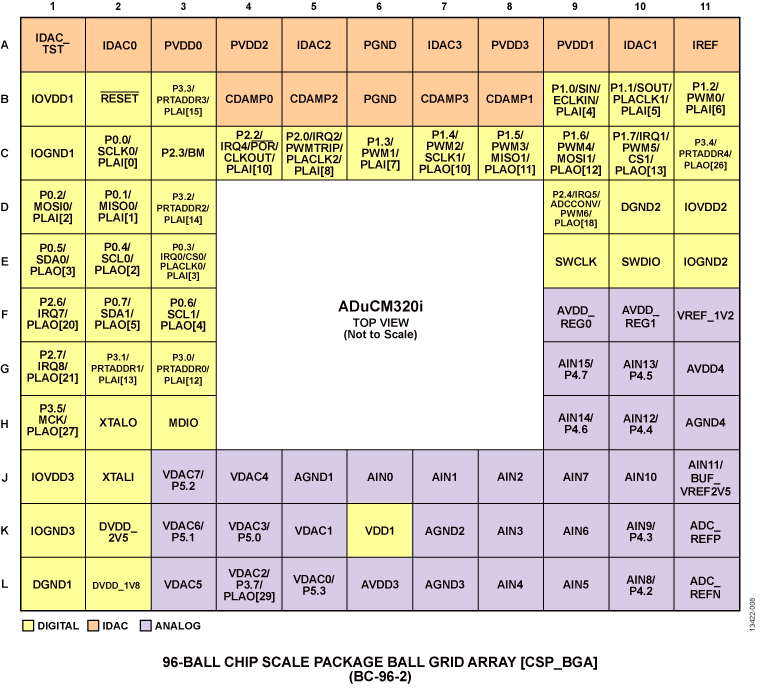
ADuCM320iPrecision Analog Microcontroller, 14-Bit Analog I/O with MDIO Interface, ARM Cortex-M3 | Embedded MCU, DSP | 4 | Active | The ADuCM320i is a fully integrated single package device that incorporates high performance analog peripherals together with digital peripherals controlled by an 80 MHz ARM®Cortex™-M3 processor and integral flash for code and data.The ADC on the ADuCM320i provides 14-bit, 1 MSPS data acquisition on up to 16 input pins that can be programmed for single-ended or differential operation. The voltage at the IDAC output pins can also be measured by the ADC, which is useful for controlling the power consumption of the current DACs. Additionally, chip temperature and supply voltages can be measured.The ADC input voltage is 0 V to VREF. A sequencer is provided, which allows a user to select a set of ADC channels to be measured in sequence without software involvement during the sequence. The sequence can optionally repeat automatically at a user selectable rate.Up to eight VDACs are provided with output ranges that are programmable to one of two voltage ranges.Four IDAC sources are provided. The output currents are programmable with a range of 0 mA to 150 mA. A low drift band gap reference and voltage comparator completes the analog input peripheral set.The ADuCM320i can be configured so that the digital and analog outputs retain their output voltages and currents through a watchdog or software reset sequence. Thus, a product can remain functional even while the ADuCM320i is resetting itself.The ADuCM320i has a low power ARM Cortex-M3 processor and a 32-bit RISC machine that offers up to 100 MIPS peak performance. Also integrated on chip are 2 × 128 kB Flash/EE memory and 32 kB of SRAM. The flash comprises two separate 128 kB blocks supporting execution from one flash block and simultaneous writing/erasing of the other flash block.The ADuCM320i operates from an on-chip oscillator or a 16 MHz external crystal and a PLL at 80 MHz. This clock can optionally be divided down to reduce current consumption. Additional low power modes can be set via software. In normal operating mode, the ADuCM320i digital core consumes about 300 µA per MHz.The device includes an MDIO interface capable of operating at up to 4 MHz. The capability to simultaneously execute from one flash block and write/erase the other flash block makes the ADuCM320i ideal for 10G, 40G, and 100G optical applications. User programming is eased by incorporating PHYADR and DEVADD hardware comparators. In addition, the nonerasable kernel code plus flags in user flash provide assistance by allowing user code to robustly switch between the two blocks of user flash code and data spaces.The ADuCM320i integrates a range of on-chip peripherals that can be configured under software control, as required in the application. These peripherals include 1 × UART, 2 × I2C, and 2 × SPI serial input/output (I/O) communication controllers, GPIO, 32-element programmable logic array, 3 general-purpose timers, plus a wake-up timer and system watchdog timer. A 16-bit PWM with seven output channels is also provided.GPIO pins on the device power up in high impedance input mode. In output mode, the software chooses between opendrain mode and push-pull mode. The pull-up resistors can be disabled and enabled in software. In GPIO output mode, the inputs can remain enabled to monitor the pins. The GPIO pins can also be programmed to handle digital or analog peripheral signals, in which case the pin characteristics are matched to the specific requirement.A large support ecosystem is available for the ARM Cortex-M3 processor to ease product development of the ADuCM320i. Access is via the ARM serial wire debug port (SW-DP). On-chip factory firmware supports in-circuit serial download via I2C. These features are incorporated into a low cost QuickStart™ development system supporting this precision analog microcontroller family.Note that throughout this data sheet, multifunction pins, such as VDAC0/P5.3, are referred to either by the entire pin name or by a single function of the pin, for example, VDAC0, when only that function is relevant.ApplicationsOptical networking |
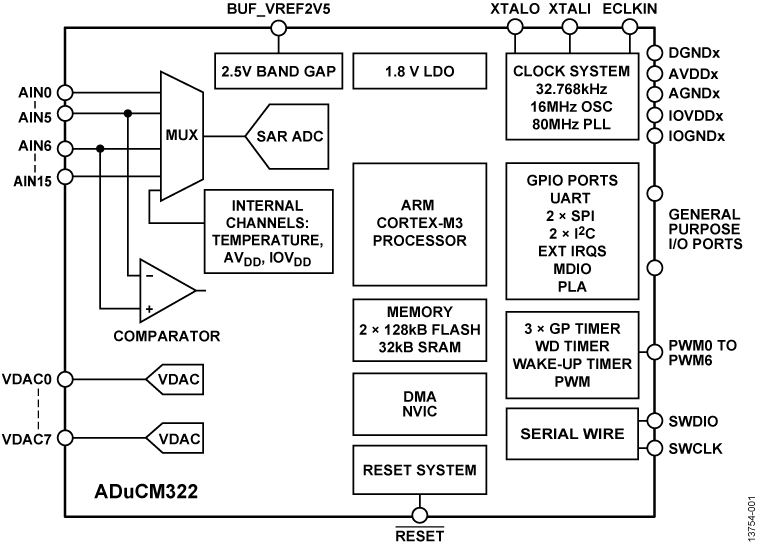
ADuCM322Precision Analog Microcontrollers, Analog I/O with MDIO Interface, ARM Cortex-M3 | Embedded | 3 | Active | The ADuCM322 is a fully integrated, single package device that incorporates high performance analog peripherals together with digital peripherals controlled by an 80 MHz ARM®Cortex™-M3 processor and integral flash for code and data.The ADC on the ADuCM322 provides 12-bit, 1 MSPS data acquisition on up to 16 input balls. Additionally, chip temperature and supply voltages can be measured.The ADC input voltage range is 0 V to VREF. A sequencer is provided, which allows a user to select a set of ADC channels to measure in sequence without software involvement during the sequence. The sequence can optionally repeat automatically at a user selectable rate. Up to eight VDACs are provided with output ranges that are programmable to one of two voltage ranges.The ADuCM322 can be configured so that the digital and analog outputs retain their output voltages through a watchdog or software reset sequence. Thus, a product can remain functional even while the ADuCM322 is resetting itself.The ADuCM322 has a low power ARM Cortex-M3 processor and a 32-bit RISC machine that offers up to 100 MIPS peak performance. Also integrated on-chip are 2 × 128 kB Flash/EE memory blocks and 32 kB of SRAM. The flash comprises two separate 128 kB blocks supporting execution from one flash block and simultaneous writing/erasing of the other flash block.The ADuCM322 operates from an on-chip oscillator or a 16 MHz external crystal and a PLL at 80 MHz. This clock can optionally be divided down to reduce current consumption. Additional low power modes can be set via software. In normal operating mode, the ADuCM322 digital core consumes about 300 μA per MHz.The device includes an MDIO interface capable of operating at up to 4 MHz. The capability to simultaneously execute from one flash block and write/erase the other flash block makes the ADuCM322 ideal for 10G, 40G, and 100G optical applications. In addition, the nonerasable kernel code plus flags in user flash provide assistance by allowing user code to robustly switch between the two blocks of user flash code and data spaces.The ADuCM322 integrates a range of on-chip peripherals that can be configured under software control, as required in the application. These peripherals include 1 × UART, 2 × I2C, and 2 × SPI serial input/output communication controllers, GPIO, 32-element PLA, three general-purpose timers, plus a wake-up timer and system watchdog timer. A 16-bit PWM with seven output channels is also provided.GPIO balls on the device power up in high impedance input mode. In output mode, the software chooses between open-drain mode and push-pull mode. The pull-up resistors can be disabled and enabled in software. In GPIO output mode, the inputs can remain enabled to monitor the balls. The GPIO balls can also be programmed to handle digital or analog peripheral signals; in such cases, the ball characteristics are matched to the specific requirement.A large support ecosystem is available for the ARM Cortex-M3 processor to ease product development of the ADuCM322. Access is via the ARM serial wire debug port (SW-DP). On-chip factory firmware supports in-circuit serial download via MDIO. These features are incorporated into a QuickStart™ development system, supporting this precision analog microcontroller family.APPLICATIONSOptical networking |
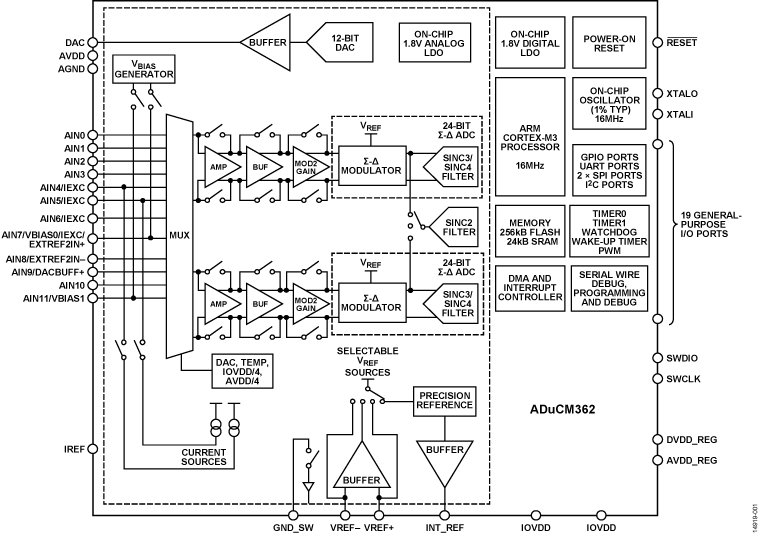
ADuCM362Low Power, Precision Analog Microcontroller with Dual Sigma-Delta ADCs, ARM Cortex-M3 | Integrated Circuits (ICs) | 1 | Active | The ADuCM362/ADuCM363is a fully integrated, 3.9 kSPS, 24-bit data acquisition system that incorporates dual, high performance, multichannel sigma-delta (Σ-Δ) analog-to-digital converters (ADCs), a 32-bit ARM Cortex™-M3 processor, and Flash/EE memory on a single chip. The ADuCM362/ ADuCM363 are designed for direct interfacing to external precision sensors in both wired and battery-powered applications. The ADuCM363 contains all the features of the ADuCM362, except that only one 24-bit Σ-Δ ADC (ADC1) is available.The ADuCM362/ADuCM363 contain an on-chip 32 kHz oscillator and an internal 16 MHz high frequency oscillator. The high frequency oscillator is routed through a programmable clock divider from which the operating frequency of the processor core clock is generated. The maximum core clock speed is 16 MHz; this speed is not limited by operating voltage or temperature.The microcontroller core is a low power ARM Cortex-M3 processor, a 32-bit RISC machine that offers up to 20 MIPS peak performance. The Cortex-M3 processor incorporates a flexible, 11-channel DMA controller that supports all wired communica-tion peripherals (both SPIs, both UARTs, and I2C). Also integrated on chip are up to 256 kB of nonvolatile Flash/EE memory and 24 kB of SRAM.The analog subsystem consists of dual ADCs, each connected to a flexible input mux. Both ADCs can operate in fully differential and single-ended modes. Other on-chip ADC features include dual programmable excitation current sources, diagnostic current sources, and a bias voltage generator of AVDD_REG/2 (900 mV) to set the common-mode voltage of an input channel. A low-side internal ground switch is provided to allow power-down of an external circuit (for example, a bridge circuit) between conversions. Optional input buffers are provided for the analog inputs and the external reference inputs. These buffers can be enabled for all PGA gain settings.The ADCs contain two parallel filters: a sinc3 or sinc4 filter in parallel with a sinc2 filter. The sinc3 or sinc4 filter is used for precision measurements. The sinc2 filter is used for fast measure-ments and for the detection of step changes in the input signal.The devices contain a low noise, low drift internal band gap reference, but they can be configured to accept one or two external reference sources in ratiometric measurement config-urations. An option to buffer the external reference inputs is provided on chip. A single-channel buffered voltage output DAC is also provided on chip.The ADuCM362/ADuCM363 integrate a range of on-chip peripherals, which can be configured under microcontroller software control as required in the application. The peripherals include two UARTs, I2C, and dual SPI serial I/O communication controllers; a 19-pin GPIO port; two general-purpose timers; a wake-up timer; and a system watchdog timer. A 16-bit PWM controller with six output channels is also provided.The ADuCM362/ADuCM363 are specifically designed to operate in battery-powered applications where low power operation is critical. The microcontroller core can be configured in a normal operating mode that consumes 290 μA/MHz (including flash/SRAM IDD). An overall system current consumption of 1 mA can be achieved with both ADCs on (input buffers off), PGA gain of 4, one SPI port on, and all timers on.The ADuCM362/ADuCM363 can be configured in a number of low power operating modes under direct program control, including a hibernate mode (internal wake-up timer active) that consumes only 4 μA. In hibernate mode, peripherals, such as external interrupts or the internal wake-up timer, can wake up the devices. This mode allows the devices to operate with ultralow power while still responding to asynchronous external or periodic events.On-chip factory firmware supports in-circuit serial download via a serial wire interface (2-pin JTAG system) and UART; non-intrusive emulation is also supported via the serial wire interface. These features are incorporated into a low cost QuickStart™ Development System that supports this precision analog micro-controller family.The devices operate from an external 1.8 V to 3.6 V voltage supply and are specified over an industrial temperature range of −40°C to +125°C.ApplicationsIndustrial automation and process controlIntelligent precision sensing systems4 mA to 20 mA loop-powered smart sensor systemsMedical devices, patient monitoring |
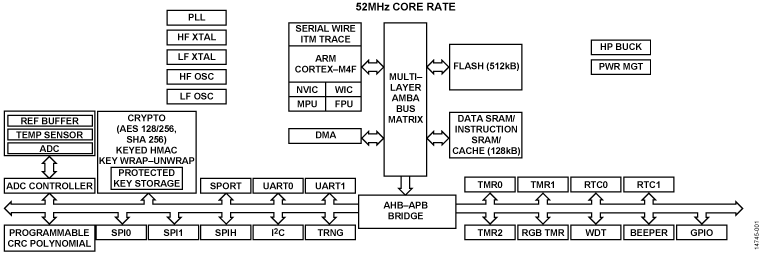
ADuCM4050Ultra Low Power ARM Cortex-M4F MCU with Integrated Power Management | Embedded | 1 | Active | The ADuCM4050 microcontroller unit (MCU) is an ultra low power integrated microcontroller system with integrated power management for processing, control, and connectivity. The MCU system is based on the ARM®Cortex®-M4F processor. The MCU also has a collection of digital peripherals, embedded static random access memory (SRAM) and embedded flash memory, and an analog subsystem that provides clocking, reset, and power management capabilities in addition to an analog-to-digital converter (ADC) subsystem.This data sheet describes the ARM Cortex-M4F core and memory architecture used on the ADuCM4050 MCU. It does not provide detailed programming information about the ARM processor.The system features include an up to 52 MHz ARM Cortex-M4F processor, 512 kB of embedded flash memory with error correction code (ECC), an optional 4 kB cache for lower active power, and 128 kB system SRAM with parity. The ADuCM4050 features a power management unit (PMU), multilayer advanced microcontroller bus architecture (AMBA) bus matrix, central direct memory access (DMA) controller, and beeper interface.The ADuCM4050 features cryptographic hardware supporting advanced encryption standard (AES)-128 and AES-256 with secure hash algorithm (SHA)-256 and the following modes: electronic code book (ECB), cipher block chaining (CBC), counter (CTR), and cipher block chaining-message authentication code (CCM/CCM*) modes.The ADuCM4050 has protected key storage with key wrap/ unwrap, and keyed hashed message authentication code (HMAC) with key unwrap.The ADuCM4050 supports serial port (SPORT), serial peripheral interface (SPI), I2C, and universal asynchronous receiver/ transmitter (UART) peripheral interfaces.The ADuCM4050 features a real-time clock (RTC), general-purpose and watchdog timers, and programmable general-purpose input/output (GPIO) pins. There is a hardware cyclic redundancy check (CRC) calculator with programmable generator polynomial. The device also features a power on reset (POR) and power supply monitor (PSM), a 12-bit successive approximation register (SAR) ADC, a red/green/blue (RGB) timer for driving RGB LED, and a true random number generator (TRNG).To support low dynamic and hibernate power management, the ADuCM4050 MCU provides a collection of power modes and features such as dynamic- and software-controlled clock gating and power gating.For full details on the ADuCM4050 MCU, refer to theADuCM4050 Ultra Low Power ARM Cortex-M4F MCU with Integrated Power Management Hardware Reference.Product HighlightsUltra low power consumption.Robust operation.Full voltage monitoring in deep sleep modes.ECC support on flash.Parity error detection on SRAM memory.Leading edge security.Fast encryption provides read protection to user algorithms.Write protection prevents device reprogramming by unauthorized code.Failure detection of 32 kHz low frequency external crystal oscillator (LFXTAL) via interrupt.SensorStrobe™for precise time synchronized sampling of external sensors. Works in hibernate mode, resulting in drastic current reduction in system solutions. Current consumption reduces by 10 times when using, for example, theADXL363accelerometer. Software intervention is not required after setup. No pulse drift due to software execution.ApplicationsInternet of Things (IoT)Smart agriculture, smart building, smart metering, smart city, smart machine, and sensor networkWearablesFitness and clinicalMachine learning and neural networks |