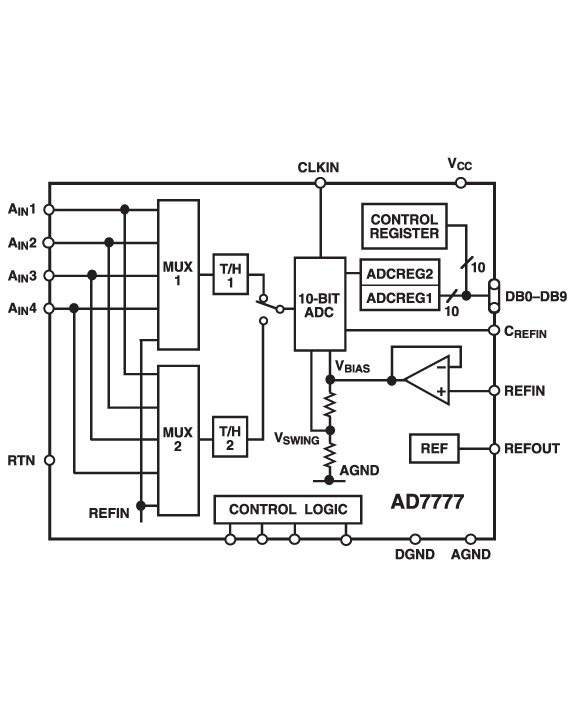
A
Analog Devices Inc./Maxim Integrated
| Series | Category | # Parts | Status | Description |
|---|---|---|---|---|
| Part | Spec A | Spec B | Spec C | Spec D | Description |
|---|---|---|---|---|---|



| Series | Category | # Parts | Status | Description |
|---|---|---|---|---|
| Part | Spec A | Spec B | Spec C | Spec D | Description |
|---|---|---|---|---|---|
| Series | Category | # Parts | Status | Description |
|---|---|---|---|---|
| Development Boards, Kits, Programmers | 9 | Active | ||
| Evaluation Boards | 7 | Active | ||
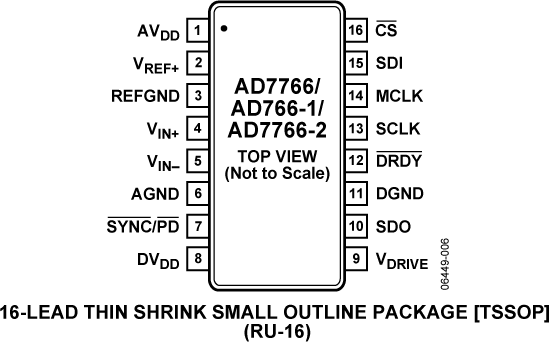
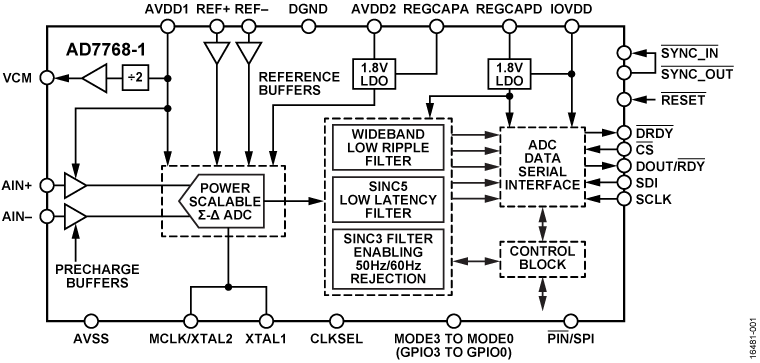
AD7768DC to 204 kHz, Dynamic Signal Analysis, Precision 24-Bit ADC with Power Scaling | Development Boards, Kits, Programmers | 7 | Active | The AD7768-1 is a low power, high performance, Σ-Δ analog-to-digital converter (ADC), with a Σ-Δ modulator and digital filter for precision conversion of both ac and dc signals. The AD7768-1 is a single-channel version of the AD7768, an 8-channel, simultaneously sampling, Σ-Δ ADC. The AD7768-1 provides a single configurable and reusable data acquisition (DAQ) footprint, which establishes a new industry standard in combined ac and dc performance and enables instrumentation and industrial system designers to design across multiple measurement variants for both isolated and nonisolated applications.The AD7768-1 achieves a 108.5 dB dynamic range when using the low ripple, finite impulse response (FIR) digital filter at 256 kSPS, giving 110.8 kHz input bandwidth, combined with ±1.1 ppm integral nonlinearity (INL), ±30 µV offset error, and ±30 ppm gain error.A wider bandwidth, up to 500 kHz Nyquist (filter −3 dB point of 204 kHz), is available using the sinc5 filter, enabling a view of signals over an extended range.The AD7768-1 offers the user the flexibility to configure and optimize for input bandwidth vs. output data rate (ODR) and vs. power dissipation. The flexibility of the AD7768-1 allows dynamic analysis of a changing input signal, making the device particularly useful in general-purpose DAQ systems. The selection of one of three available power modes allows the designer to achieve required noise targets while minimizing power consumption. The design of the AD7768-1 is unique in that it becomes a reusable and flexible platform for low power dc and high performance ac measurement modules.The AD7768-1 achieves the optimum balance of dc and ac performance with excellent power efficiency. The following three operating modes allow the user to trade off the input bandwidth vs. power budgets:Fast mode offers both a sinc filter with up to 256 kSPS and 52.2 kHz of bandwidth, and 26.4 mW of power consumption, or a FIR filter with up to 256 kSPS, 110.8 kHz of bandwidth and 36.8 mW of power consumption.Median mode offers a FIR filter with up to 128 kSPS, 55.4 kHz of bandwidth and 19.7 mW of power consumption.Low power mode offers a FIR filter with up to 32 kSPS, 13.85 kHz of bandwidth and 6.75 mW of power consumption.The AD7768-1 offers extensive digital filtering capabilities that meet a wide range of system requirements. The filter options allow configuration for frequency domain measurements with tight gain error over frequency, linear phase response requirements (brick wall filter), a low latency path (sinc5 or sinc3) for use in control loop applications, and measuring dc inputs with the ability to configure the sinc3 filter to reject the line frequency of either 50 Hz or 60 Hz. All filters offer programmable decimation.A 1.024 MHz sinc5 filter path exists for users seeking an even higher ODR than is achievable using the low ripple FIR filter. This path is quantization noise limited. Therefore, it is best suited for customers requiring minimum latency for control loops or implementing custom digital filtering on an external field programmable gate array (FPGA) or digital signal processor (DSP).The filter options include the following:A low ripple FIR filter with a ±0.005 dB pass-band ripple to 102.4 kHz.A low latency sinc5 filter with up to a 1.024 MHz data rate to maximize control loop responsiveness.A low latency sinc3 filter that is fully programmable, with 50 Hz/60 Hz rejection capabilities.When using the AD7768-1, embedded analog functionality within the AD7768-1 greatly reduces the design burden over the entire application range. The precharge buffer on each analog input decreases the analog input current compared to competing products, simplifying the task of an external amplifier to drive the analog input.A full buffer input on the reference reduces the input current, providing a high impedance input for the external reference device or in buffering any reference sense resistor scenarios used in ratiometric measurements.The device operates with a 5.0 V AVDD1 − AVSS supply, a 2.0 V to 5.0 V AVDD2 − AVSS supply, and a 1.8 V to 3.3 V IOVDD − DGND supply.In low power mode, the AVDD1, AVDD2, and IOVDD supplies can run from a single 3.0 V rail.The device requires an external reference. The absolute input reference (REFIN) voltage range is 1 V to AVDD1 − AVSS.The specified operating temperature range is −40°C to +125°C. The device is housed in a 4 mm × 5 mm, 28-lead LFCSP.Note that, throughout this data sheet, multifunction pins, such as XTAL2/MCLK, are referred to either by the entire pin name or by a single function of the pin, for example, MCLK, when only that function is relevant.ApplicationsPlatform ADC to serve a superset of measurements and sensor typesSound and vibration, acoustic, and material science research and developmentControl and hardware in loop verificationCondition monitoring for predictive maintenanceElectrical test and measurementAudio testing and current and voltage measurementClinical electroencephalogram (EEG), electromyogram (EMG), and electrocardiogram (ECG) vital signs monitoringUSB-, PXI-, and Ethernet-based modular DAQChannel to channel isolated modular DAQ designs |
AD7768-1DC to 204 kHz, Dynamic Signal Analysis, Precision 24-Bit ADC with Power Scaling | Analog to Digital Converters (ADC) | 1 | Active | The AD7768-1 is a low power, high performance, Σ-Δ analog-to-digital converter (ADC), with a Σ-Δ modulator and digital filter for precision conversion of both ac and dc signals. The AD7768-1 is a single-channel version of the AD7768, an 8-channel, simultaneously sampling, Σ-Δ ADC. The AD7768-1 provides a single configurable and reusable data acquisition (DAQ) footprint, which establishes a new industry standard in combined ac and dc performance and enables instrumentation and industrial system designers to design across multiple measurement variants for both isolated and nonisolated applications.The AD7768-1 achieves a 108.5 dB dynamic range when using the low ripple, finite impulse response (FIR) digital filter at 256 kSPS, giving 110.8 kHz input bandwidth, combined with ±1.1 ppm integral nonlinearity (INL), ±30 µV offset error, and ±30 ppm gain error.A wider bandwidth, up to 500 kHz Nyquist (filter −3 dB point of 204 kHz), is available using the sinc5 filter, enabling a view of signals over an extended range.The AD7768-1 offers the user the flexibility to configure and optimize for input bandwidth vs. output data rate (ODR) and vs. power dissipation. The flexibility of the AD7768-1 allows dynamic analysis of a changing input signal, making the device particularly useful in general-purpose DAQ systems. The selection of one of three available power modes allows the designer to achieve required noise targets while minimizing power consumption. The design of the AD7768-1 is unique in that it becomes a reusable and flexible platform for low power dc and high performance ac measurement modules.The AD7768-1 achieves the optimum balance of dc and ac performance with excellent power efficiency. The following three operating modes allow the user to trade off the input bandwidth vs. power budgets:Fast mode offers both a sinc filter with up to 256 kSPS and 52.2 kHz of bandwidth, and 26.4 mW of power consumption, or a FIR filter with up to 256 kSPS, 110.8 kHz of bandwidth and 36.8 mW of power consumption.Median mode offers a FIR filter with up to 128 kSPS, 55.4 kHz of bandwidth and 19.7 mW of power consumption.Low power mode offers a FIR filter with up to 32 kSPS, 13.85 kHz of bandwidth and 6.75 mW of power consumption.The AD7768-1 offers extensive digital filtering capabilities that meet a wide range of system requirements. The filter options allow configuration for frequency domain measurements with tight gain error over frequency, linear phase response requirements (brick wall filter), a low latency path (sinc5 or sinc3) for use in control loop applications, and measuring dc inputs with the ability to configure the sinc3 filter to reject the line frequency of either 50 Hz or 60 Hz. All filters offer programmable decimation.A 1.024 MHz sinc5 filter path exists for users seeking an even higher ODR than is achievable using the low ripple FIR filter. This path is quantization noise limited. Therefore, it is best suited for customers requiring minimum latency for control loops or implementing custom digital filtering on an external field programmable gate array (FPGA) or digital signal processor (DSP).The filter options include the following:A low ripple FIR filter with a ±0.005 dB pass-band ripple to 102.4 kHz.A low latency sinc5 filter with up to a 1.024 MHz data rate to maximize control loop responsiveness.A low latency sinc3 filter that is fully programmable, with 50 Hz/60 Hz rejection capabilities.When using the AD7768-1, embedded analog functionality within the AD7768-1 greatly reduces the design burden over the entire application range. The precharge buffer on each analog input decreases the analog input current compared to competing products, simplifying the task of an external amplifier to drive the analog input.A full buffer input on the reference reduces the input current, providing a high impedance input for the external reference device or in buffering any reference sense resistor scenarios used in ratiometric measurements.The device operates with a 5.0 V AVDD1 − AVSS supply, a 2.0 V to 5.0 V AVDD2 − AVSS supply, and a 1.8 V to 3.3 V IOVDD − DGND supply.In low power mode, the AVDD1, AVDD2, and IOVDD supplies can run from a single 3.0 V rail.The device requires an external reference. The absolute input reference (REFIN) voltage range is 1 V to AVDD1 − AVSS.The specified operating temperature range is −40°C to +125°C. The device is housed in a 4 mm × 5 mm, 28-lead LFCSP.Note that, throughout this data sheet, multifunction pins, such as XTAL2/MCLK, are referred to either by the entire pin name or by a single function of the pin, for example, MCLK, when only that function is relevant.ApplicationsPlatform ADC to serve a superset of measurements and sensor typesSound and vibration, acoustic, and material science research and developmentControl and hardware in loop verificationCondition monitoring for predictive maintenanceElectrical test and measurementAudio testing and current and voltage measurementClinical electroencephalogram (EEG), electromyogram (EMG), and electrocardiogram (ECG) vital signs monitoringUSB-, PXI-, and Ethernet-based modular DAQChannel to channel isolated modular DAQ designs |
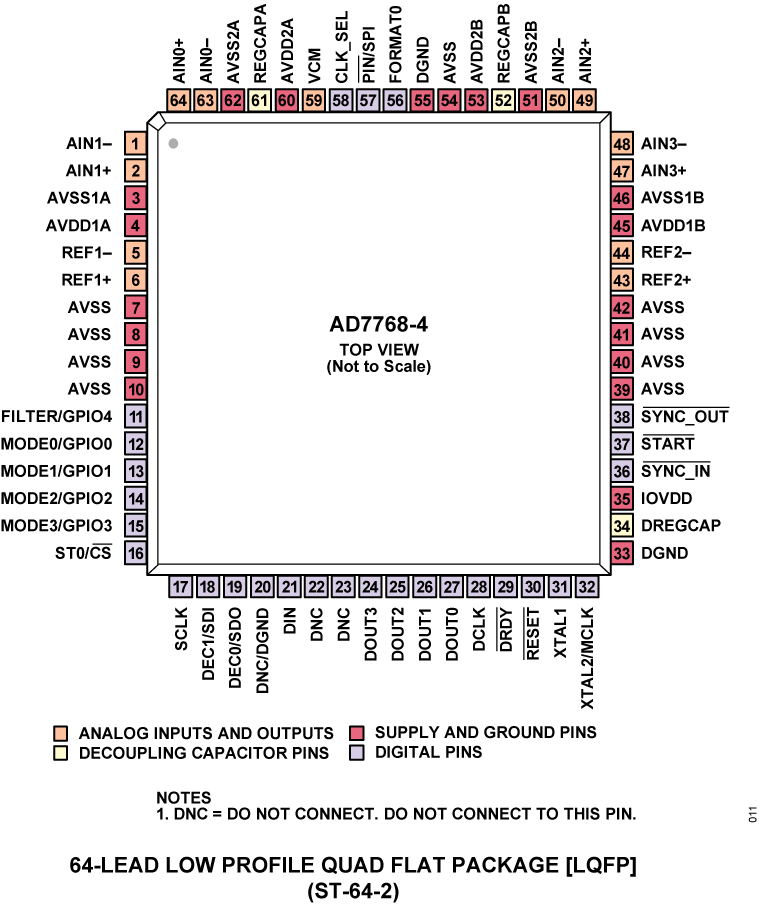
AD7768-44-Channel, 24-Bit, Simultaneous Sampling ADC, Power Scaling, 110.8 kHz BW | Data Acquisition | 1 | Active | TheAD7768/AD7768-4 are 8-channel and 4-channel 24-bit, simultaneous sampling, sigma-delta (Σ-Δ) analog-to-digital converters (ADCs) with power scaling and 110.8 kHz bandwidth. The devices have a Σ-Δ modulator and digital filter per channel, which enables synchronized sampling of ac and dc signals.The AD7768/AD7768-4 achieve 108 dB dynamic range at a maximum input bandwidth of 110.8 kHz, combined with typical performance of ±2 ppm integral nonlinearity (INL), ±50 μV offset error, and ±30 ppm gain error.The AD7768/AD7768-4 user can trade off input bandwidth, output data rate, and power dissipation, and select one of three power modes to optimize for noise targets and power consumption. The flexibility of the AD7768/AD7768-4 allows them to become reusable platforms for low power dc and high performance ac measurement modules.The AD7768/AD7768-4 have three modes: fast mode (256 kSPS maximum, 110.8 kHz input bandwidth, 51.5 mW per channel), median mode (128 kSPS maximum, 55.4 kHz input bandwidth, 27.5 mW per channel) and low power mode (32 kSPS maximum, 13.8 kHz input bandwidth, 9.375 mW per channel).The AD7768/AD7768-4 offer extensive digital filtering capabilities, such as a wideband, low ±0.005 dB pass-band ripple, antialiasing low-pass filter with sharp roll-off, and 105 dB attenuation at the Nyquist frequency.Frequency domain measurements can use the wideband linear phase filter. This filter has a flat pass band (±0.005 dB ripple) from dc to 102.4 kHz at 256 kSPS, from dc to 51.2 kHz at 128 kSPS, or from dc to 12.8 kHz at 32 kSPS.The AD7768/AD7768-4 also offer sinc response via a sinc5 filter, a low latency path for low bandwidth, and low noise measurements. The wideband and sinc5 filters can be selected and run on a per channel basis.Within these filter options, the user can improve the dynamic range by selecting from decimation rates of ×32, ×64, ×128, ×256, ×512, and ×1024. The ability to vary the decimation filtering optimizes noise performance to the required input bandwidth.Embedded analog functionality on each ADC channel makes design easier, such as a precharge buffer on each analog input that reduces analog input current and a precharge reference buffer per channel reduces input current and glitches on the reference input terminals.The device operates with a 5 V AVDD1A and AVDD1B supply, a 2.25 V to 5.0 V AVDD2A and AVDD2B supply, and a 2.5 V to 3.3 V or 1.8 V IOVDD supply (see the 1.8 V IOVDD Operation section for specific requirements for operating at 1.8 V IOVDD).The device requires an external reference; the absolute input reference voltage range is 1 V to AVDD1 − AVSS.The specified operating temperature range is −40°C to +105°C. The device is housed in a 10 mm × 10 mm, 64-lead low profile quad flat package (LQFP) with a 12 mm × 12 mm printed circuit board (PCB) footprint.APPLICATIONSData acquisition systems: USB/PXI/EthernetInstrumentation and industrial control loopsAudio test and measurementVibration and asset condition monitoring3-phase power quality analysisSonarHigh precision medical electroencephalogram (EEG)/electromyography (EMG)/electrocardiogram (ECG) |
| Analog to Digital Converters (ADCs) Evaluation Boards | 3 | Active | ||
AD77718-Channel, 24-Bit, 128 kSPS Simultaneous Sampling ADC | Analog to Digital Converters (ADC) | 4 | Active | The AD7771 is an 8-channel, simultaneous sampling analog-to-digital converter (ADC). Eight full Σ-Δ ADCs are on-chip. The AD7771 provides an ultralow input current to allow direct sensor connection. Each input channel has a programmable gain stage allowing gains of 1, 2, 4, and 8 to map lower amplitude sensor outputs into the full-scale ADC input range, maximizing the dynamic range of the signal chain. The AD7771 accepts a VREFvoltage from 1 V up to 3.6 V. The analog inputs accept unipolar (0 V to VREF) or true bipolar (±VREF/2 V) analog input signals with 3.3 V or ±1.65 V analog supply voltages, respectively. The analog inputs can be configured to accept true differential or single-ended signals to match different sensor output configurations.Each channel contains an ADC modulator and a sinc3/sinc5, low latency digital filter. A sample rate converter (SRC) is provided to allow fine resolution control over the AD7771 output data rate (ODR). This control can be used in applications where the ODR resolution is required to maintain coherency with 0.01 Hz changes in the line frequency. The SRC is programmable through the serial port interface (SPI). The AD7771 implements two different interfaces: a data output interface and SPI control interface. The ADC data output interface is dedicated to transmitting the ADC conversion results from the AD7771 to the processor. The SPI writes to and reads from the AD7771 configuration registers and for the control and reading of data from the successive approximation register (SAR) ADC. The SPI can also be configured to output the Σ-Δ conversion data.The AD7771 includes a 12-bit SAR ADC. This ADC can be used for AD7771 diagnostics without having to decommission one of the Σ-Δ ADC channels dedicated to system measurement functions. With the use of an external multiplexer, which can be controlled through the three general-purpose input/output pins (GPIOs), and signal conditioning, the SAR ADC can validate the Σ-Δ ADC measurements in applications where functional safety is required. In addition, the AD7771 SAR ADC includes an internal multiplexer to sense internal nodes.The AD7771 contains a 2.5 V reference and reference buffer. The reference has a typical temperature coefficient of ±10 ppm/°C.The AD7771 offers two modes of operation: high resolution mode and low power mode. High resolution mode provides a higher dynamic range while consuming 16.6 mW per channel; low power mode consumes only 5.25 mW per channel at a reduced dynamic range specification.The specified operating temperature range is −40°C to +105°C, although the device is operational up to +125°C.Note that throughout this data sheet, certain terms are used to refer to either the multifunction pins or a range of pins. The multifunction pins, such as DCLK0/SDO, are referred to either by the entire pin name or by a single function of the pin, for example, DCLK0, when only that function is relevant. In the case of ranges of pins, AVSSx refers to the following pins: AVSS1A, AVSS1B, AVSS2A, AVSS2B, AVSS3, and AVSS4.ApplicationsPower quality and measurement applicationsGeneral-purpose data acquisitionElectroencephalography (EEG)Industrial process control |
| Data Acquisition | 5 | Active | ||
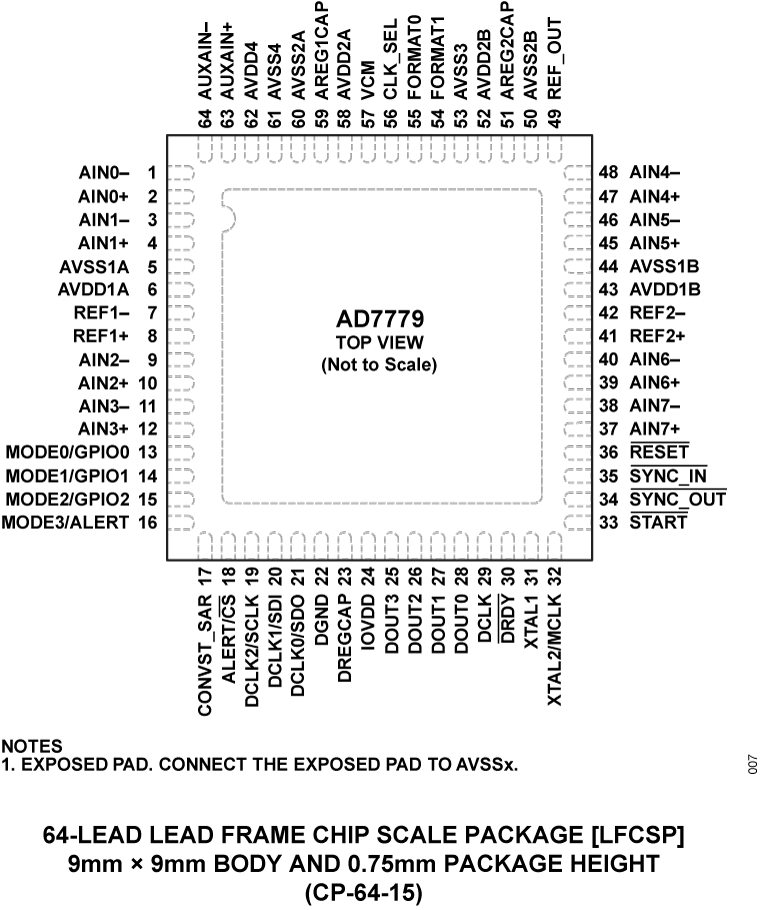
AD77798-Channel, 24-Bit, 16 kSPS Simultaneous Sampling ADC | Integrated Circuits (ICs) | 2 | Active | The AD7779 is an 8-channel, simultaneous sampling ADC. There are eight full Σ-Δ ADCs on chip. The AD7779 provides an ultralow input current to allow direct sensor connection. Each input channel has a programmable gain stage allowing gains of 1, 2, 4, and 8 to map lower amplitude sensor outputs into the full-scale ADC input range, maximizing the dynamic range of the signal chain. The AD7779 accepts VREFfrom 1 V up to 3.6 V. The analog inputs accept unipolar (0 V to VREF/GAIN) or true bipolar (±VREF/GAIN/2 V) analog input signals with 3.3 V or ±1.65 V analog supply voltages. The analog inputs can be configured to accept true differential, pseudo differential, or singleended signals to match different sensor output configurations.Each channel contains an ADC modulator and a sinc3, low latency digital filter. An SRC is provided to allow fine resolution control over the AD7779 ODR. This control can be used in applications where the ODR resolution is required to maintain coherency with 0.01 Hz changes in the line frequency. The SRC is programmable through the serial port interface (SPI). The AD7779 implements two different interfaces: a data output interface and SPI control interface. The ADC data output interface is dedicated to transmitting the ADC conversion results from the AD7779 to the processor. The SPI interface is used to write to and read from the AD7779 configuration registers and for the control and reading of data from the SAR ADC. The SPI interface can also be configured to output the Σ-Δ conversion data.The AD7779 includes a 12-bit SAR ADC. This ADC can be used for AD7779 diagnostics without having to decommission one of the Σ-Δ ADC channels dedicated to system measurement functions. With the use of an external multiplexer, which can be controlled through the three general-purpose inputs/outputs pins (GPIOs), and signal conditioning, the SAR ADC can be used to validate the Σ-Δ ADC measurements in applications where functional safety is required. In addition, the AD7779 SAR ADC includes an internal multiplexer to sense internal nodes.The AD7779 contains a 2.5 V reference and reference buffer. The reference has a typical temperature coefficient of 10 ppm/°C. The AD7779 offers two modes of operation: high resolution mode and low power mode. High resolution mode provides a higher dynamic range while consuming 10.75 mW per channel; low power mode consumes just 3.37 mW per channel at a reduced dynamic range specification.The specified operating temperature range is −40°C to +105°C, although the device is operational up to +125°C.ApplicationsCircuit breakersGeneral-purpose data acquisitionElectroencephalography (EEG)Industrial process control |
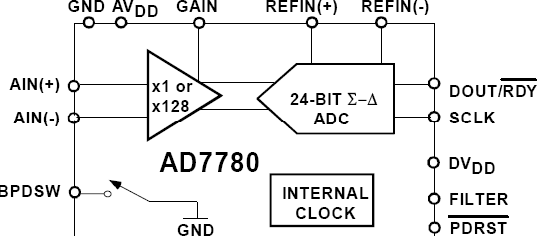
AD778024-Bit Pin-Programmable Low Power Σ−Δ ADC | Data Acquisition | 4 | Active | The AD7780 is a complete low power front-end solution for bridge sensor products, including weigh scales, strain gages, and pressure sensors. It contains a precision, low power, 24-bit sigma-delta (Σ-Δ) ADC; an on-chip, low noise programmable gain amplifier (PGA); and an on-chip oscillator.Consuming only 330 μA, the AD7780 is particularly suitable for portable or battery-operated products where very low power is required. The AD7780 also has a power-down mode that allows the user to switch off the power to the bridge sensor and power down the AD7780 when not converting, thus increasing the battery life of the product.For ease of use, all the features of the AD7780 are controlled by dedicated pins. Each time a data read occurs, eight status bits are appended to the 24-bit conversion. These status bits contain a pattern sequence that can be used to confirm the validity of the serial transfer.The on-chip PGA has a gain of 1 or 128, supporting a full-scale differential input of ±5 V or ±39 mV. The device has two filter response options. The filter response at the 16.7 Hz update rate provides superior dynamic performance. The settling time is 120 ms at this update rate. At the 10 Hz update rate, the filter response provides greater than −45 dB of stop-band attenuation. In load cell applications, this stop-band rejection is useful to reject low frequency mechanical vibrations of the load cell. The settling time is 300 ms at this update rate. Simultaneous 50 Hz/60 Hz rejection occurs at both the 10 Hz and 16.7 Hz update rates.The AD7780 operates with a power supply from 2.7 V to 5.25 V. It is available in a narrow body, 14-lead SOIC package and a 16-lead TSSOP package.ApplicationsWeigh scalesPressure MeasurementIndustrial Process ControlPortable instrumentation |
| Part | Category | Description |
|---|---|---|
 Analog Devices Inc./Maxim Integrated | Development Boards Kits Programmers | EVAL BOARD HMC264LM3 |
 Analog Devices Inc./Maxim Integrated | Development Boards Kits Programmers | EVAL BOARD HMC362S8GE |
 Analog Devices Inc./Maxim Integrated | Development Boards Kits Programmers | BOARD EVAL DIVIDER HMC365 |
 Analog Devices Inc./Maxim Integrated | Development Boards Kits Programmers | EVAL BOARD HMC413QS16G |
 Analog Devices Inc./Maxim Integrated | Development Boards Kits Programmers | EVAL BOARD HMC414MS8G |
 Analog Devices Inc./Maxim Integrated | Development Boards Kits Programmers | EVAL BRD, 3.5GHZ, SPDT NON-REFLECTIVE SW ROHS COMPLIANT: YES |
 Analog Devices Inc./Maxim Integrated | Development Boards Kits Programmers | BOARD EVALUATION HMC435AMS8G |
 Analog Devices Inc./Maxim Integrated | Development Boards Kits Programmers | EVALUATION BOARD, HMC536MS8G, RF SWITCH, RF / IF |
 Analog Devices Inc./Maxim Integrated | Development Boards Kits Programmers | EVAL BOARD HMC415LP3 |
 Analog Devices Inc./Maxim Integrated | Development Boards Kits Programmers | EVAL BRD, HBT MMIC, DIVIDE-BY-2, 8GHZ ROHS COMPLIANT: YES |