A
Analog Devices Inc./Maxim Integrated
| Series | Category | # Parts | Status | Description |
|---|---|---|---|---|
| Part | Spec A | Spec B | Spec C | Spec D | Description |
|---|---|---|---|---|---|



| Series | Category | # Parts | Status | Description |
|---|---|---|---|---|
| Part | Spec A | Spec B | Spec C | Spec D | Description |
|---|---|---|---|---|---|
| Part | Category | Description |
|---|---|---|
 Analog Devices Inc./Maxim Integrated LTC1879EGN#TRUnknown | Integrated Circuits (ICs) | IC REG BUCK ADJ 1.2A 16SSOP |
 Analog Devices Inc./Maxim Integrated LTC2208CUP#TRUnknown | Integrated Circuits (ICs) | IC ADC 16BIT 130MSPS 64-QFN |
 Analog Devices Inc./Maxim Integrated ADP2108ACBZ-1.1-R7Obsolete | Integrated Circuits (ICs) | IC REG BUCK 1.1V 600MA 5WLCSP |
 Analog Devices Inc./Maxim Integrated EV1HMC832ALP6GObsolete | Development Boards Kits Programmers | EVAL BOARD FOR HMC832ALP6GE |
 Analog Devices Inc./Maxim Integrated LTC488ISWUnknown | Integrated Circuits (ICs) | IC LINE RCVR RS485 QUAD 16-SOIC |
 Analog Devices Inc./Maxim Integrated LTC6946IUFD-2Obsolete | Integrated Circuits (ICs) | IC CLK/FREQ SYNTH 28QFN |
 Analog Devices Inc./Maxim Integrated MAX5556ESA+TObsolete | Integrated Circuits (ICs) | IC DAC/AUDIO 16BIT 50K 8SOIC |
 Analog Devices Inc./Maxim Integrated EVAL-FLTR-LD-1RZUnknown | Unclassified | EVAL BRD FOR AD800 SERIES |
 Analog Devices Inc./Maxim Integrated | Development Boards Kits Programmers | BOARD EVAL FOR AD9963 |
 Analog Devices Inc./Maxim Integrated LTC1296CCSW#TRUnknown | Integrated Circuits (ICs) | IC DATA ACQ SYS 12BIT 5V 20SOIC |
| Series | Category | # Parts | Status | Description |
|---|---|---|---|---|
| Motion Sensors | 6 | Active | ||
| Sensor Evaluation Boards | 11 | Active | ||
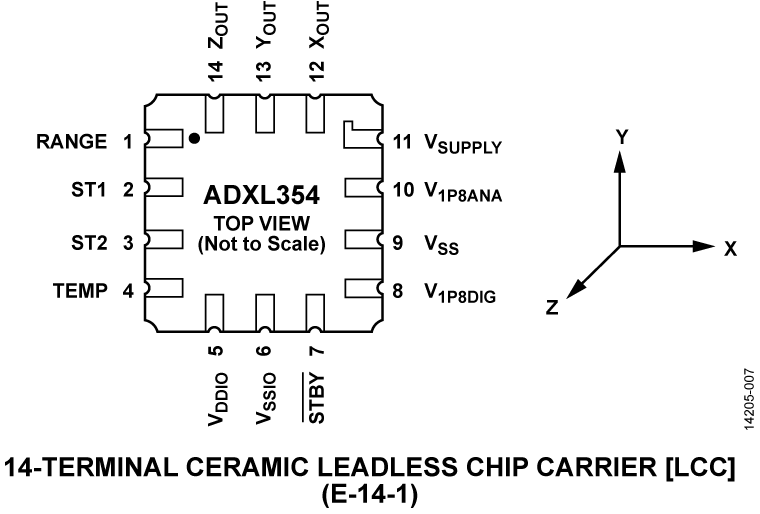
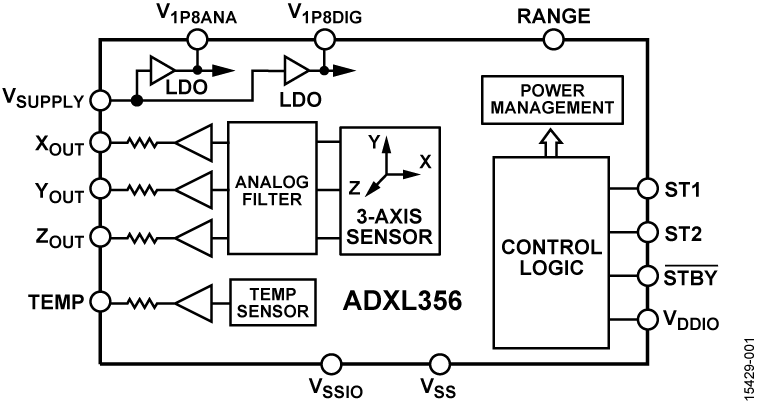
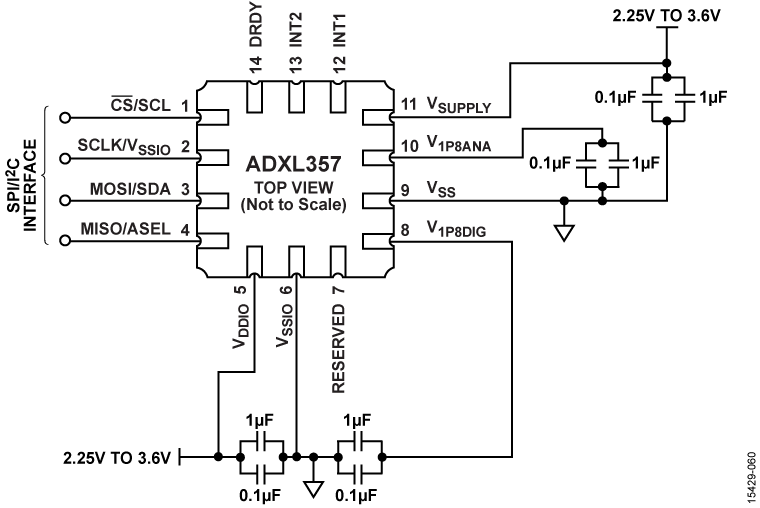
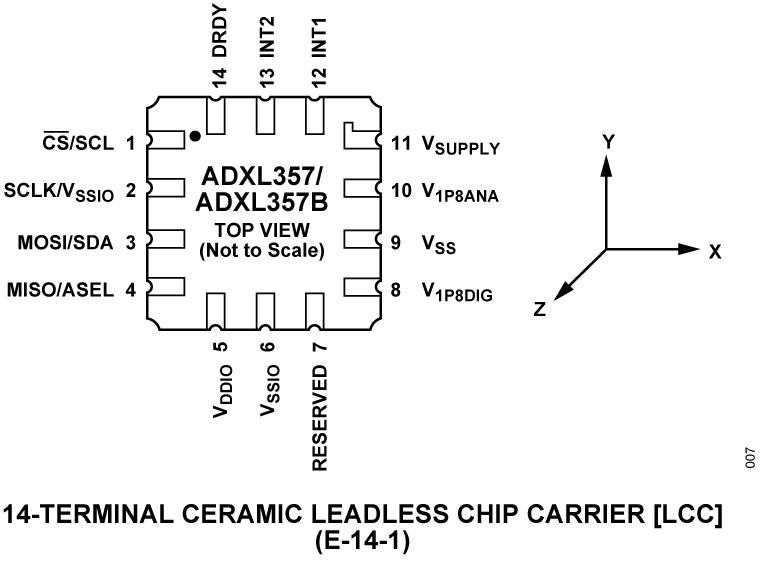
ADXL357Low Noise, Low Drift, Low Power, 3-Axis MEMS Accelerometers with Digital Output | Development Boards, Kits, Programmers | 4 | Active | The analog output ADXL356 and the digital outputsADXL357and ADXL357B are low noise density, low 0goffset drift, low power, 3-axis accelerometers with selectable measurement ranges. The ADXL356B supports the ±10gand ±20granges, the ADXL356C supports the ±10gand ±40granges, and the ADXL357 and ADXL357B support the ±10g, ±20g, and ±40granges.The ADXL356/ADXL357/ADXL357B1offer industry leading noise, minimal offset drift over temperature, and long-term stability, enabling precision applications with minimal calibration.The low drift, low noise, and low power ADXL357 and ADXL357B enable accurate tilt measurement. The ADXL357B is more robust/suitable for tilt sensing in high vibration environments. The low noise of the ADXL356 over higher frequencies is ideal for condition-based monitoring and other vibration sensing applications.The ADXL357 and ADXL357B multifunction pin names may be referenced only by their relevant function for either the serial peripheral interface (SPI) or limited I2C interface.ApplicationsInertial measurement units (IMUs)/altitude and heading reference systems (AHRSs)Platform stabilization systemsStructural health monitoringSeismic imagingTilt sensingRoboticsCondition monitoring |
ADXL357BLow Noise, Low Drift, Low Power, 3-Axis MEMS Accelerometers | Sensors, Transducers | 2 | Active | The analog output ADXL356 and the digital outputsADXL357and ADXL357B are low noise density, low 0goffset drift, low power, 3-axis accelerometers with selectable measurement ranges. The ADXL356B supports the ±10gand ±20granges, the ADXL356C supports the ±10gand ±40granges, and the ADXL357 and ADXL357B support the ±10g, ±20g, and ±40granges.The ADXL356/ADXL357/ADXL357B1offer industry leading noise, minimal offset drift over temperature, and long-term stability, enabling precision applications with minimal calibration.The low drift, low noise, and low power ADXL357 and ADXL357B enable accurate tilt measurement. The ADXL357B is more robust/suitable for tilt sensing in high vibration environments. The low noise of the ADXL356 over higher frequencies is ideal for condition-based monitoring and other vibration sensing applications.The ADXL357 and ADXL357B multifunction pin names may be referenced only by their relevant function for either the serial peripheral interface (SPI) or limited I2C interface.ApplicationsInertial measurement units (IMUs)/altitude and heading reference systems (AHRSs)Platform stabilization systemsStructural health monitoringSeismic imagingTilt sensingRoboticsCondition monitoring |
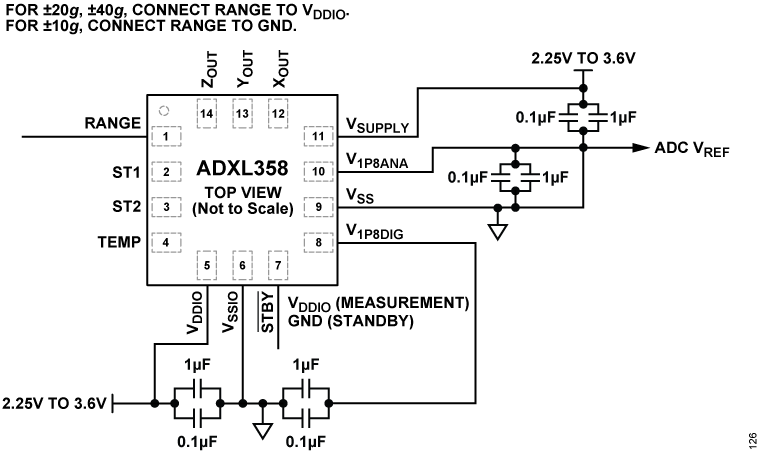
ADXL358Low Noise, Low Drift, Low Power, 3-Axis MEMS Accelerometer | Accelerometers | 6 | Active | The analog output ADXL358 is a low noise density, low 0goffset drift, low power, 3-axis accelerometer with selectable measurement ranges. The ADXL358B supports the ±10gand ±20granges, and the ADXL358C supports the ±10gand ±40granges.The ADXL358 offers industry leading noise, minimal offset drift over temperature, and long-term stability, enabling precision applications with minimal calibration.The low noise of the ADXL358 over higher frequencies is ideal for condition-based monitoring and other vibration sensing applications.APPLICATIONSInertial measurement units (IMUs)/attitude and heading reference systems (AHRSs)Platform stabilization systemsStructural health monitoringSeismic imagingTilt sensingRoboticsCondition monitoringProtected by U.S. Patents 8,472,270; 9,041,462; 8,665,627; 8,917,099; 6,892,576; 9,297,825; and 7,956,621. |
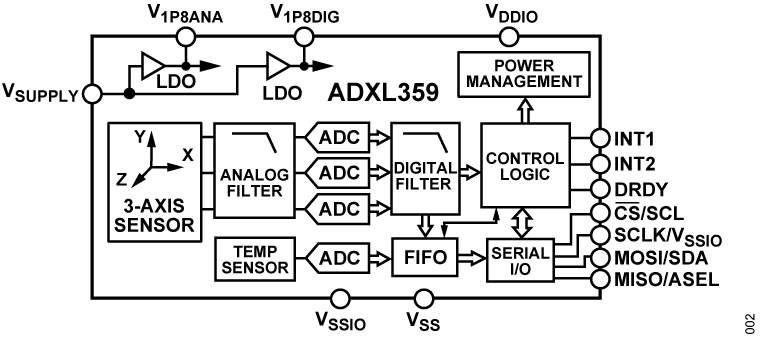
ADXL359Low Noise, Low Drift, Low Power 3-Axis MEMS Accelerometer | Accelerometers | 3 | Active | The digital output ADXL3591 is a low noise density, low 0goffset drift, low power, 3-axis microelectromechanical system (MEMS) accelerometer with selectable measurement ranges. The ADXL359 supports the ±10g, ±20g, and ±40granges.The ADXL359 offers industry leading noise, minimal offset drift over temperature, and long-term stability, enabling precision applications with minimal calibration.The low drift, low noise, and low power ADXL359 enables accurate tilt measurement in an environment with high vibration, such as airborne inertial measurement units (IMUs). The low noise over higher frequencies is ideal for wireless condition monitoring.The ADXL359 multifunction pin names may be referenced only by their relevant function for either the serial peripheral interface (SPI) or limited I2C interface.APPLICATIONSIMUs and altitude and heading reference systems (AHRSs)Platform stabilization systemsVibration sensingStructural health monitoringTilt sensingRoboticsCondition monitoringProtected by U.S. Patents 8,472,270; 9,041,462; 8,665,627; 8,917,099; 6,892,576; 9,297,825; and 7,956,621. |
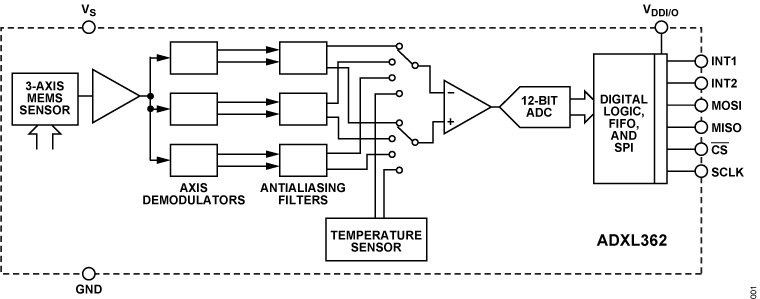
ADXL362Micropower, 3-Axis, ±2g/±4g/±8gDigital Output MEMS Accelerometer | Sensor Evaluation Boards | 6 | Active | The ADXL362 is an ultralow power, 3-axis MEMS accelerometer that consumes less than 2 μA at a 100 Hz output data rate and 270 nA when in motion triggered wake-up mode. Unlike accelerometers that use power duty cycling to achieve low power consumption, the ADXL362 does not alias input signals by undersampling; it samples the full bandwidth of the sensor at all data rates.The ADXL362 always provides 12-bit output resolution; 8-bit formatted data is also provided for more efficient single-byte transfers when a lower resolution is sufficient. Measurement ranges of ±2g, ±4g, and ±8gare available, with a resolution of 1 mg/LSB on the ±2grange. For applications where a noise level lower than the normal 550 μg/√Hz of the ADXL362 is desired, either of two lower noise modes (down to 175 μg/√Hz typical) can be selected at minimal increase in supply current.In addition to its ultralow power consumption, the ADXL362 has many features to enable true system level power reduction. It includes a deep multimode output FIFO, a built-in micropower temperature sensor, and several activity detection modes including adjustable threshold sleep and wake-up operation that can run as low as 270 nA at a 6 Hz (approximate) measurement rate. A pin output is provided to directly control an external switch when activity is detected, if desired. In addition, the ADXL362 has provisions for external control of sampling time and/or an external clock.The ADXL362 operates on a wide 1.6 V to 3.5 V supply range, and can interface, if necessary, to a host operating on a separate, lower supply voltage. The ADXL362 is available in a 3 mm × 3.25 mm × 1.06 mm package.APPLICATIONSHearing aidsHome healthcare devicesMotion enabled power save switchesWireless sensorsMotion enabled metering devices |
| Evaluation Boards | 5 | Active | ||
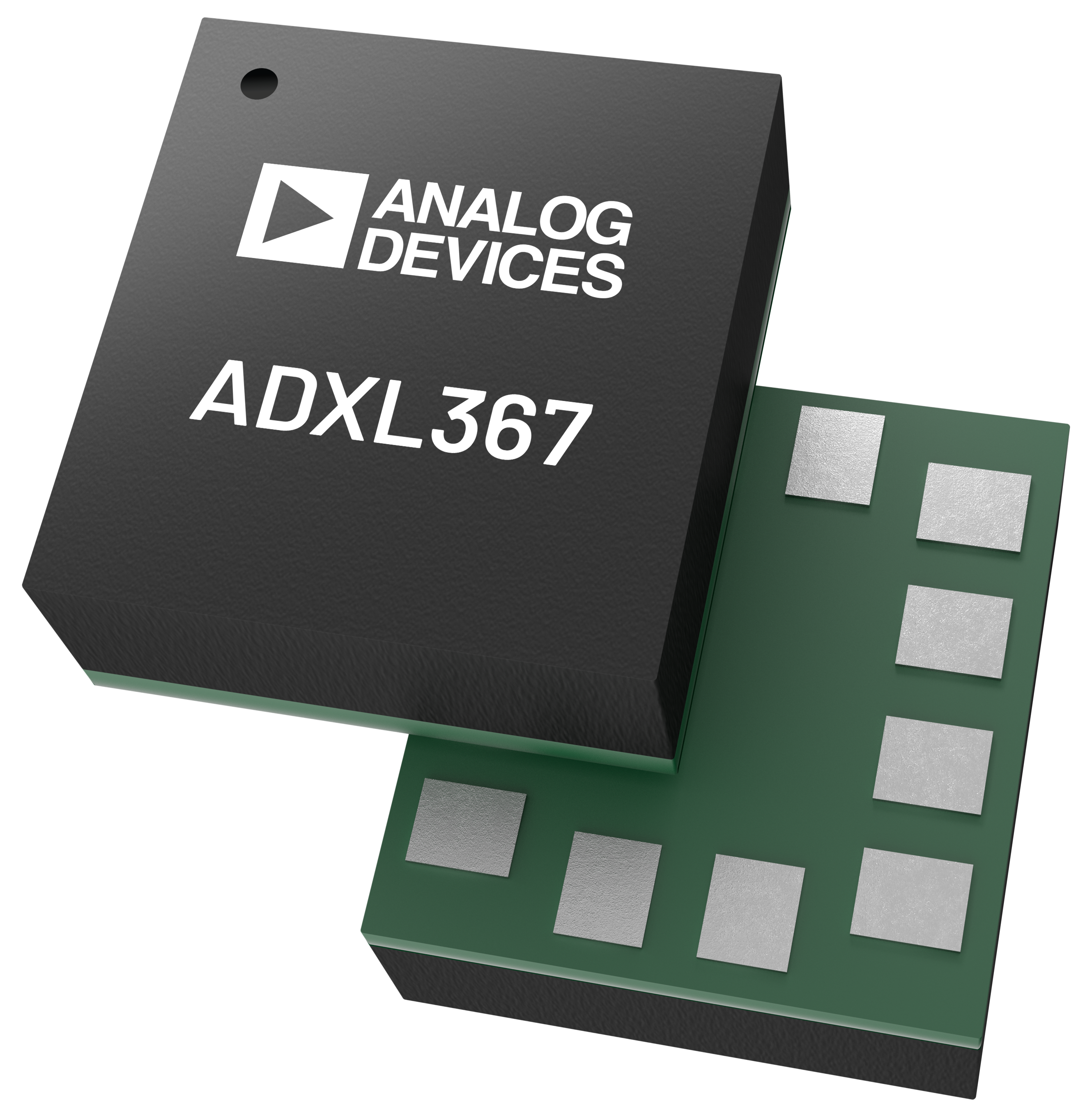
ADXL367Nanopower, 3-Axis, ±2g/±4g/±8gDigital Output MEMS Accelerometer | Evaluation Boards | 2 | Active | The ADXL367 is an ultralow power, 3-axis microelectromechanical systems (MEMS) accelerometer that consumes only 0.89 μA at a 100 Hz output data rate and 180 nA when in motion-triggered wake-up mode. Unlike accelerometers that use power duty cycling to achieve low power consumption, the ADXL367 does not alias input signals by undersampling, but samples the full bandwidth of the sensor at all data rates.The ADXL367 always provides 14-bit output resolution. 8-bit formatted data is offered for more efficient single-byte transfers when a lower resolution is sufficient. 12-bit formatted data is also provided for ADXL362 design compatibility. Notice that the low and high bytes are inverted, compared with the ADXL362 word formatting. Measurement ranges of ±2g, ±4g, and ±8gare available, with a resolution of 0.25 mg/LSB on the ±2grange.In addition to its ultralow power consumption, the ADXL367 has many features to enable true system level power reduction. It includes a deep multimode output first in, first out (FIFO), a built-in micropower temperature sensor, an internal analog-to-digital converter (ADC) for synchronous conversion of an additional analog input with interrupt capability, single-tap and double-tap detection that can operate at any output data rate with only an added 35 nA of current, and a state machine to prevent a false triggering. In addition, the ADXL367 has provisions for external control of the sampling time and/or an external clock.The ADXL367 operates on a wide 1.1 V to 3.6 V supply range, and can interface, if necessary, to a host operating on a separate supply voltage. The ADXL367 is available in a 2.2 mm × 2.3 mm × 0.87 mm package.APPLICATIONS24/7 sensingHearing aidsVital signs monitoring devicesMotion-enabled power save switchesMotion-enabled metering devicesSmart watch with single-cell operationSmart home |
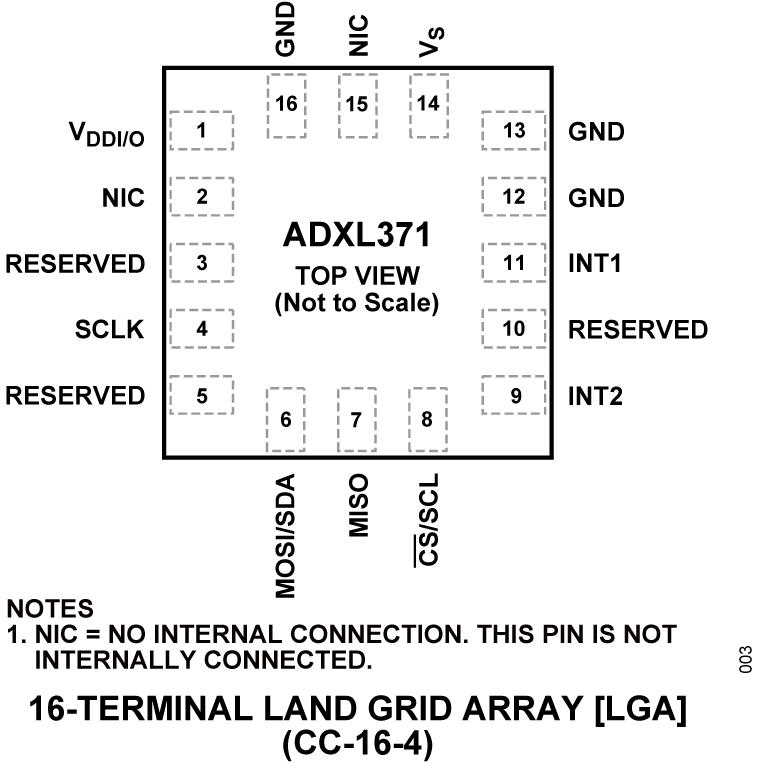
ADXL371Micropower, 3-Axis, ±200gDigital Output, MEMS Accelerometer | Accelerometers | 2 | Active | The ADXL371 is an ultra low power, 3-axis, ±200gmicroelectromechanical system (MEMS) accelerometer that consumes 28 μA at a 2560 Hz output data rate (ODR). The ADXL371 does not power cycle its front end to achieve its low power operation and therefore does not run the risk of aliasing the output of the sensor.In addition to its ultra low power consumption, the ADXL371 enables impact detection while providing system level power reduction. The device includes a deep multimode output first in, first out (FIFO), several activity detection modes, and a method for capturing only the peak acceleration of overthreshold events.Two additional lower power modes with interrupt driven, wake-up features are available for monitoring motion during periods of inactivity. In wake-up mode, acceleration data can be averaged to obtain a low enough output noise to trigger on lowgthresholds. In instant on mode, the ADXL371 consumes 1.7 μA while continuously monitoring the environment for impacts. When an impact event that exceeds the internally set threshold is detected, the device switches to normal operating mode fast enough to record the event.Highgapplications tend to experience acceleration content over a wide range of frequencies. The ADXL371 includes a four-pole, low-pass antialiasing filter to attenuate out of band signals that are common in highgapplications. The ADXL371 also incorporates a high-pass filter to eliminate initial and slow changing errors, such as ambient temperature drift.The ADXL371 provides 12-bit output data at a 100 mg/LSB scale factor. The user can access configuration and data registers via the serial peripheral interface (SPI) or I2C protocol. The ADXL371 operates over a wide supply voltage range and is available in a 3 mm × 3.25 mm × 1.06 mm package.APPLICATIONSImpact and shock detectionAsset health assessmentPortable Internet of Things (IoT) edge nodesConcussion and head trauma detection |