A
Analog Devices Inc./Maxim Integrated
| Series | Category | # Parts | Status | Description |
|---|---|---|---|---|
| Part | Spec A | Spec B | Spec C | Spec D | Description |
|---|---|---|---|---|---|



| Series | Category | # Parts | Status | Description |
|---|---|---|---|---|
| Part | Spec A | Spec B | Spec C | Spec D | Description |
|---|---|---|---|---|---|
| Part | Category | Description |
|---|---|---|
 Analog Devices Inc./Maxim Integrated LTC1879EGN#TRUnknown | Integrated Circuits (ICs) | IC REG BUCK ADJ 1.2A 16SSOP |
 Analog Devices Inc./Maxim Integrated LTC2208CUP#TRUnknown | Integrated Circuits (ICs) | IC ADC 16BIT 130MSPS 64-QFN |
 Analog Devices Inc./Maxim Integrated ADP2108ACBZ-1.1-R7Obsolete | Integrated Circuits (ICs) | IC REG BUCK 1.1V 600MA 5WLCSP |
 Analog Devices Inc./Maxim Integrated EV1HMC832ALP6GObsolete | Development Boards Kits Programmers | EVAL BOARD FOR HMC832ALP6GE |
 Analog Devices Inc./Maxim Integrated LTC488ISWUnknown | Integrated Circuits (ICs) | IC LINE RCVR RS485 QUAD 16-SOIC |
 Analog Devices Inc./Maxim Integrated LTC6946IUFD-2Obsolete | Integrated Circuits (ICs) | IC CLK/FREQ SYNTH 28QFN |
 Analog Devices Inc./Maxim Integrated MAX5556ESA+TObsolete | Integrated Circuits (ICs) | IC DAC/AUDIO 16BIT 50K 8SOIC |
 Analog Devices Inc./Maxim Integrated EVAL-FLTR-LD-1RZUnknown | Unclassified | EVAL BRD FOR AD800 SERIES |
 Analog Devices Inc./Maxim Integrated | Development Boards Kits Programmers | BOARD EVAL FOR AD9963 |
 Analog Devices Inc./Maxim Integrated LTC1296CCSW#TRUnknown | Integrated Circuits (ICs) | IC DATA ACQ SYS 12BIT 5V 20SOIC |
| Series | Category | # Parts | Status | Description |
|---|---|---|---|---|
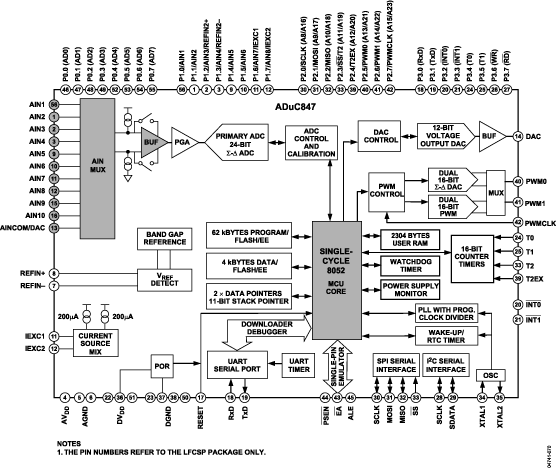
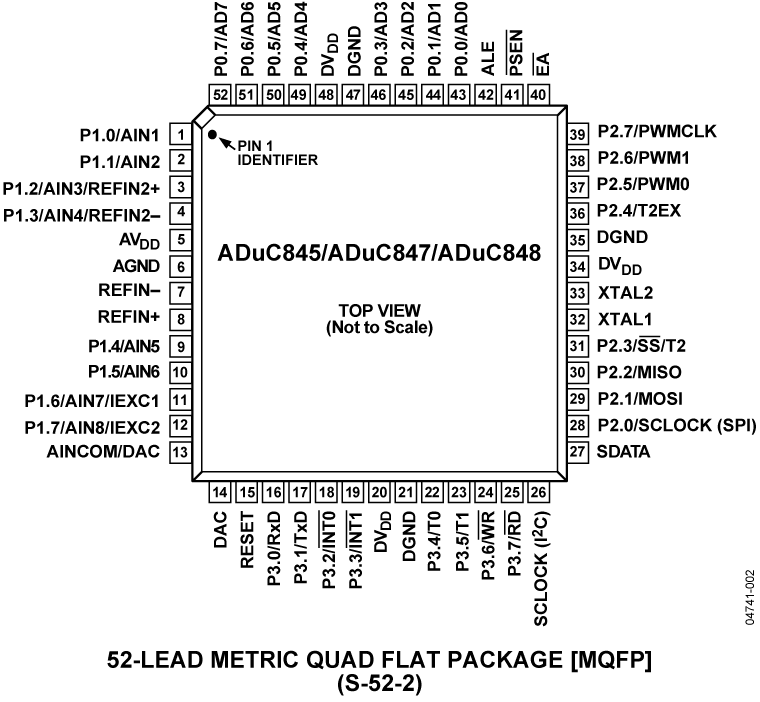
ADUC847MicroConverter®Multichannel24-/16-Bit ADCs with Embedded 62 kB Flash and Single-Cycle MCU | Embedded MCU, DSP Evaluation Boards | 11 | Active | TheADuC845, ADuC847, andADuC848are single-cycle, 12.58 MIPs, 8052 core upgrades to the ADuC834 and ADuC836. They include additional analog inputs for applications requiring more ADC channels.The ADuC845, ADuC847, and ADuC848 are complete smart transducer front ends. The family integrates high resolution Σ-Δ ADCs with flexible, up to 10-channel, input multiplexing, a fast 8-bit MCU, and program and data Flash/EE memory on a single chip.The ADuC845 includes two (primary and auxiliary) 24-bit Σ-Δ ADCs with internal buffering and PGA on the primary ADC. The ADuC847 includes the same primary ADC as the ADuC845 (auxiliary ADC removed). The ADuC848 is a 16-bit ADC version of the ADuC847.The ADCs incorporate flexible input multiplexing, a temperature sensor (ADuC845 only), and a PGA (primary ADC only) allowing direct measurement of low-level signals. The ADCs include on-chip digital filtering and programmable output data rates that are intended for measuring wide dynamic range and low frequency signals, such as those in weigh scale, strain gage, pressure transducer, or temperature measurement applications.The devices operate from a 32 kHz crystal with an on-chip PLL generating a high frequency clock of 12.58 MHz. This clock is routed through a programmable clock divider from which the MCU core clock operating frequency is generated. The microcontroller core is an optimized single-cycle 8052 offering up to 12.58 MIPs performance while maintaining 8051 instruction set compatibility.The available nonvolatile Flash/EE program memory options are 62 kbytes, 32 kbytes, and 8 kbytes. 4 kbytes of nonvolatile Flash/EE data memory and 2304 bytes of data RAM are also provided on-chip. The program memory can be configured as data memory to give up to 60 kbytes of NV data memory in data logging applications.On-chip factory firmware supports in-circuit serial download and debug modes (via UART), as well as single-pin emulation mode via theEApin. The ADuC845, ADuC847, and ADuC848 are supported by the QuickStart™ development system featuring low cost software and hardware development tools.ApplicationsMultichannel sensor monitoringIndustrial/environmental instrumentationWeigh scales, pressure sensors, temperature monitoringPortable instrumentation, battery-powered systemsData logging, precision system monitoring |
| Embedded | 10 | Active | ||
| Embedded | 1 | Active | ||
| Development Boards, Kits, Programmers | 3 | Active | ||
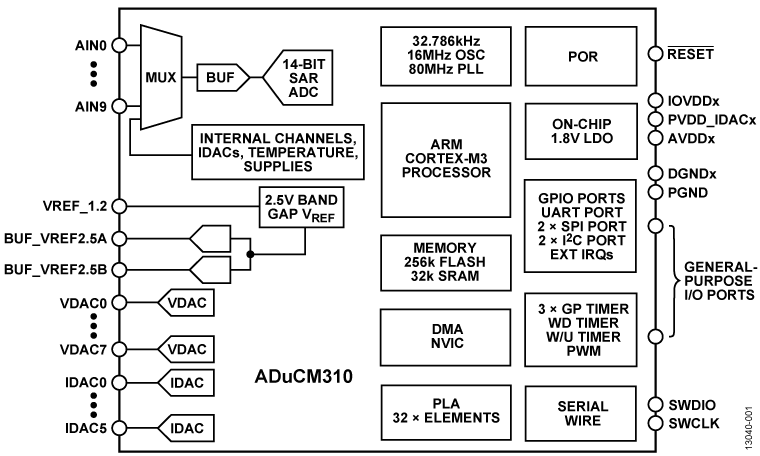
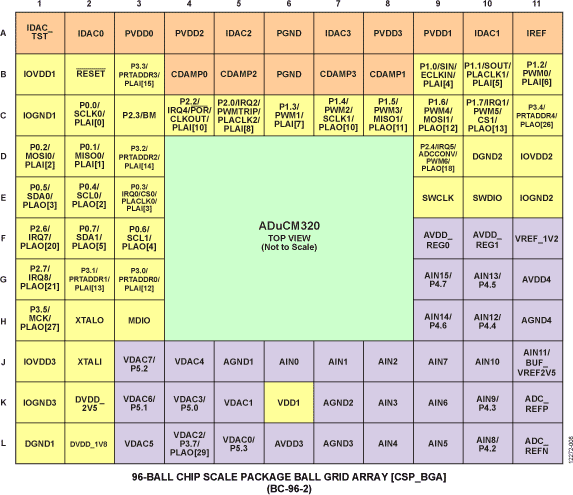
ADUCM320Precision Analog Microcontroller, 14-Bit Analog I/O with MDIO Interface, Arm Cortex-M3 | Evaluation Boards | 4 | Active | The ADuCM320i is a fully integrated single package device that incorporates high performance analog peripherals together with digital peripherals controlled by an 80 MHz ARM®Cortex™-M3 processor and integral flash for code and data.The ADC on the ADuCM320i provides 14-bit, 1 MSPS data acquisition on up to 16 input pins that can be programmed for single-ended or differential operation. The voltage at the IDAC output pins can also be measured by the ADC, which is useful for controlling the power consumption of the current DACs. Additionally, chip temperature and supply voltages can be measured.The ADC input voltage is 0 V to VREF. A sequencer is provided, which allows a user to select a set of ADC channels to be measured in sequence without software involvement during the sequence. The sequence can optionally repeat automatically at a user selectable rate.Up to eight VDACs are provided with output ranges that are programmable to one of two voltage ranges.Four IDAC sources are provided. The output currents are programmable with a range of 0 mA to 150 mA. A low drift band gap reference and voltage comparator completes the analog input peripheral set.The ADuCM320i can be configured so that the digital and analog outputs retain their output voltages and currents through a watchdog or software reset sequence. Thus, a product can remain functional even while the ADuCM320i is resetting itself.The ADuCM320i has a low power ARM Cortex-M3 processor and a 32-bit RISC machine that offers up to 100 MIPS peak performance. Also integrated on chip are 2 × 128 kB Flash/EE memory and 32 kB of SRAM. The flash comprises two separate 128 kB blocks supporting execution from one flash block and simultaneous writing/erasing of the other flash block.The ADuCM320i operates from an on-chip oscillator or a 16 MHz external crystal and a PLL at 80 MHz. This clock can optionally be divided down to reduce current consumption. Additional low power modes can be set via software. In normal operating mode, the ADuCM320i digital core consumes about 300 µA per MHz.The device includes an MDIO interface capable of operating at up to 4 MHz. The capability to simultaneously execute from one flash block and write/erase the other flash block makes the ADuCM320i ideal for 10G, 40G, and 100G optical applications. User programming is eased by incorporating PHYADR and DEVADD hardware comparators. In addition, the nonerasable kernel code plus flags in user flash provide assistance by allowing user code to robustly switch between the two blocks of user flash code and data spaces.The ADuCM320i integrates a range of on-chip peripherals that can be configured under software control, as required in the application. These peripherals include 1 × UART, 2 × I2C, and 2 × SPI serial input/output (I/O) communication controllers, GPIO, 32-element programmable logic array, 3 general-purpose timers, plus a wake-up timer and system watchdog timer. A 16-bit PWM with seven output channels is also provided.GPIO pins on the device power up in high impedance input mode. In output mode, the software chooses between opendrain mode and push-pull mode. The pull-up resistors can be disabled and enabled in software. In GPIO output mode, the inputs can remain enabled to monitor the pins. The GPIO pins can also be programmed to handle digital or analog peripheral signals, in which case the pin characteristics are matched to the specific requirement.A large support ecosystem is available for the ARM Cortex-M3 processor to ease product development of the ADuCM320i. Access is via the ARM serial wire debug port (SW-DP). On-chip factory firmware supports in-circuit serial download via I2C. These features are incorporated into a low cost QuickStart™ development system supporting this precision analog microcontroller family.Note that throughout this data sheet, multifunction pins, such as VDAC0/P5.3, are referred to either by the entire pin name or by a single function of the pin, for example, VDAC0, when only that function is relevant.ApplicationsOptical networking |
| Embedded MCU, DSP | 2 | Active | ||
| Embedded | 1 | Obsolete | ||
| Microcontrollers | 1 | Obsolete | ||
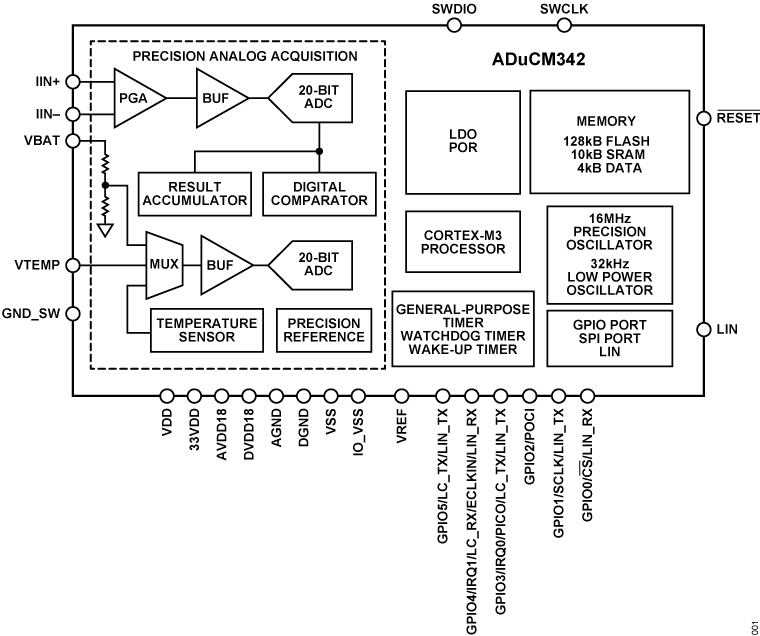
ADUCM342Integrated, Precision Battery Sensor for Automotive Systems | Embedded | 1 | Active | The ADuCM342 is a fully integrated, 8 kHz data acquisition system that incorporates dual, high performance, multichannel, Σ-Δ analogto-digital converters (ADCs), a 32-bit ARM®Cortex™-M3 processor, and flash. The ADuCM342 has 128 kB Flash/EE memory and a 4 kB data flash. Error correction code (ECC) is available on all flash and SRAM memories.The ADuCM342 is a complete system solution for battery monitoring in 12 V automotive applications.The ADuCM342 integrates all features required to precisely and intelligently monitor, process, and diagnose 12 V battery parameters including battery current, voltage, and temperature over a wide range of operating conditions.Minimizing external system components, the device is powered directly from a 12 V battery. On-chip, low dropout (LDO) regulators generate the supply voltage for two integrated Σ-Δ ADCs. The ADCs precisely measure the battery current, voltage, and temperature to characterize the state of the health and the charge of the car battery.The device operates from an on-chip, 16.384 MHz high frequency oscillator that supplies the system clock that is routed through a programmable clock divider, from which the core clock operating frequency is generated. The device also contains a 32.768 kHz oscillator for low power operation.The analog subsystem consists of an ADC with a programmable-gain amplifier (PGA) that allows the monitoring of various current and voltage ranges. The analog subsystem also includes an on-chip precision reference.The ADuCM342 integrates a range of on‑chip peripherals that can be configured under core software control as required in the application. These peripherals include a serial port interface (SPI) serial input/output communication controller, six general-purpose input/output (GPIO) pins, one general-purpose timer, a wake-up timer, and a watchdog timer. For more information, refer to the ADuCM342 hardware reference manual.The ADuCM342 is designed to operate in battery-powered applications where low power operation is critical. The microcontroller core can be configured in normal operating mode, which results in an overall system current consumption of 18.5 mA when all peripherals are active. The device can also be configured in a number of low power operating modes under direct program control, consuming <100 μA.The ADuCM342 includes a local interconnect network (LIN) physical interface for single-wire, high voltage communications in automotive environments. The LIN transceiver is compliant to LIN 2.2A and society of automotive engineers (SAE) J2602-2.The device operates from an external 3.6 V to 19 V (on VDD, Pin 26) voltage supply and is specified over the −40°C to +115°C temperature range, with additional typical specifications at +115°C to +125°C.The information in this data sheet is relevant for silicon revision A60.The ADuCM342 is developed for use in ISO 26262 applications for automotive safety integrity level capability C (ASIL C) supporting single-point fault metric (SPFM) 90% and latent fault metric (LFM) 60% at the IC component level.The ADuCM342 is a low electromagnetic emissions and high electromagnetic immunity device.APPLICATIONSBattery sensing and management for automotive and light mobility vehiclesAuxiliary battery monitoring in xEVLead acid battery measurement for power supplies in industrial and medical domains |
| Development Boards, Kits, Programmers | 6 | Active | ||