A
Analog Devices Inc./Maxim Integrated
| Series | Category | # Parts | Status | Description |
|---|---|---|---|---|
| Part | Spec A | Spec B | Spec C | Spec D | Description |
|---|---|---|---|---|---|



| Series | Category | # Parts | Status | Description |
|---|---|---|---|---|
| Part | Spec A | Spec B | Spec C | Spec D | Description |
|---|---|---|---|---|---|
| Series | Category | # Parts | Status | Description |
|---|---|---|---|---|
| Digital Potentiometers | 11 | Active | ||
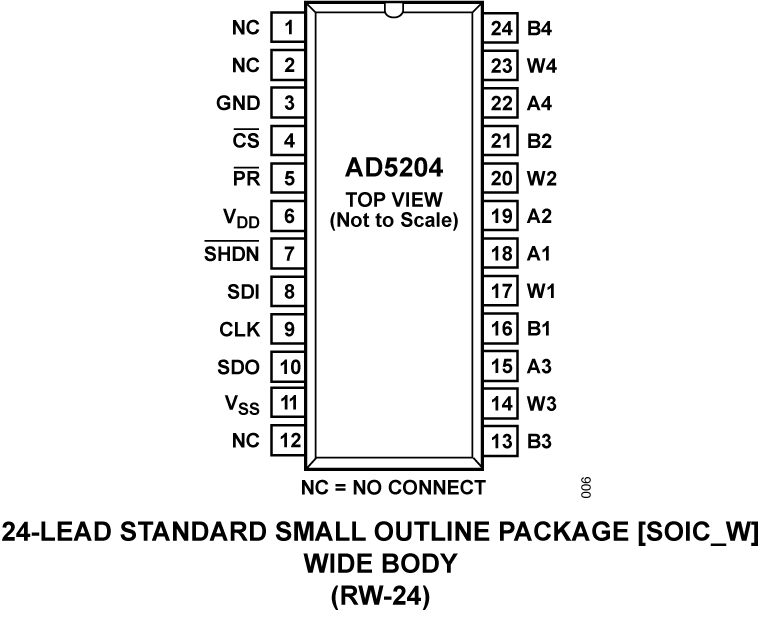
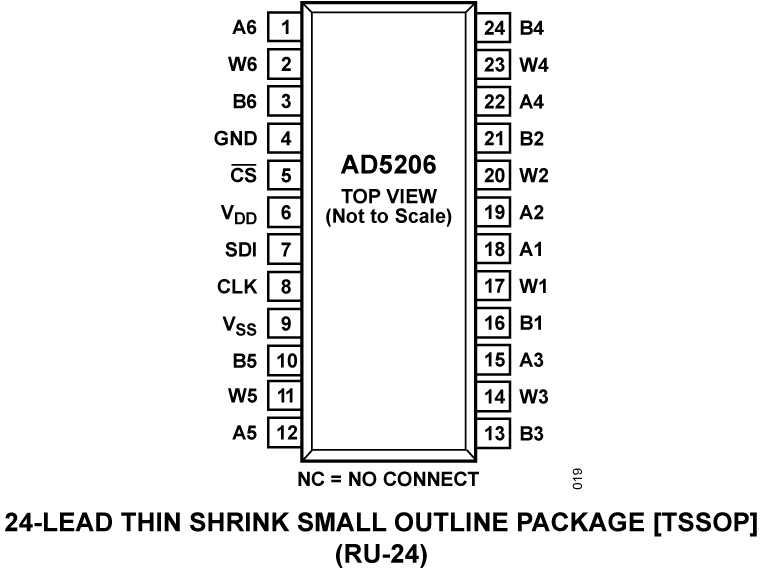
AD52044-Channel Digital Potentiometer | Evaluation Boards | 21 | Active | The AD5204/AD5206provide 4-/6-channel, 256-position digitally controlled variable resistor (VR) devices. These devices perform the same electronic adjustment function as a potentiometer or variable resistor. Each channel of the AD5204/AD5206 contains a fixed resistor with a wiper contact that taps the fixed resistor value at a point determined by a digital code loaded into the SPI-compatible serial-input register. The resistance between the wiper and either endpoint of the fixed resistor varies linearly with respect to the digital code transferred into the VR latch. The variable resistor offers a completely programmable value of resistance between the A terminal and the wiper or the B terminal and the wiper. The fixed A-to-B terminal resistance of 10 kΩ, 50 kΩ, or 100 kΩ has a nominal temperature coefficient of 700 ppm/°C.Each VR has its own VR latch that holds its programmed resistance value. These VR latches are updated from an internal serial-to-parallel shift register that is loaded from a standard 3-wire serial-input digital interface. Eleven data bits make up the data-word clocked into the serial input register. The first three bits are decoded to determine which VR latch is loaded with the last eight bits of the data-word when theCSstrobe is returned to logic high. A serial data output pin at the opposite end of the serial register (AD5204 only) allows simple daisy chaining in multiple VR applications without requiring additional external decoding logic.An optional reset (PR) pin forces all the AD5204 wipers to the midscale position by loading 0x80 into the VR latch.The AD5204/AD5206 are available in the 24-lead surface-mount SOIC and TSSOP packages. The AD5204 is also available in a 32-lead, 5 mm × 5 mm LFCSP package. All parts are guaranteed to operate over the extended industrial temperature range of −40°C to +85°C. For additional single-, dual-, and quad-channel devices, see the AD8400/AD8402/AD8403 data sheets.ApplicationsMechanical potentiometer replacementInstrumentation: gain, offset adjustmentProgrammable voltage-to-current conversionProgrammable filters, delays, time constantsLine impedance matching |
| Integrated Circuits (ICs) | 19 | Active | ||
| Integrated Circuits (ICs) | 8 | Active | ||
| Linear | 6 | Active | ||
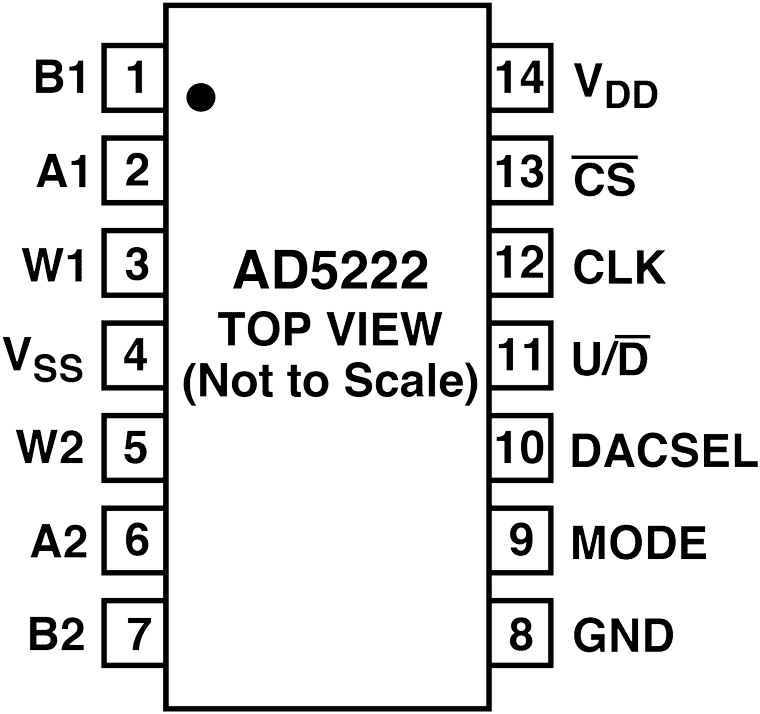
AD5220Increment/Decrement Digital Potentiometer | Digital Potentiometers | 21 | Active | The AD5220 provides a single channel, 128-position digitally controlled variable resistor (VR) device. This device performs the same electronic adjustment function as a potentiometer or variable resistor. These products were optimized for instrument and test equipment push-button applications. A choice between bandwidth or power dissipation are available as a result of the wide selection of end-to-end terminal resistance values.The AD5220 contains a fixed resistor with a wiper contact that taps the fixed resistor value at a point determined by a digitally controlled UP/DOWN counter. The resistance between the wiper and either end point of the fixed resistor provides a con stant resistance step size that is equal to the end-to-end resistance divided by the number of positions (e.g., RSTEP= 10 kΩ/ 128 = 78Ω). The variable resistor offers a true adjustable value of resistance, between the A terminal and the wiper, or the B terminal and the wiper. The fixed A-to-B terminal resistance of 10 kΩ, 50 kΩ, or 100 kΩhas a nominal temperature coefficient of 800 ppm/°C.The chip selectCS, count CLK and U/Ddirection control inputs set the variable resistor position. These inputs that control the internal UP/DOWN counter can be easily generated with mechanical or push button switches (or other contact closure devices). External debounce circuitry is required for the negative-edge sensitive CLK pin. This simple digital interface eliminates the need for microcontrollers in front panel interface designs.The AD5220 is available in both surface mount (SO-8) and the 8-lead plastic DIP package. For ultracompact solutions selected models are available in the thinμSOIC package. All parts are guaranteed to operate over the extended industrial temperature range of -40°C to +85°C. For 3-wire, SPI compatible interface applications, see the AD7376 / AD8400 / AD8402 / AD8403 products.APPLICATIONSMechanical PotentiometerReplacement RemoteIncremental Adjustment Applications Instrumentation: Gain, Offset AdjustmentProgrammable Voltage-to-Current ConversionProgrammable Filters, Delays, Time ConstantsLine Impedance MatchingPower Supply Adjustment |
| Integrated Circuits (ICs) | 18 | Active | ||
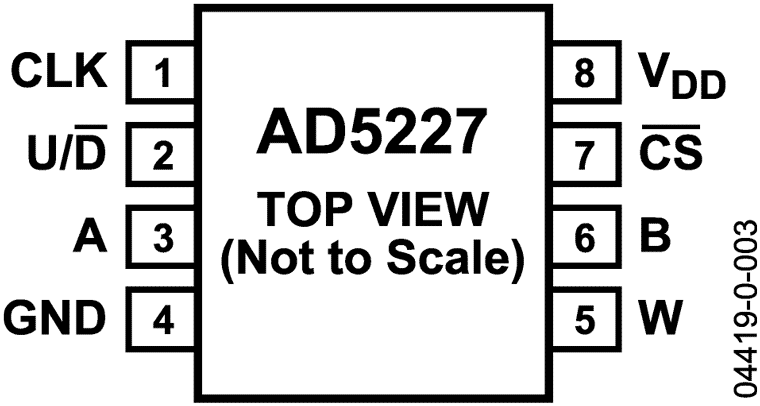
AD522764-Position Digital Up/Down Control Potentiometer | Integrated Circuits (ICs) | 4 | Active | The AD5227 is Analog Devices’ latest 64-step up/down control digital potentiometer. This device performs the same electronic adjustment function as a 5 V potentiometer or variable resistor. Its simple 3-wire up/down interface allows manual switching or high speed digital control. The AD5227 presets to midscale at power-up. WhenCSis enabled, the devices changes step at every clock pulse. The direction is determined by the state of the U/Dpin (see ). The interface is simple to activate by any host controller, discrete logic, or manually with a rotary encoder or pushbuttons. The AD5227’s 64-step resolution, small footprint, and simple interface enable it to replace mechanical potentiometers and trimmers with typically 6× improved resolution, solid-state reliability, and design layout flexibility, resulting in a considerable cost savings in end users’ systems.The AD5227 is available in a compact thin SOT-23-8 (TSOT-8) Pb-free package. The part is guaranteed to operate over the automotive temperature range of −40°C to +105°C.Users who consider EEMEM potentiometers should refer to some recommendations in the Applications section.APPLICATIONSMechanical potentiometer and trimmer replacementsLCD backlight, contrast, and brightness controlsPortable electronics level adjustmentProgrammable power supplyDigital trimmer replacementsAutomatic closed-loop control |
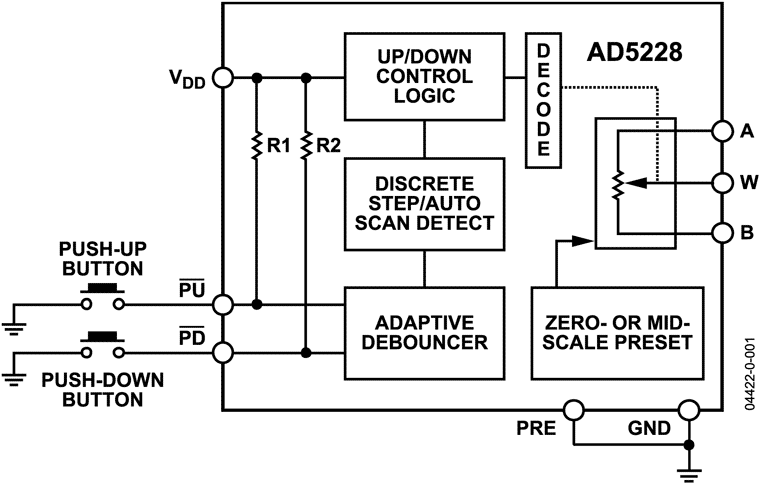
AD522832-Position Manual Up/Down Control Potentiometer | Data Acquisition | 5 | Active | The AD5228 is Analog Devices’ latest 32-step-up/step-down control digital potentiometer emulating mechanical potentiometer operation. Its simple up/down control interface allows manual control with just two external pushbutton tactile switches. The AD5228 is designed with a built-in adaptive debouncer that ignores invalid bounces due to contact bounce commonly found in mechanical switches. The debouncer is adaptive, accommodating a variety of pushbutton tactile switches that generally have less than 10 ms of bounce time during contact closures. When choosing the switch, the user should consult the timing specification of the switch to ensure its suitability in an AD5228 application.The AD5228 can increment or decrement the resistance in discrete steps or in autoscan mode. When thePUorPDbutton is pressed briefly (no longer than 0.6 s), the resistance of the AD5228 changes by one step. When thePUorPDbutton is held continuously for more than a second, the device activates the autoscan mode and changes four resistance steps per second.The AD5228 can also be controlled digitally; its up/down features simplify microcontroller usage. The AD5228 is available in a compact thin SOT-23-8 (TSOT-8) package. The part is guaranteed to operate over the automotive temperature range of −40°C to +105°C.The AD5228’s simple interface, small footprint, and very low cost enable it to replace mechanical potentiometers and trimmers with typically 3× improved resolution, solid-state reliability, and faster adjustment, resulting in considerable cost saving in end users’ systems.Users who consider EEMEM potentiometers should refer to the recommendations in the Applications section.APPLICATIONSMechanical potentiometer and trimmer replacementsLCD backlight, contrast, and brightness controlsDigital volume controlPortable device-level adjustmentsElectronic front panel-level controlsProgrammable power supply |
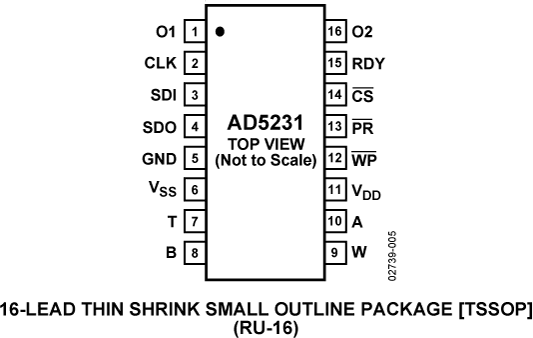
AD5231Nonvolatile Memory, 1024-Position Digital Potentiometer | Digital Potentiometers | 9 | Active | The AD5231 is a nonvolatile memory, digitally controlled potentiometer with 1024-step resolution. The device performs the same electronic adjustment function as a mechanical potentiometer with enhanced resolution, solid state reliability, and remote controllability. The AD5231 has versatile programming that uses a standard 3-wire serial interface for 16 modes of operation and adjustment, including scratchpad programming, memory storing and restoring, increment/decrement, ±6 dB/step log taper adjustment, wiper setting readback, and extra EEMEM for user-defined information, such as memory data for other components, look-up table, or system identification information.In scratchpad programming mode, a specific setting can be programmed directly to the RDAC register that sets the resistance between Terminals W–A and Terminals W–B. This setting can be stored into the EEMEM and is transferred automatically to the RDAC register during system power-on.The EEMEM content can be restored dynamically or through externalPRstrobing, and aWPfunction protects EEMEM contents. To simplify the programming, the linear-step increment or decrement commands can be used to move the RDAC wiper up or down, one step at a time. The ±6 dB step commands can be used to double or half the RDAC wiper setting.The AD5231 is available in a 16-lead TSSOP. The part is guaranteed to operate over the extended industrial temperature range of −40°C to +85°C.APPLICATIONSMechanical potentiometer replacementInstrumentation: gain, offset adjustmentProgrammable voltage to current conversionProgrammable filters, delays, time constantsProgrammable power supplyLow resolution DAC replacementSensor calibration |
| Part | Category | Description |
|---|---|---|
 Analog Devices Inc./Maxim Integrated | Development Boards Kits Programmers | EVAL BOARD HMC264LM3 |
 Analog Devices Inc./Maxim Integrated | Development Boards Kits Programmers | EVAL BOARD HMC362S8GE |
 Analog Devices Inc./Maxim Integrated | Development Boards Kits Programmers | BOARD EVAL DIVIDER HMC365 |
 Analog Devices Inc./Maxim Integrated | Development Boards Kits Programmers | EVAL BOARD HMC413QS16G |
 Analog Devices Inc./Maxim Integrated | Development Boards Kits Programmers | EVAL BOARD HMC414MS8G |
 Analog Devices Inc./Maxim Integrated | Development Boards Kits Programmers | EVAL BRD, 3.5GHZ, SPDT NON-REFLECTIVE SW ROHS COMPLIANT: YES |
 Analog Devices Inc./Maxim Integrated | Development Boards Kits Programmers | BOARD EVALUATION HMC435AMS8G |
 Analog Devices Inc./Maxim Integrated | Development Boards Kits Programmers | EVALUATION BOARD, HMC536MS8G, RF SWITCH, RF / IF |
 Analog Devices Inc./Maxim Integrated | Development Boards Kits Programmers | EVAL BOARD HMC415LP3 |
 Analog Devices Inc./Maxim Integrated | Development Boards Kits Programmers | EVAL BRD, HBT MMIC, DIVIDE-BY-2, 8GHZ ROHS COMPLIANT: YES |