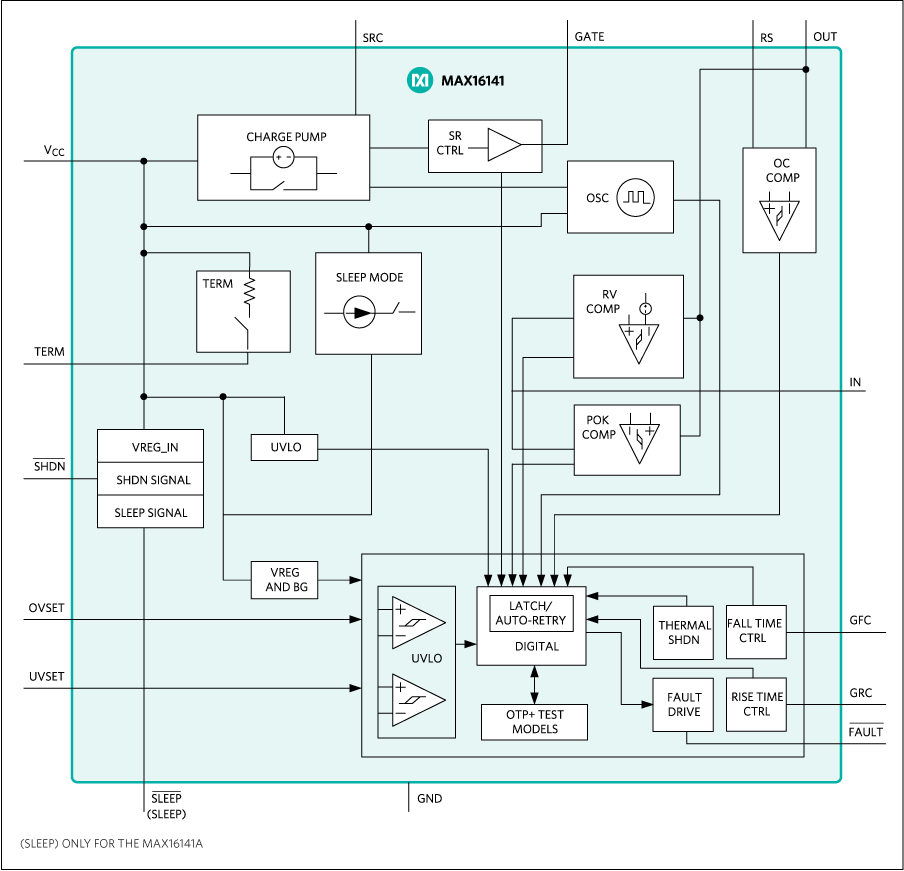
MAX161413.5V to 36V Ideal Diode Controllers with Voltage and Current Circuit Breaker | Development Boards, Kits, Programmers | 14 | Active | The MAX16141/MAX16141A, ideal diode controllers, provide system protection against a variety of system faults, such as reverse current, reverse voltage, overcurrent, input overvoltage/undervoltage, and overtemperature conditions. The wide operating voltage range of 3.5V to 36V, combined with 5µA (typ) of shutdown current, make the MAX16141/ MAX16141A ideal for automotive applications. An integrated charge pump drives the gate of the back-to-back external nFETs 9V above the source connection, minimizing power loss between the source and the load.A fast-acting comparator allows the MAX16141/MAX16141A to block reverse-current flow within 1µs (max) of the input falling below the output voltage. An external current-sense resistor between RS and OUT provides overload monitoring capability. Two input pins, OVSET and UVSET, provide set points to protect against input overvoltage and undervoltage events using a simple resistive-divider.During startup, the MAX16141/MAX16141A monitor the voltage drop across the external nFETs (VIN- VOUT) and the load current for overcurrent fault to ensure VOUTis greater than 0.9 x VIN. Once the startup event is complete, the MAX16141/MAX16141A are ready to protect against systems faults. During normal operation, some systems experience brownouts or short interruptions of power. To ensure smooth system recovery from these interruptions, the MAX16141/MAX16141A include a secondary power input (VCC) to keep critical circuits alive. When the main input power recovers, the MAX16141/MAX16141A enable the gate in fast mode (70µs, typ) to charge the output capacitor.Both devices feature a low-power mode that is enabled with a logic input. In low-power mode the devices allow limited current flow from source to the load. For the MAX16141, the low power mode is enabled using an active low logic input, active-low SLEEP. For the MAX16141A, the lower-power mode is activated using an active-high logic input (SLEEP).Additional features include an internal switch that isolates the monitoring from the UVSET and OVSET resistive network in shutdown mode to help minimize system power loss.The MAX16141/MAX16141A are available in a 4mm x 4mm x 0.75mm, 16-pin TQFN package and operate over the automotive temperature range of -40°C to +125°C.ApplicationsAutomotive Power SystemsNetwork/Telecom Power SystemsPoE SystemsRAID SystemsServers |
| Power Management (PMIC) | 2 | Active | |
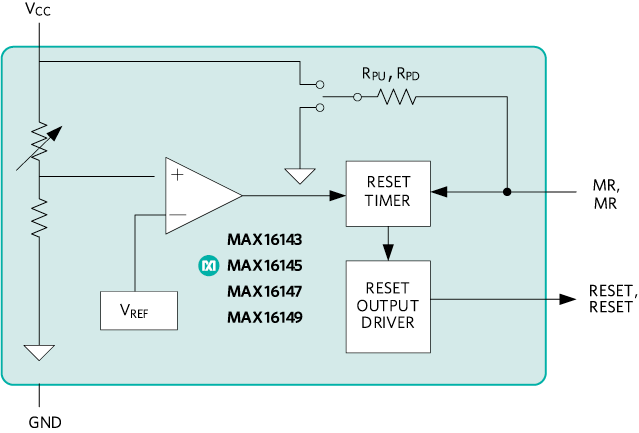
MAX16147High-Voltage Supervisors with Manual Reset Input | Power Management (PMIC) | 2 | Active | The MAX16143, MAX16145, MAX16147, and MAX16149 are supervisory circuits that monitor their own supply voltages using a factory-set reset threshold that ranges from +3.3V to +11.6V. A manual reset (MR or active-low MR) input is included. The RESET (or active-low RESET) output has options for active-low, active-high, push-pull, or open-drain. The reset output asserts when the monitored voltage falls below the threshold voltage, and remains asserted until the monitored voltage has exceeded its threshold (plus hysteresis) for a time equal to the factory-set reset timeout period. Available reset timeout periods range from 30µs to 4.2s.The 5-pin SOT23 and 4-bump wafer-level packages (WLPs) offer compatibility with space-constrained environments. These ICs are fully specified over the -40°C to +125°C temperature range.ApplicationsCommunications EquipmentIndustrial EquipmentServers |
| Voltage Regulators - Linear, Low Drop Out (LDO) Regulators | 3 | Active | |
| Controllers | 8 | Active | |
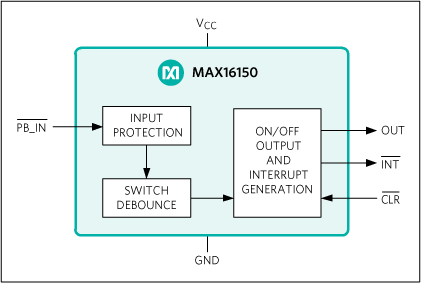
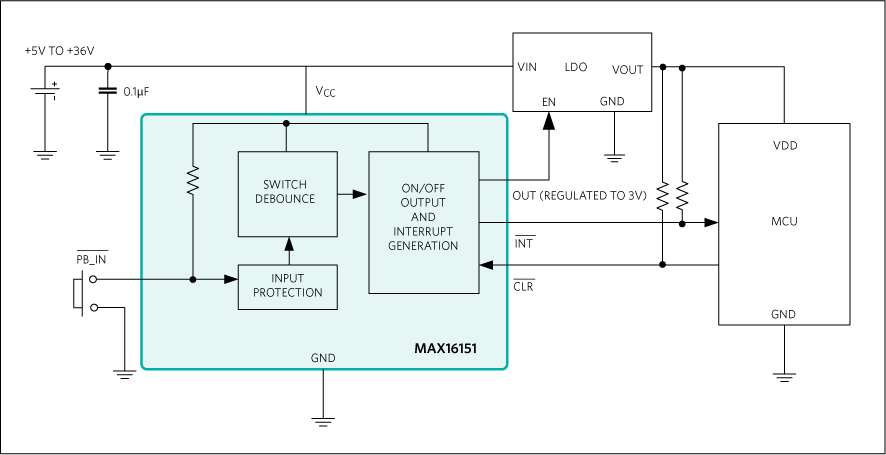
MAX16151High Voltage Pushbutton On/Off Controller | Power Management (PMIC) | 2 | Active | The MAX16151 is a high voltage, pushbutton on/off controller with a switch debouncer and built-in latch. This device accepts a noisy input from a mechanical switch and produces a clean, latched output, as well as a one-shot interrupt output, in response to a switch closure exceeding the debounce period at active-low PB_IN. A switch closure longer than the shutdown period at active-low PB_IN results in a longer one-shot interrupt output. The MAX16151 family has two sets of devices: one in which a longer switch closure greater than the shutdown period deasserts the latched output, and another in which the latched output stays asserted. See Table 1 for more information.The MAX16151 operates from a supply range of +5V to +36V and consumes less than 15µA of supply current to ensure minimal battery current in low-power applications. The robust switch input active-low (PB_IN) handles ±60V levels and is ±10kV electrostatic discharge (ESD) protected for use in harsh industrial environments. The 3V regulated latched output can serve as a logic signal to control a pass transistor or voltage regulator. A separate active-low INT output provides a system interrupt whenever a valid pushbutton signal is detected. An asynchronous active-low CLR input allows an external signal to force the latched output to the OFF state. The MAX16151 operates over the -40°C to +125°C temperature range and is available in a 1.23mm x 0.83mm, 6-bump wafer-level package (WLP), and a 6-pin thin SOT23 package.ApplicationsPortable InstrumentsIndustrial EquipmentDesktop and Notebook ComputersTelecommunication and Servers |
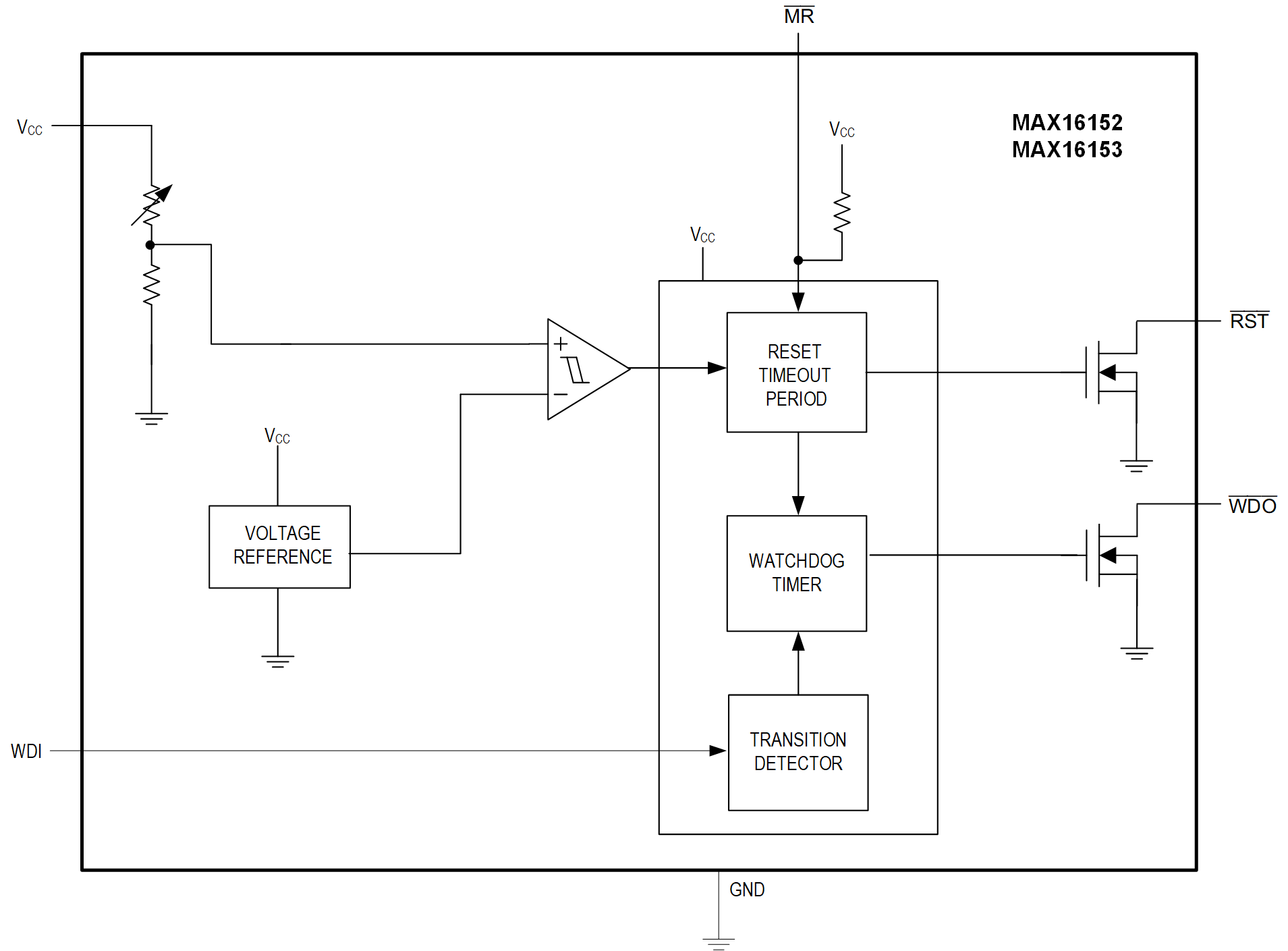
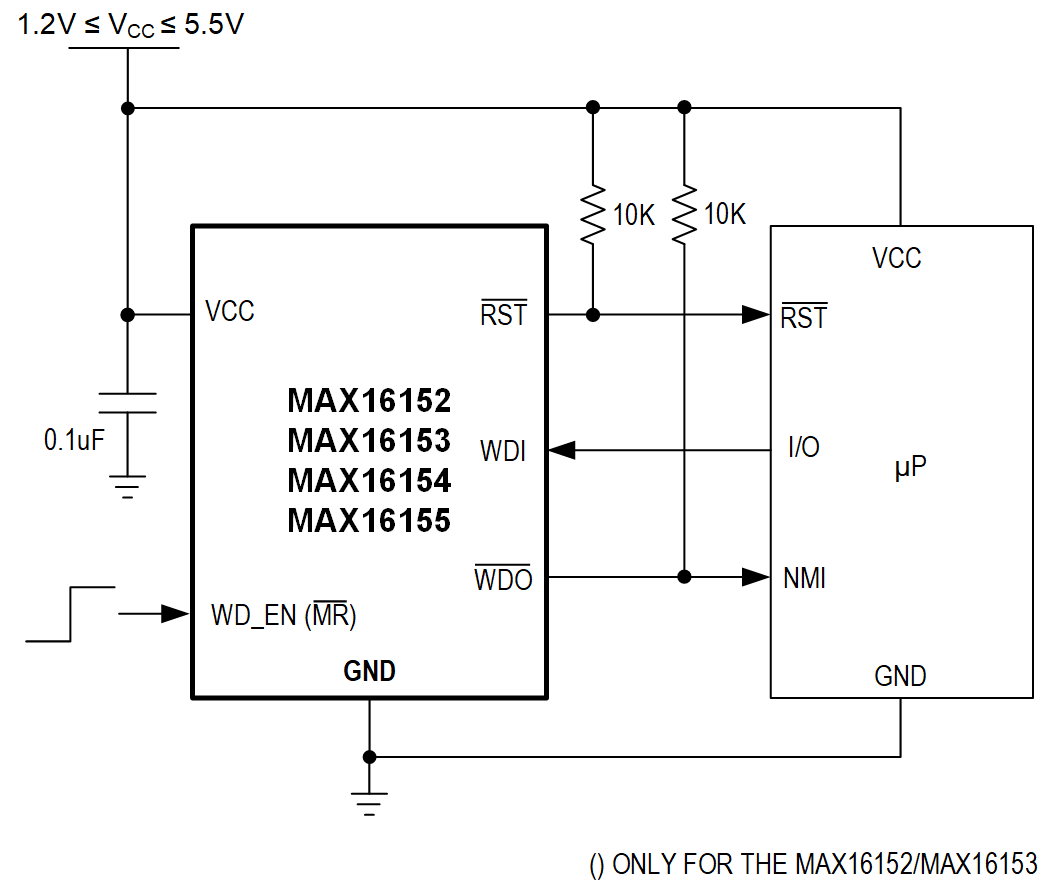
MAX16152nanoPower Supervisor and Watchdog Timer | Power Management (PMIC) | 2 | Active | The MAX16152/MAX16153/MAX16154/MAX16155 ultra-low-current supervisory circuits monitor a single system supply voltage and the integrity of code execution by a microprocessor or microcontroller. These supervisors assert the reset output whenever the VCCsupply voltage is greater than the minimum operating voltage, but less than the reset threshold. After the supply voltage rises above the reset threshold, the reset output remains asserted for the reset timeout period, and then de-asserts. Reset voltage thresholds are available from 1.50V to 5.0V in approximately 100mV increments.A watchdog timer circuit monitors microprocessor or microcontroller activity. During normal operation, the microprocessor or microcontroller should repeatedly toggle the watchdog input (WDI) before the supervisor’s watchdog timeout period elapses to confirm that the system is executing code properly. If the microprocessor or microcontroller does not provide a valid watchdog input transition before the timeout period expires, the supervisor asserts a watchdog (active-low WDO) output to signal that the system is not executing code as expected. The watchdog output pulse can be used to reset the microprocessor or microcontroller, or it may be used to interrupt the system to warn of execution errors. The MAX16152 and MAX16153 feature a manual reset input (active-low MR) to allow an external pushbutton or logic signal to initiate a reset pulse. The MAX16154 and MAX16155 feature a logic input (WD_EN) that allows the system to enable and disable the watchdog function.The MAX16152 and MAX16154 are offered in a 0.86mm x 1.27mm, 6-bump WLP, while the MAX16153 and MAX16155 are offered in 6-pin SOT23 package. All devices operate over the -40°C to +125°C temperature range.ApplicationsGlucose Monitors/Patient MonitorMeteringPortable/Battery-Powered EquipmentTablets/e-Readers/Mobile Devices |
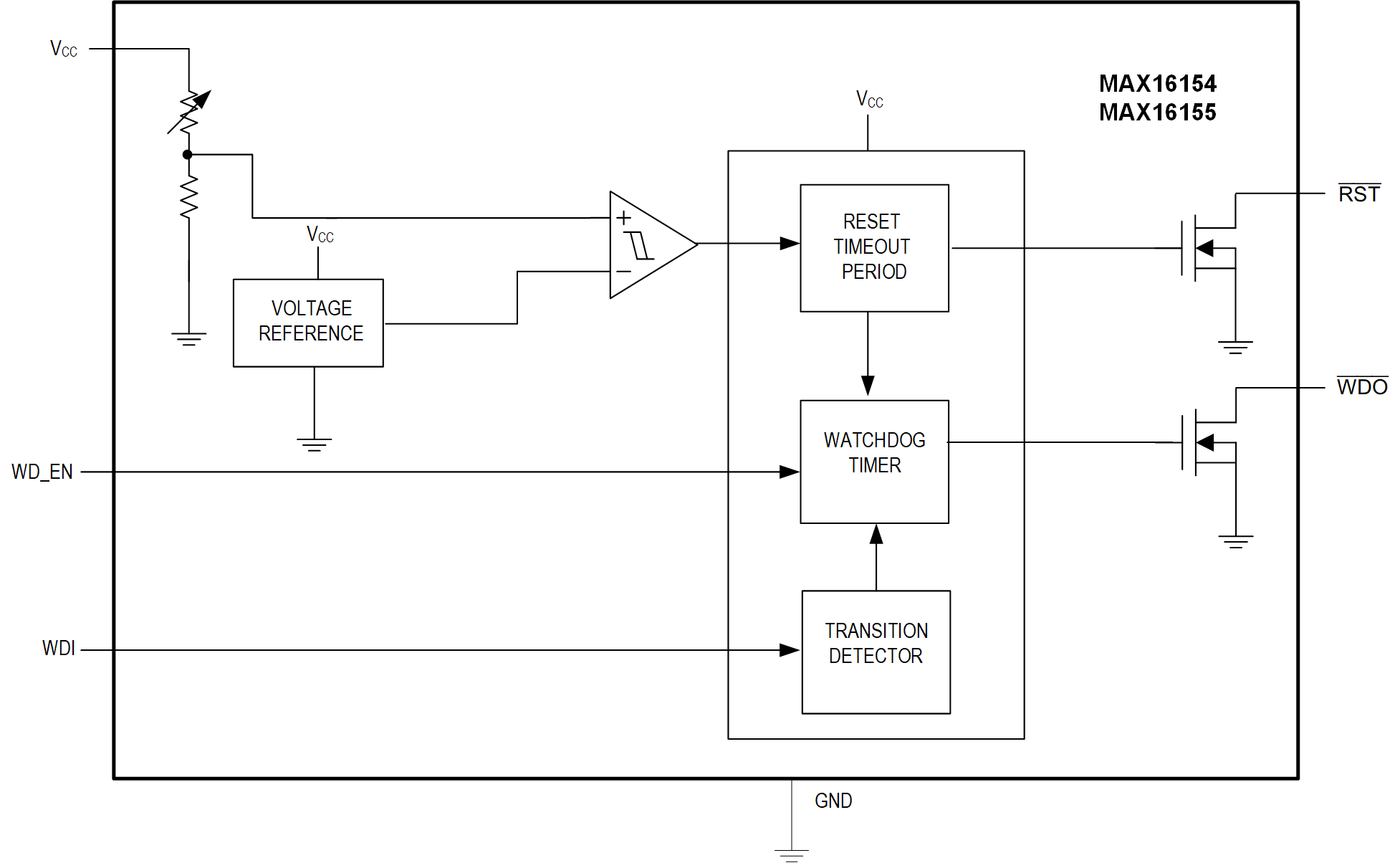
MAX16154nanoPower Supervisor and Watchdog Timer | Integrated Circuits (ICs) | 2 | Active | The MAX16152/MAX16153/MAX16154/MAX16155 ultra-low-current supervisory circuits monitor a single system supply voltage and the integrity of code execution by a microprocessor or microcontroller. These supervisors assert the reset output whenever the VCCsupply voltage is greater than the minimum operating voltage, but less than the reset threshold. After the supply voltage rises above the reset threshold, the reset output remains asserted for the reset timeout period, and then de-asserts. Reset voltage thresholds are available from 1.50V to 5.0V in approximately 100mV increments.A watchdog timer circuit monitors microprocessor or microcontroller activity. During normal operation, the microprocessor or microcontroller should repeatedly toggle the watchdog input (WDI) before the supervisor’s watchdog timeout period elapses to confirm that the system is executing code properly. If the microprocessor or microcontroller does not provide a valid watchdog input transition before the timeout period expires, the supervisor asserts a watchdog (active-low WDO) output to signal that the system is not executing code as expected. The watchdog output pulse can be used to reset the microprocessor or microcontroller, or it may be used to interrupt the system to warn of execution errors. The MAX16152 and MAX16153 feature a manual reset input (active-low MR) to allow an external pushbutton or logic signal to initiate a reset pulse. The MAX16154 and MAX16155 feature a logic input (WD_EN) that allows the system to enable and disable the watchdog function.The MAX16152 and MAX16154 are offered in a 0.86mm x 1.27mm, 6-bump WLP, while the MAX16153 and MAX16155 are offered in 6-pin SOT23 package. All devices operate over the -40°C to +125°C temperature range.ApplicationsGlucose Monitors/Patient MonitorMeteringPortable/Battery-Powered EquipmentTablets/e-Readers/Mobile Devices |
MAX16155nanoPower Supervisor and Watchdog Timer | Integrated Circuits (ICs) | 6 | Active | The MAX16152/MAX16153/MAX16154/MAX16155 ultra-low-current supervisory circuits monitor a single system supply voltage and the integrity of code execution by a microprocessor or microcontroller. These supervisors assert the reset output whenever the VCCsupply voltage is greater than the minimum operating voltage, but less than the reset threshold. After the supply voltage rises above the reset threshold, the reset output remains asserted for the reset timeout period, and then de-asserts. Reset voltage thresholds are available from 1.50V to 5.0V in approximately 100mV increments.A watchdog timer circuit monitors microprocessor or microcontroller activity. During normal operation, the microprocessor or microcontroller should repeatedly toggle the watchdog input (WDI) before the supervisor’s watchdog timeout period elapses to confirm that the system is executing code properly. If the microprocessor or microcontroller does not provide a valid watchdog input transition before the timeout period expires, the supervisor asserts a watchdog (active-low WDO) output to signal that the system is not executing code as expected. The watchdog output pulse can be used to reset the microprocessor or microcontroller, or it may be used to interrupt the system to warn of execution errors. The MAX16152 and MAX16153 feature a manual reset input (active-low MR) to allow an external pushbutton or logic signal to initiate a reset pulse. The MAX16154 and MAX16155 feature a logic input (WD_EN) that allows the system to enable and disable the watchdog function.The MAX16152 and MAX16154 are offered in a 0.86mm x 1.27mm, 6-bump WLP, while the MAX16153 and MAX16155 are offered in 6-pin SOT23 package. All devices operate over the -40°C to +125°C temperature range.ApplicationsGlucose Monitors/Patient MonitorMeteringPortable/Battery-Powered EquipmentTablets/e-Readers/Mobile Devices |
| Supervisors | 2 | Active | |