DS110RT410 Series
8.5 to 11.3-Gbps quad channel retimer with adaptive EQ and CDR
Manufacturer: Texas Instruments
Catalog
8.5 to 11.3-Gbps quad channel retimer with adaptive EQ and CDR
Key Features
• Each Channel Independently Locks to Data Ratesfrom 8.5 to 11.3 Gbps and Sub-ratesSub-rates of Divide by 2, 4, or 8Fast-Lock Operation Based on Protocol-SelectModeLow Latency (≈ 300 ps)Adaptive Equalization up to 34-dB Boost at 5 GHzAdjustable Transmit VOD: 600 to 1300 mVp-pAdjustable Transmit De-emphasis to –12 dBTypical Power Dissipation (EQ+CDR+DE):150 mW/ChannelProgrammable Output Polarity InversionInput Signal Detection, CDR Lock Detection andIndicatorOn-Chip Eye Monitor (EOM), PRBS GeneratorSingle 2.5-V ±5% Power SupplySMBus and EEPROM Configuration ModesOperating Temperature Range of –40 to 85°CWQFN 48-Pin 7-mm × 7-mm PackageEasy Pin Compatible Upgrade Between Repeaterand RetimersDS100RT410 (EQ+CDR+DE): 10.3125 GbpsDS100DF410 (EQ+DFE+CDR+DE):10.3125 GbpsDS110RT410 (EQ+CDR+DE): 8.5 to11.3 GbpsDS110DF410 (EQ+DFE+CDR+DE): 8.5 to11.3 GbpsDS125RT410 (EQ+CDR+DE): 9.8 to12.5 GbpsDS125DF410 (EQ+DFE+CDR+DE):9.8 to 12.5 GbpsDS100BR410 (EQ+DE): Up to10.3125 GbpsEach Channel Independently Locks to Data Ratesfrom 8.5 to 11.3 Gbps and Sub-ratesSub-rates of Divide by 2, 4, or 8Fast-Lock Operation Based on Protocol-SelectModeLow Latency (≈ 300 ps)Adaptive Equalization up to 34-dB Boost at 5 GHzAdjustable Transmit VOD: 600 to 1300 mVp-pAdjustable Transmit De-emphasis to –12 dBTypical Power Dissipation (EQ+CDR+DE):150 mW/ChannelProgrammable Output Polarity InversionInput Signal Detection, CDR Lock Detection andIndicatorOn-Chip Eye Monitor (EOM), PRBS GeneratorSingle 2.5-V ±5% Power SupplySMBus and EEPROM Configuration ModesOperating Temperature Range of –40 to 85°CWQFN 48-Pin 7-mm × 7-mm PackageEasy Pin Compatible Upgrade Between Repeaterand RetimersDS100RT410 (EQ+CDR+DE): 10.3125 GbpsDS100DF410 (EQ+DFE+CDR+DE):10.3125 GbpsDS110RT410 (EQ+CDR+DE): 8.5 to11.3 GbpsDS110DF410 (EQ+DFE+CDR+DE): 8.5 to11.3 GbpsDS125RT410 (EQ+CDR+DE): 9.8 to12.5 GbpsDS125DF410 (EQ+DFE+CDR+DE):9.8 to 12.5 GbpsDS100BR410 (EQ+DE): Up to10.3125 Gbps
Description
AI
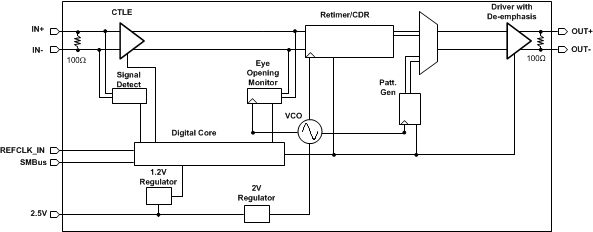
The DS110RT410 is a four-channel retimer with integrated signal conditioning. The device includes a fully adaptive continuous-time linear equalizer (CTLE), clock and data recovery (CDR), and a transmit de-emphasis (DE) driver to enable data transmission over long, lossy and crosstalk-impaired highspeed serial links to achieve BER < 1 × 10–15. For channels with a high amount of crosstalk, the DS110DF410 should be used because it has self-calibrating 5-tap decision-feedback equalizer (DFE).
Each channel can independently lock to data rates from 8.5 to 11.3 Gbps, and associated sub-rates (divide by 2, 4, and 8) to support a variety of communication protocols. A 25-MHz crystal oscillator clock is used to speed up the CDR lock process. This clock is not used for training the PLL and does not need to be synchronous with the serial data.
The programmable settings can be applied using the SMBus (I2C) interface, or they can be loaded through an external EEPROM. An on-chip eye monitor and a PRBS generator allow real-time measurement of high-speed serial data for system bring-up or field tuning.
The DS110RT410 is a four-channel retimer with integrated signal conditioning. The device includes a fully adaptive continuous-time linear equalizer (CTLE), clock and data recovery (CDR), and a transmit de-emphasis (DE) driver to enable data transmission over long, lossy and crosstalk-impaired highspeed serial links to achieve BER < 1 × 10–15. For channels with a high amount of crosstalk, the DS110DF410 should be used because it has self-calibrating 5-tap decision-feedback equalizer (DFE).
Each channel can independently lock to data rates from 8.5 to 11.3 Gbps, and associated sub-rates (divide by 2, 4, and 8) to support a variety of communication protocols. A 25-MHz crystal oscillator clock is used to speed up the CDR lock process. This clock is not used for training the PLL and does not need to be synchronous with the serial data.
The programmable settings can be applied using the SMBus (I2C) interface, or they can be loaded through an external EEPROM. An on-chip eye monitor and a PRBS generator allow real-time measurement of high-speed serial data for system bring-up or field tuning.