Catalog
0 Hz/DC to 18 GHz, SP4T, MEMS Switch
Key Features
• Fully operational from DC to 18 GHz (typical)
• RF performance characteristicsInsertion loss: −1.7 dB (typical) at 16 GHzIsolation: −18.5 dB (typical) at 6 GHzIIP3: 73 dBm (typical)RF power: 33 dBm (maximum)
• Insertion loss: −1.7 dB (typical) at 16 GHz
• Isolation: −18.5 dB (typical) at 6 GHz
• IIP3: 73 dBm (typical)
• RF power: 33 dBm (maximum)
• On resistance: 1.9 Ω (typical)
• DC current handling: 200 mA
• Actuation lifetime: 200 million cycles (minimum)
• On switching time: 200 μs (typical)
• Integrated 3.3 V driver for simple control with parallel and SPI interface
• Independently controllable switches
• Space saving integrated passive componentsEliminates floating nodes on the switch
• Eliminates floating nodes on the switch
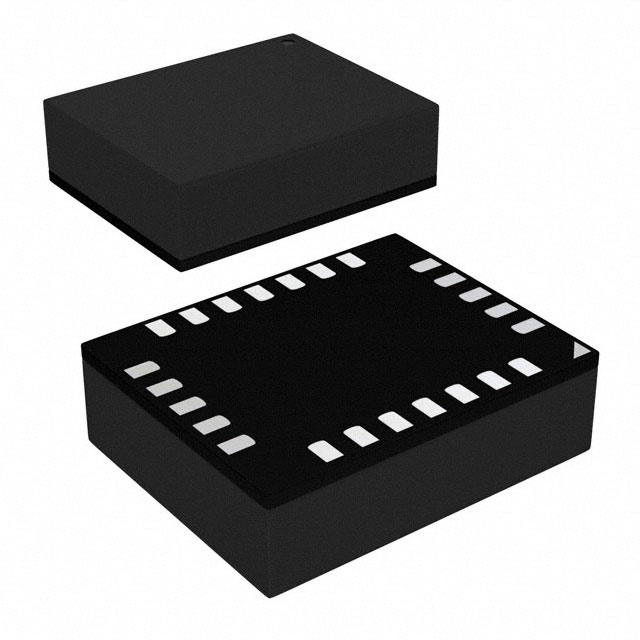
• 5 mm × 4 mm × 1.0 mm, 24-lead land grid array package
• Temperature range: −40°C to +85°C
• Switch position is unknown with no supply voltage
Description
AI
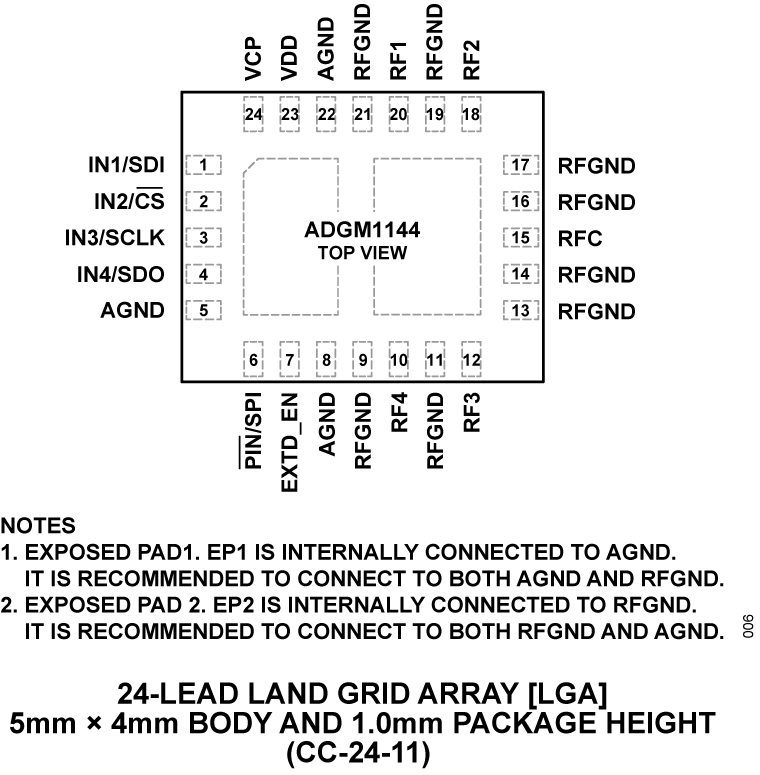
The ADGM1144 is a wideband, single-pole, four-throw (SP4T) switch, fabricated using Analog Devices, Inc., microelectromechanical system (MEMS) switch technology. This technology enables a small form factor, wide RF bandwidth, highly linear, low insertion loss switch that is operational down to 0 Hz/DC, making it an ideal solution for a wide range of RF and precision equipment switching needs.An integrated driver chip generates a high voltage to an electrostatically actuate switch that can be controlled by a parallel interface and a serial peripheral interface (SPI). All four switches are independently controllable.The device is packaged in a 24-lead, 5 mm × 4 mm × 1.0 mm land grid array package (LGA).The ADGM1144 has integrated 10 MΩ resistors required for floating node avoidance. The presence of these integrated 10 MΩ resistors saves board space and eliminates floating nodes on the switch. To ensure optimum operation of the ADGM1144, refer to the Critical Operational Requirements section of the data sheet.Throughout this data sheet, multifunction pins, such as IN1/SDI, are referred to either by the entire pin name or by a single function of the pin, for example IN1, when only that function is relevant.APPLICATIONSAutomatic test equipment (ATE) load and probe boardsDC with high speed digital testingRelay replacementsRF test instrumentationATE: RF, digital, and mixed signalsRF wireless communicationsHigh performance RF switching