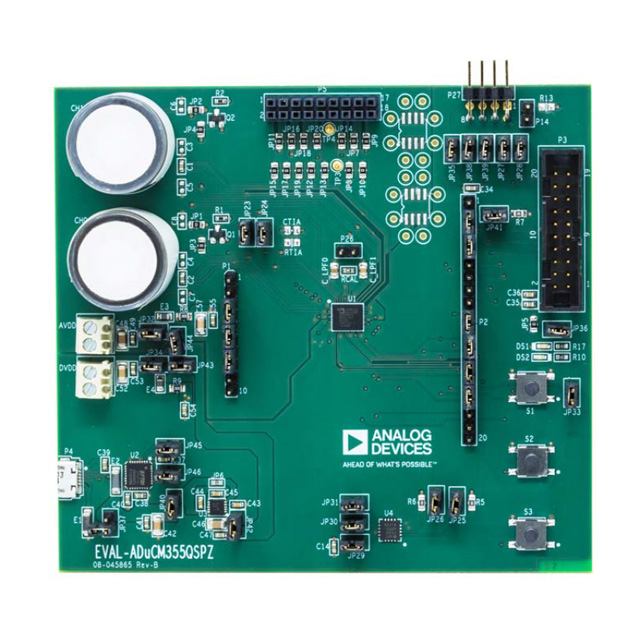
ADUCM355 Series
Precision Analog Microcontroller with Chemical Sensor Interface
Manufacturer: Analog Devices
Catalog
Precision Analog Microcontroller with Chemical Sensor Interface
Key Features
• Analog input/output16-bit, 400 kSPS ADCVoltage, current, and impedance measurement capabilityInternal and external current and voltage channelsUltralow leakage switch matrix and input muxInput buffers, PGA
• 16-bit, 400 kSPS ADC
• Voltage, current, and impedance measurement capabilityInternal and external current and voltage channelsUltralow leakage switch matrix and input muxInput buffers, PGA
• Internal and external current and voltage channels
• Ultralow leakage switch matrix and input mux
• Input buffers, PGA
• Voltage DACsTwo dual output voltage DACsOutput range: 0.2 V to 2.4 V (±2.2 V voltage potential to sensor) for 12-bit outputsTwo bias potentiostat and TIA amplifiersUltralow power, 1 μA per amplifierOne high speed 12-bit voltage DACOutput range to sensor: −607 mV to +607 mVHigh speed TIA for impedance measurementsProgrammable gain amplifier on output
• Two dual output voltage DACsOutput range: 0.2 V to 2.4 V (±2.2 V voltage potential to sensor) for 12-bit outputs
• Output range: 0.2 V to 2.4 V (±2.2 V voltage potential to sensor) for 12-bit outputs
• Two bias potentiostat and TIA amplifiersUltralow power, 1 μA per amplifier
• Ultralow power, 1 μA per amplifier
• One high speed 12-bit voltage DACOutput range to sensor: −607 mV to +607 mVHigh speed TIA for impedance measurementsProgrammable gain amplifier on output
• Output range to sensor: −607 mV to +607 mV
• High speed TIA for impedance measurements
• Programmable gain amplifier on output
• Amplifiers, accelerators, and referencesTwo low power, low noise amplifiersSuitable for potentiostat bias in electrochemical sensingTwo low power, low noise TIAsSuitable for measuring sensor current output in the ±0.00005 μA to ±3000 μA rangeProgrammable load and gain resistorsAnalog hardware acceleratorsDigital waveform generatorDFT and digital filters2.5 V and 1.82 V on-chip, precision voltage references
• Two low power, low noise amplifiersSuitable for potentiostat bias in electrochemical sensing
• Suitable for potentiostat bias in electrochemical sensing
• Two low power, low noise TIAsSuitable for measuring sensor current output in the ±0.00005 μA to ±3000 μA rangeProgrammable load and gain resistors
• Suitable for measuring sensor current output in the ±0.00005 μA to ±3000 μA range
• Programmable load and gain resistors
• Analog hardware acceleratorsDigital waveform generatorDFT and digital filters
• Digital waveform generator
• DFT and digital filters
• 2.5 V and 1.82 V on-chip, precision voltage references
• Internal Temperature Sensor, ±2°C accurateImpedance measurement range of <1 Ω to 10 MΩ, 0.016 Hz to 200,000 Hz
• Impedance measurement range of <1 Ω to 10 MΩ, 0.016 Hz to 200,000 Hz
• Voltammetry scan rate up to 2000 steps per second
• Microcontroller26 MHz ARM Cortex-M3 processorSerial wire port supports code download and debugging128 kB flash/64 kB of SRAM
• 26 MHz ARM Cortex-M3 processor
• Serial wire port supports code download and debugging
• 128 kB flash/64 kB of SRAM
• Security and safetyHardware cyclic redundancy check (CRC) with programmable polynomial generatorRead and write protection of user flash
• Hardware cyclic redundancy check (CRC) with programmable polynomial generator
• Read and write protection of user flash
• On-chip peripheralsUART, I2C, and SPI serial input/outputUp to 17 GPIO pinsExternal interrupt optionGeneral-purpose, wake-up, and watchdog timers
• UART, I2C, and SPI serial input/output
• Up to 17 GPIO pinsExternal interrupt option
• External interrupt option
• General-purpose, wake-up, and watchdog timers
• Power2.8 V to 3.6 V supply and active measurement rangePower supply monitorActive current consumption: 30 μA/MHz for digital sectionHibernate with bias to external sensor: 8.5 μAShutdown mode with no SRAM retention: 2 μA
• 2.8 V to 3.6 V supply and active measurement range
• Power supply monitor
• Active current consumption: 30 μA/MHz for digital section
• Hibernate with bias to external sensor: 8.5 μA
• Shutdown mode with no SRAM retention: 2 μA
• Package and temperature range6 mm × 5 mm, 72-lead LGA packageFully specified for −40°C to +85°C ambient operation
• 6 mm × 5 mm, 72-lead LGA package
• Fully specified for −40°C to +85°C ambient operation
Description
AI
The ADuCM355 is an on-chip system that controls and measures electrochemical sensors and biosensors. The ADuCM355 is an ultralow power, mixed-signal microcontroller based on the Arm®Cortex™-M3 processor. The device features current, voltage, and impedance measurement capability.The ADuCM355 features a 16-bit, 400 kSPS, multichannel successive approximation register (SAR) analog-to-digital converter (ADC) with input buffers, built-in antialias filter (AAF), and programmable gain amplifier (PGA). The current inputs include three transimpedance amplifiers (TIA) with programmable gain and load resistors for measuring different sensor types. The analog front end (AFE) also contains two low power amplifiers designed specifically for potentiostat capability to maintain a constant bias voltage to an external electrochemical sensor. The noninverting inputs of these two amplifiers are controlled by on-chip, dual output digital-to-analog converters (DACs). The analog outputs include a high speed DAC and output amplifier designed to generate an ac signal.The ADC operates at conversion rates up to 400 kSPS with an input range of −0.9 V to +0.9 V. An input mux before the ADC allows the user to select an input channel for measurement. These input channels include three external current inputs, multiple external voltage inputs, and internal channels. The internal channels allow diagnostic measurements of the internal supply voltages, die temperature, and reference voltages.Two of the three voltage DACs are dual output, 12-bit string DACs. One output per DAC controls the noninverting input of a potentiostat amplifier, and the other controls the noninverting input of the TIA.The third DAC (sometimes referred to as the high speed DAC) is designed for the high power TIA for impedance measurements. The output frequency range of this DAC is up to 200 kHz.A precision 1.82 V and 2.5 V on-chip reference source is available. The internal ADC and voltage DAC circuits use this on-chip reference source to ensure low drift performance for all peripherals.The ADuCM355 integrates a 26 MHz Arm Cortex-M3 processor, which is a 32-bit reduced instruction set computer (RISC) machine. The Arm Cortex-M3 processor also has a flexible multichannel direct memory access controller (DMA) supporting two independent serial peripheral interface (SPI) ports, universal asynchronous receiver/transmitter (UART), and I2C communication peripherals. The ADuCM355 has 128 kB of nonvolatile flash/EE memory and 64 kB of single random access memory (SRAM) integrated on-chip.The digital processor subsystem is clocked from a 26 MHz on-chip oscillator. The oscillator is the source of the main digital die system clock. Optionally, a 26 MHz phase-locked loop (PLL) can be used as the digital system clock. This clock can be internally subdivided so that the processor operates at a lower frequency and saves power. A low power, internal 32 kHz oscillator is available and can clock the timers. The ADuCM355 includes three general-purpose timers, a wake-up timer (which can be used as a general-purpose timer), and a system watchdog timer.The analog subsystem has a separate 16 MHz oscillator used to clock the ADC, DACs, and other digital logic on the analog die. The analog die also contains a separate 32 kHz, low power oscillator to clock a watchdog timer on the analog die. Both the 32 kHz oscillator and this watchdog are independent from the digital die oscillators and system watchdog timer.A range of communication peripherals can be configured as required in a specific application. These peripherals include UART, I2C, two SPI ports, and general-purpose input/output (GPIO) ports. The GPIOs, combined with the general-purpose timers, can be combined to generate a pulse-width modulation (PWM) type output.Nonintrusive emulation and program download are supported via the serial wire debug port (SW-DP) interface.The ADuCM355 operates from a 2.8 V to 3.6 V supply and is specified over a temperature range of −40°C to +85°C. The chip is packaged in a 72-lead, 6 mm × 5 mm land grid array (LGA) package.Note that, throughout this data sheet, multifunction pins, such as P0.0/SPI0_CLK, are referred to either by the entire pin name or by a single function of the pin, for example, P0.0, when only that function is relevant.ApplicationsGas detectionFood qualityEnvironmental sensing (air, water, and soil)Blood glucose metersLife sciences and biosensing analysisBioimpedance measurementsGeneral Amperometry, voltammetry, and impedance spectroscopy functions